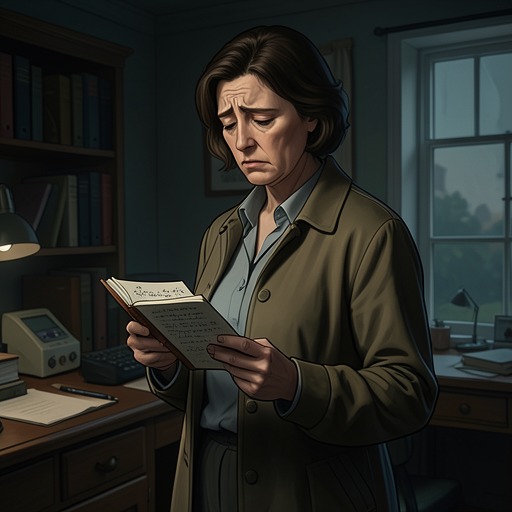
Grief as Enduring Love
Tiny Beautiful Things: Advice on Love and Life from Dear SugarGrief as Enduring Love describes bereavement not as a wound that must become harmless or disappear, but as the continuing presence of love after death. Sugar insists that a death can remain permanently wrong and the survivor nevertheless go on living. Her examples move between the unanswerable absence of her mother, the physical nearness of treasured objects, and the task of addressing a father whose son has died. The connection between grief and love does not make loss acceptable; it offers a way to carry it without mistaking survival for forgetting.
Loss That Never Becomes All Right
Sugar’s mother died alone in a hospital room, and Sugar was not beside her. For years she replayed the sequence of choices that had kept her from her mother’s last hours, but thinking through it could not change what happened. Their final exchange remained painfully specific: her mother could no longer bear the pain of being touched, so she asked Sugar not to kiss her; Sugar said she would return in the morning and told her she loved her. Her mother was silent until Sugar was almost out the door, then managed one word: love. When Sugar returned, her mother was dead. The memory contains both the absence Sugar cannot undo and the love that still reached her in that last word.
Years later, a woman who had also lost her mother young told Sugar that it would never be okay that their mothers were dead. The words undid her. Both women were then in their forties or fifties, writers with children, good relationships, and fulfilling careers; they could be happy and fortunate, yet their mothers were missing from graduations, weddings, first-book publications, and the births of their children. Sugar does not treat that contradiction as proof that grief has failed to heal. A life can hold joy while loss remains present in its deepest register. The dead mother is absent from each milestone, and the survivor’s happiness does not cancel that absence.
Objects as Continuing Bonds
Several months after her mother died, Sugar found a glass jar of stones at the far end of her mother’s bedroom closet while clearing the house she had thought of as home. Holding the jar briefly felt like holding her mother. The stones had been gathered by Sugar and her siblings as children—from beaches, trails, and grassy patches beside parking lots—and pressed into their mother’s hands. Their palms had made her a keeper of the things they considered worth saving. Sitting on the bedroom floor, Sugar poured out the mostly small, smooth, black stones and ran her fingers over them. Her mother had called them worry stones and said rubbing them could soothe the mind.
The jar did not restore the person it seemed to hold. Sugar looked for her mother in many ordinary possessions: peppermint Tic Tacs from the glove compartment of the car on the day she died, moccasins that still carried the shape and smell of her size-six feet a year later, large reading glasses, a gray porcelain horse, and a bank pen with a real hundred-dollar bill shredded inside. She also named a butter dish, the shirts her mother had sewn, and the stones. None contained her mother, and Sugar came to understand that the search could not retrieve her. Yet the objects still mattered: they gave memory a tactile form without pretending that an object could reverse death.
More than twenty years after the loss, the stones Sugar once gave her mother have been replaced by stones her children give to her. She keeps the best ones in her pockets; sometimes she carries a particularly perfect one for weeks, her hand repeatedly finding its black curve. The gesture echoes her mother’s practice of keeping and rubbing stones, but its direction has changed: Sugar is now the mother receiving what children find worth saving. The connection is neither a recovery of the past nor a clean break from it. Love persists through an ordinary, bodily practice that has passed into another generation.
Love in the Obliterated Place
Writing to Living Dead Dad, whose twenty-two-year-old son was killed by a driver who ran a red light, Sugar addresses grief without claiming that consolation can undo the death. Repeated expressions of sympathy may form, in her image, a quilt or a river, but they cannot bring the son back or prevent the collision. She asks the bereaved father to remember that beneath rage, thoughts of suicide, imagined futures, regrets, and the circumstances of the crash is his pure fatherly love. No one can take that love away; it will live in him for the rest of his life. Sugar relates this claim to her own experience: she carries her mother within her, and her grief is immense, but her love is bigger. The pain is not evidence that the death was deserved or meaningful; it is evidence that the son was truly loved.
This counsel does not promise that identifying love will end suffering. Sugar says that small things allowed into consciousness will not prevent pain, but can help someone survive the next day. She describes the bereaved person’s new world as an obliterated place where what came before is at once erased and still everywhere. There is no return to the former life, and the work of deep grief is making a home in this altered one. Love and grief may be unending, while their shape shifts; understanding can arrive over years, not all at once. Her language holds destruction and creation together rather than turning loss into a simple passage toward recovery.
Acceptance, Memory, and What Continues
For Sugar, part of living with death is relinquishing futures that existed only in expectation. She recalls her son saying at six that people die at all ages. She uses that recognition to accept that her mother’s life lasted forty-five years, rather than remain measured against the imagined ages at which she might have been alive. For Living Dead Dad, she gives the same discipline a stark form: his son’s life was twenty-two years long; there is no twenty-three. The number does not diminish the life or soothe the unfairness of its ending. It marks the difference between the person who lived and the future others expected him to inhabit.
The red velvet dress her mother bought for a granddaughter she would never know becomes another material trace of love carried forward. Sugar saved it in a cedar chest that belonged to her mother, keeping it hidden for years as she moved through her twenties and thirties and had a son and then a daughter. Its significance arose through the conjunction of her mother’s death and her daughter’s birth: it testified to the loss of the grandmother who would not meet the child, and to a love that had extended into Sugar’s life beyond the mother’s death. Seeing her daughter wear the dress on the second Christmas of her life gave that inheritance a visible, present form. The dress did not make the absence beautiful or erase its pain; it allowed the two truths to remain together.
Sugar also understands honoring the dead as a way of becoming more fully the person their love helped raise. She tells Living Dead Dad that her mother’s influence lives within her, and that becoming the woman her mother raised has been one of the deepest comforts available to her. She would give back what grief has taught her if she could, but she does not deny that it has changed what she can see and compelled her to reach toward others. In this account, enduring love is not a command to find a lesson in every death. It is the bond that remains when the person is gone, and the possibility of carrying that bond into care, memory, and a life that continues without calling the loss all right.