Brown woolen blanket
To Kill a MockingbirdThe brown woolen blanket is a deceptively simple object that carries immense narrative weight in Harper Lee's To Kill a Mockingbird. It appears during the chaotic night of Miss Maudie Atkinson's house fire, when the entire neighborhood gathers to fight the blaze. For Scout and Jem Finch, standing in the cold across the street, the blanket is the first concrete, undeniable proof that Boo Radley—the reclusive neighbor they have spent years mythologizing and fearing—is not a monster but a protector. The blanket transforms their understanding of Boo from a ghostly figure of local legend into a real, caring human being who watches over them from the shadows. Its discovery forces Scout and Jem to reconcile their childhood fantasies with a more complex, compassionate reality, and it becomes a silent testament to the quiet, unsolicited kindness that defines Boo's character throughout the novel.
Appearance and Discovery
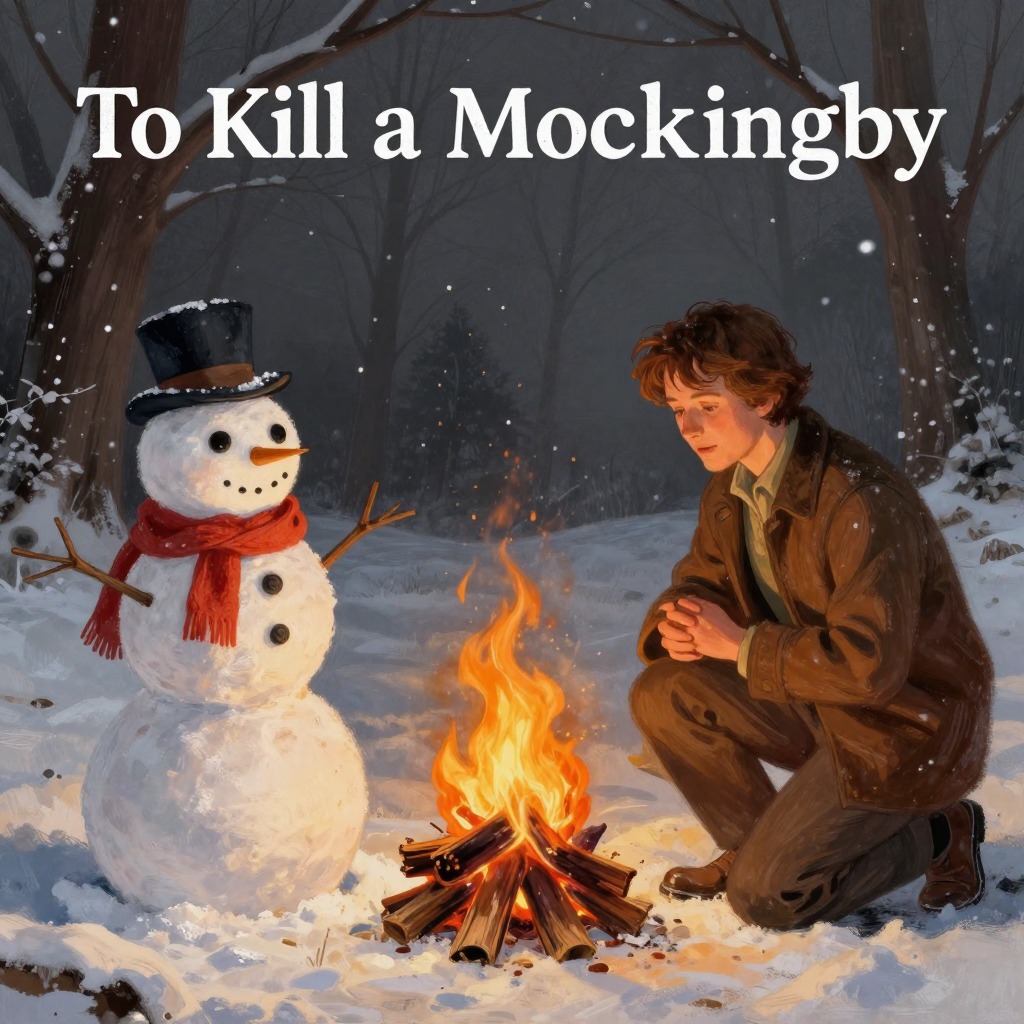
The blanket enters the story not as a planned gift but as a spontaneous act of care. During the fire at Miss Maudie's house, Atticus Finch instructs Scout and Jem to stand in front of the Radley Place and stay out of the way. The children obey, watching the fire consume their neighbor's home. In the chaos and cold, Scout is so absorbed in the spectacle that she does not notice when someone drapes a brown woolen blanket around her shoulders. She wears it "squaw-fashion" without any awareness of its origin. It is only later, when the family is safely inside their own home drinking hot chocolate, that Atticus notices the blanket and asks whose it is. Scout, bewildered, has no answer. Jem is equally confused, insisting that they did not move from their spot and that no one approached them. The blanket's sudden, unexplained presence creates a mystery that the children cannot solve on their own.
Revelation of Boo Radley's Presence
Atticus Finch, with his characteristic calm perception, solves the mystery. He reveals that Boo Radley must have placed the blanket around Scout while she was absorbed in watching the fire. "You were so busy looking at the fire you didn't know it when he put the blanket around you," Atticus explains. The revelation is staggering for Scout and Jem. The idea that Boo Radley—the man they have imagined as a malevolent phantom, the subject of their games and fears—sneaked out of his house, approached them in the dark, and performed an act of simple, protective kindness shatters their preconceptions. Jem, in a rush of emotion, pours out all the secrets he has been keeping: the gifts in the knot-hole, the mended pants, the cement that Nathan Radley used to seal the tree. He insists that Boo has never harmed them, that he could have hurt Jem but instead tried to mend his pants. The blanket becomes the catalyst for Jem's confession and for a new understanding of Boo as a benevolent, if invisible, presence in their lives.
Symbolic Meaning and Narrative Function
The brown woolen blanket functions as a powerful symbol of unseen care and the gap between public reputation and private reality. It is a gift given without expectation of thanks or recognition, a pure act of kindness from a man the town has labeled a freak and a danger. The blanket also serves as a narrative device that forces Scout and Jem to grow up. Until this moment, Boo Radley has been a character in their own stories, a figure of fun and fear. The blanket makes him real. It is a tangible object that cannot be explained away by imagination or rumor. Scout's physical reaction to the revelation—her stomach turning to water, nearly vomiting—underscores the emotional impact of this new knowledge. The blanket also connects to the novel's broader theme of empathy and understanding. Just as Atticus urges Scout to "climb into someone's skin and walk around in it," the blanket is a literal covering that suggests Boo's desire to protect and comfort, even from a distance. It is a silent communication that transcends the barriers of fear and prejudice that isolate Boo from the community.
Connection to Other Gifts and the Knot-Hole
The blanket is part of a series of anonymous gifts that Boo Radley leaves for the Finch children, a pattern that begins with the treasures found in the knot-hole of the oak tree on the Radley Place. Earlier, the children discover soap dolls carved in the likeness of Scout and Jem, a tarnished spelling medal, a pocket watch that will not run on a chain with an aluminum knife, and a package of chewing gum. These gifts are left in the knot-hole, a secret communication that Jem and Scout initially attribute to various neighbors but gradually come to suspect might come from Boo. The knot-hole is eventually cemented by Nathan Radley, an act that Jem correctly interprets as an attempt to stop their communication. The blanket, however, is different. It is not left in a hiding place but is placed directly on Scout's person, a more intimate and immediate gesture. It also occurs after the knot-hole has been sealed, suggesting that Boo finds other ways to reach out. The blanket, like the earlier gifts, is a form of silent, generous communication that challenges the children's assumptions and builds a bridge between Boo's isolated world and their own.
Thematic Significance: Courage, Kindness, and Invisible Acts
The blanket embodies the novel's redefinition of courage and heroism. Atticus Finch teaches his children that real courage is not a man with a gun but the willingness to do what is right even when defeat is certain. Boo Radley's act of placing a blanket on a child in the cold is a small, invisible act of courage. He risks exposure, ridicule, and possibly worse by leaving his house and approaching the children in the midst of a public emergency. His kindness is performed without any audience, without any hope of recognition or reward. The blanket, therefore, becomes a symbol of the quiet, unheroic heroism that the novel champions. It is a reminder that the most meaningful acts of care are often the ones that go unseen, and that true goodness is not performed for applause but flows from a genuine concern for others. For Scout, the blanket is a lesson in empathy, forcing her to see Boo not as a source of fear but as a fellow human being capable of love and protection. It is a step toward the understanding that, as Atticus says, "you never really understand a person until you consider things from his point of view."