Pocket watch
To Kill a MockingbirdThe pocket watch that would not run, discovered in the knot-hole of the Radley Place oak tree four days after the spelling medal, was the biggest prize the Finch children had yet received from their secret benefactor. It came on a chain with an aluminum knife, and Scout immediately wondered if it might be white gold. Atticus estimated the watch, knife, and chain together would probably be worth ten dollars if they were new, a considerable sum that underscored the value of the gift. The watch's non-functional state, however, made it more than a simple treasure: it became a project, a puzzle, and a symbol of the giver's hidden presence.
Discovery and Initial Response
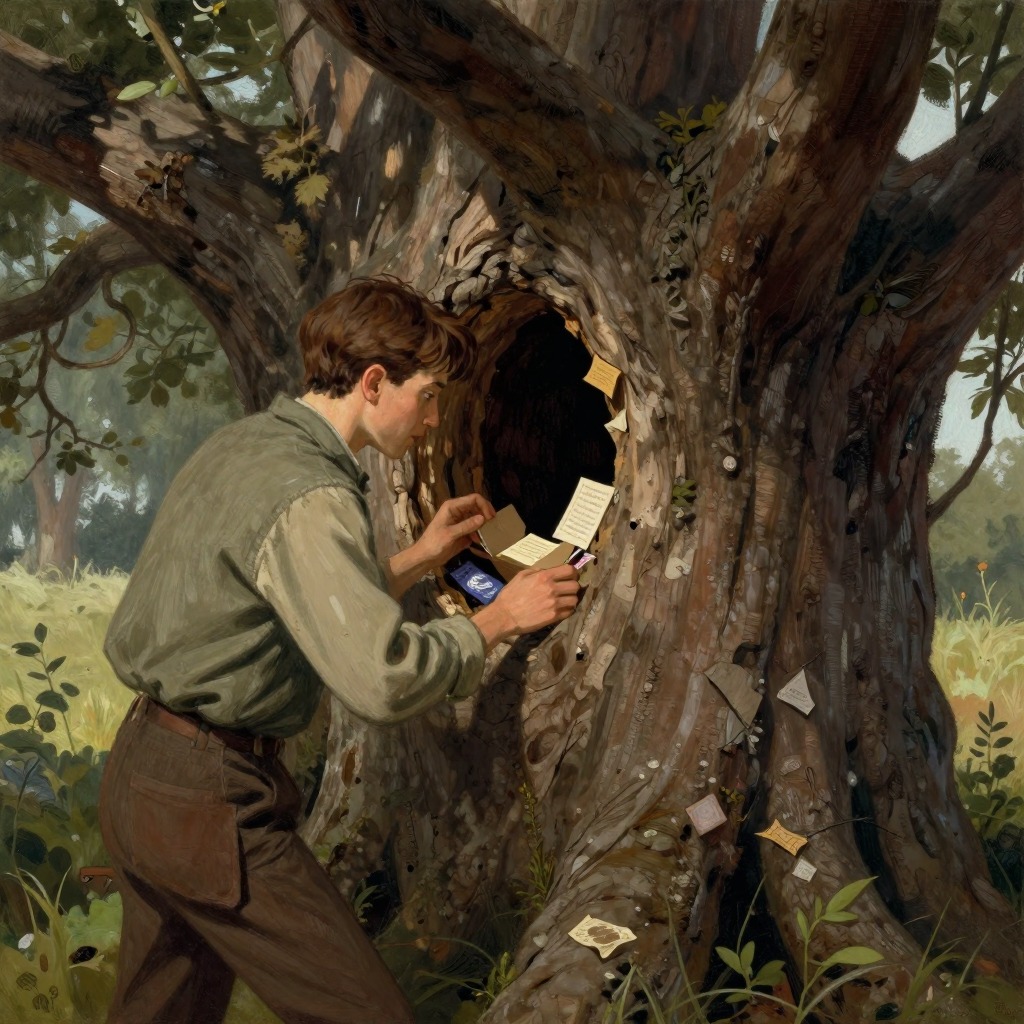
The watch appeared in the knot-hole four days after the spelling medal, following a pattern of gifts that had already included two soap dolls carved in the children's likenesses, a package of chewing gum, and the tarnished spelling medal. Jem, who had been carrying his grandfather's watch as a special privilege once a week, immediately asked Atticus if he could keep the found watch instead, hoping he might be able to fix it. When the novelty of carrying his grandfather's watch wore off and it became a burdensome daily task, Jem no longer felt the need to check the time every five minutes, suggesting that the found watch represented something more meaningful than mere timekeeping: it was a connection to the mysterious figure who had been leaving gifts.
Jem's Attempt at Repair
Jem threw himself into repairing the watch with the earnestness of a boy who believed he could restore what was broken. He did a fair job, managing to reassemble the mechanism, though one spring and two tiny pieces were left over. Despite his efforts, the watch would not run. His frustrated sigh—"Oh-h, it'll never go"—captured the disappointment of a project that had failed despite his best intentions. The failure of the repair attempt prompted Jem to consider writing a letter to whoever was leaving the gifts, a plan that led to the composition of a note signed "Jeremy Atticus Finch" and then revised to "Jem Finch," with Scout adding "Jean Louise Finch (Scout)" beneath it. This letter, intended to express gratitude and establish contact, was never delivered because the knot-hole was filled with cement the next morning, an act that Jem later learned was carried out by Mr. Nathan Radley, who claimed the tree was dying.
Significance in the Pattern of Gifts
The pocket watch belonged to a sequence of objects that together constituted Boo Radley's only means of communication with the outside world. The gifts began with the soap dolls, which Jem immediately recognized as miniature representations of himself and Scout, and continued with the chewing gum, the spelling medal, and finally the watch and knife. Each gift was a deliberate, carefully chosen offering from a man who had been confined to the Radley Place for decades. The watch, unlike the dolls or the medal, was broken, and its brokenness may have been precisely what made it meaningful: it was an object that needed care, that invited Jem to engage with it, to try to fix it, to make it work again. In this sense, the watch was not merely a gift but an invitation to relationship, a broken thing that required the recipient's attention and effort.
Connection to the Broader Narrative
The pocket watch appears in the same narrative arc that includes the soap dolls, the spelling medal, and the chewing gum, all of which are discovered in the knot-hole during the autumn following the children's initial attempts to make Boo Radley come out. The gifts are the first evidence that the Radley Place's mysterious occupant is not a monster but a person capable of kindness and attention. When Jem later confesses to Atticus about the knot-hole and the gifts, he includes the watch in his outpouring of secrets, revealing that he has understood all along that the gifts came from Boo Radley. The watch, like the other objects, becomes part of the evidence that Atticus tells the children to keep to themselves, a secret that Scout might someday thank Boo Radley for, as Atticus says after the fire when he reveals that Boo had placed a blanket around Scout's shoulders. The watch thus participates in the novel's larger pattern of hidden kindness, of gifts that cannot be acknowledged publicly but that transform the giver and receiver nonetheless.
The Watch as Object and Symbol
As a material object, the pocket watch is defined by its failure: it will not run, it cannot be fixed, it is broken in a way that Jem's best efforts cannot mend. Yet this very failure makes it a more powerful symbol than a working watch would have been. It represents the impossibility of direct communication between Boo Radley and the children, the way their connection must remain indirect, mediated by objects left in a tree. The watch's brokenness also mirrors the brokenness of Boo Radley himself, a man damaged by years of confinement and family tragedy, who can only reach out through gifts that are themselves imperfect. When Jem finally gives up on repairing the watch, he does not throw it away; he keeps it, along with the other gifts, in his trunk, preserving the evidence of a relationship that could never be completed but that was nonetheless real.