Zeebo
To Kill a MockingbirdZeebo is Calpurnia's eldest son and the garbage collector of Maycomb, a figure who moves between the town's white and Black worlds with a quiet dignity that marks him as a respected member of the First Purchase African M.E. Church. He is the one who, on Sheriff Heck Tate's instructions, collects the carcass of the rabid dog Tim Johnson after Atticus Finch shoots it, gingerly lifting the body with a pitchfork and pouring a disinfectant over the spot where the animal fell. This task, performed with the same matter-of-fact competence he brings to his regular rounds, places him at the edge of the novel's most dramatic public event, a silent witness to the revelation of Atticus's hidden marksmanship.
Role in the Church and the Practice of Linin'
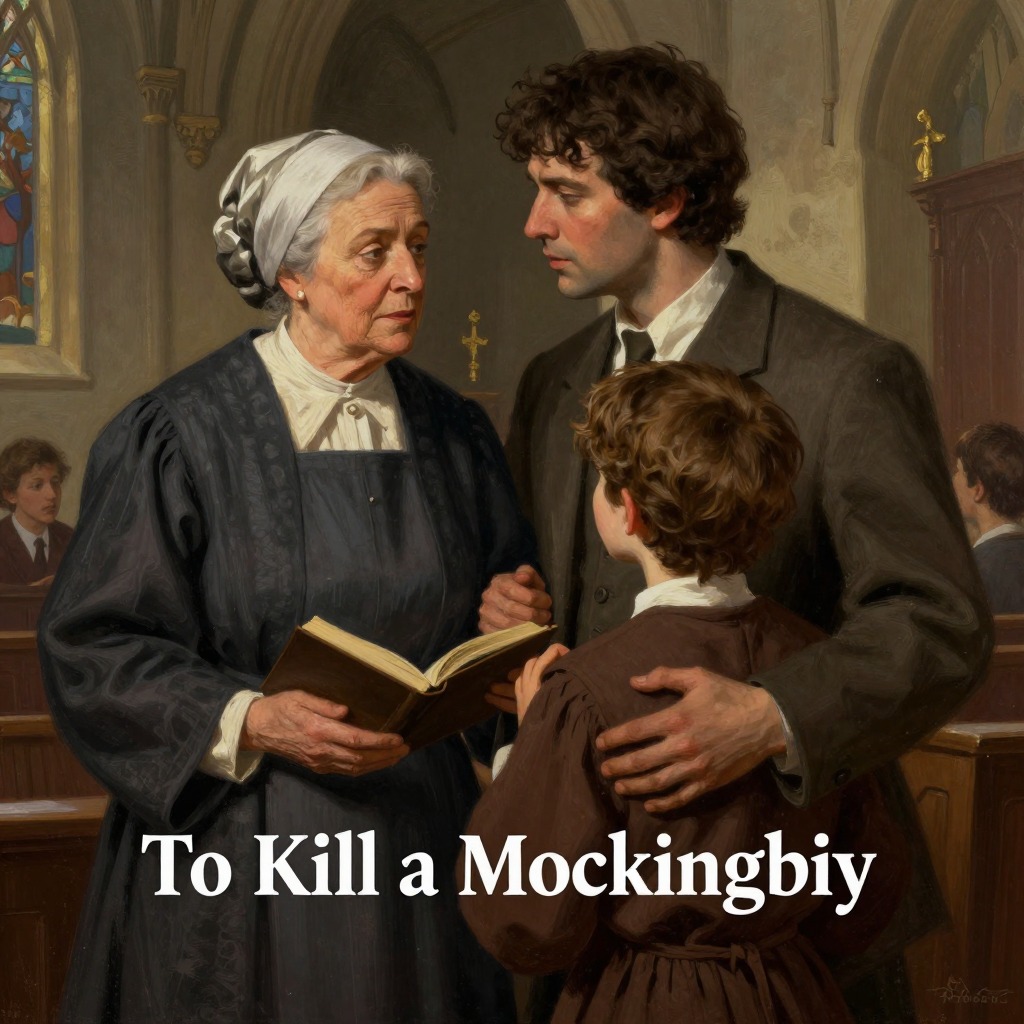
Zeebo's most significant appearance comes when Jem and Scout attend church with Calpurnia. He is the music superintendent, and when Reverend Sykes calls for the first hymn, Zeebo rises from his pew, walks down the center aisle, and opens a battered hymn-book. He reads a line—"There's a land beyond the river"—and miraculously on pitch, a hundred voices sing his words back. This is "linin'," the call-and-response method of hymn-singing used because only about four people in the congregation can read. Zeebo closes the book at the chorus, a signal for the congregation to proceed without his help, and line for line, voices follow in simple harmony until the hymn ends in a melancholy murmur. Jem and Scout, accustomed to printed hymn-books at their own church, are astonished by this practice, and Jem later asks Calpurnia why they sing that way. Zeebo's role as the linin' leader makes him the living bridge between the written word and the oral tradition that sustains the community's worship.
Relationship with Calpurnia and the Finch Family
Zeebo is Calpurnia's son, a fact that Scout realizes with a jolt when she learns that Calpurnia taught him to read. There was no school for Black children when Zeebo was a boy, so Calpurnia made him learn from a page of the Bible every day, using the only books she had—Blackstone's Commentaries, given to her by Scout's grandfather. Zeebo now has half-grown children of his own, making Calpurnia a grandmother, a dimension of her life that Scout had never considered. When Lula confronts Calpurnia for bringing white children to the church, Zeebo steps forward from the crowd to welcome Jem and Scout, telling them not to pay attention to Lula, who is "contentious" because Reverend Sykes threatened to church her. "We're mighty glad to have you all," he says, his voice like the rumble of distant artillery, and his authority in the community is such that the confrontation dissolves. Zeebo's presence at the church door, alongside Reverend Sykes, affirms that the Finch children are welcome, and his words carry the weight of a man who speaks for the congregation's better instincts.
Significance and Narrative Role
Zeebo is a minor character whose appearances carry disproportionate weight. He is the visible proof that Calpurnia has a rich, independent life outside the Finch household—a life that includes a son, grandchildren, and a position of leadership in her church. His competence as the garbage collector, his authority as the music superintendent, and his quiet dignity in the face of Lula's challenge all mark him as a figure of stability and moral clarity within the Black community of Maycomb. Through Zeebo, the novel shows that the world of the Quarters is not a monolith but a community with its own hierarchies, conflicts, and forms of grace. His linin' of the hymns, in particular, becomes a powerful image of how faith and culture are preserved and transmitted in the absence of formal education, a practice that Jem and Scout witness with wonder and that Calpurnia explains with patient pride.