
Battle’s Investigation and Judgment
Towards ZeroBattle balances evidence, intuition, and procedural duty as he works to clear the innocent and expose the real murderer.
increasing Bearing strength in each event
 decreasing
Bearing strength in each eventdecreasingThe Calm Investigator
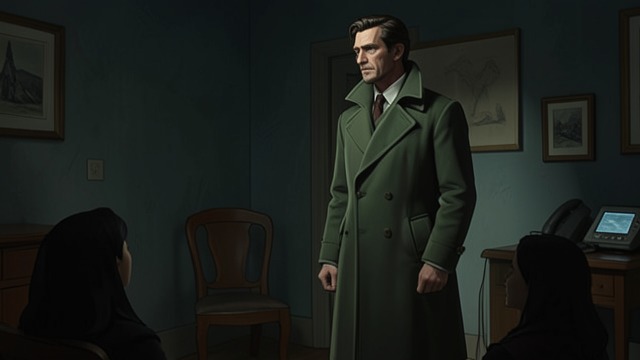
Battle Takes the Case
A measured presence
Superintendent Battle joins Inspector Leach after Lady Tressilian’s death. His wooden expression and deliberate manner make him seem less brilliant than the people around him expect.
He treats everyone as a possible suspect and attends closely to small inconsistencies. His calm is a method of keeping the case open, not proof that he has settled it.
A case with consequences
Battle recognizes that the inquiry may implicate someone respected and popular. He agrees to proceed because a mistaken accusation would be especially damaging.
The Case Against Nevile

Evidence and Doubt
A plausible suspect
Nevile has argued with Lady Tressilian, stands to inherit money, and appears connected to the bloody club and stained suit. The evidence is strong enough that refusing to seek a warrant would require explanation.
Battle nevertheless sees that the case combines an apparent quarrel with elaborate preparation. He doubts that the weapon, fingerprints, and scene all belong to one straightforward account.
A controlled strategy
Rather than immediately arrest Nevile, Battle lets the suspicion remain visible while he checks statements and watches the household. His apparent slowness creates room to discover what the evidence conceals.
A Prior Lesson in Guilt

Recognizing False Confession
A daughter’s ordeal
At Meadway, Battle recognizes that his daughter Sylvia has confessed to thefts she did not commit. She has yielded to pressure and misread suspicion as certainty.
Battle relies on his knowledge of her character and insists that the school involve police evidence. The true thief is identified through material proof rather than psychological guesswork.
An insight carried forward
The episode teaches Battle that a guilty-sounding confession can be a response to fear rather than guilt. When Audrey accepts arrest, that memory keeps him from treating her behaviour as conclusive.
The False Case Against Audrey

Duty Against Intuition
An apparent solution
Battle finds a linked set of physical clues against Audrey and obtains a warrant. Her words appear to confirm the charge, while Nevile’s passionate defence risks seeming like misplaced chivalry.
Thomas’s revelation that Audrey left Nevile removes the revenge motive Battle had assumed. Battle still cannot disregard facts simply because his motive theory has failed.
A need for a new fact
The superintendent recognizes that evidence pointing to Audrey may be manufactured. MacWhirter’s arrival offers a possible route out of an otherwise dangerous conflict between duty and suspicion.
The Confession Experiment

Testing the Last Suspect
A physical test
Battle recreates the possibility of a swimmer crossing the river and deliberately throws Latimer into the water. The test establishes that Latimer cannot be the climber described by the physical evidence.
He then directs the same logic toward Nevile, who has the strength and skill to swim, climb, and return. The investigative confrontation is designed to break the confidence behind the false trails.
Law and necessity
Nevile confesses, giving Battle the admission the evidence alone might not have secured. Battle has used deception and theatrical pressure, but he has aimed them at uncovering a planned murder and preventing Audrey’s wrongful execution.
September 13, at the first examination
September 13, before the bank inquiry
Earlier that year, before Battle’s holiday
September 13, after the will is clarified
Near the ending, aboard the launch
