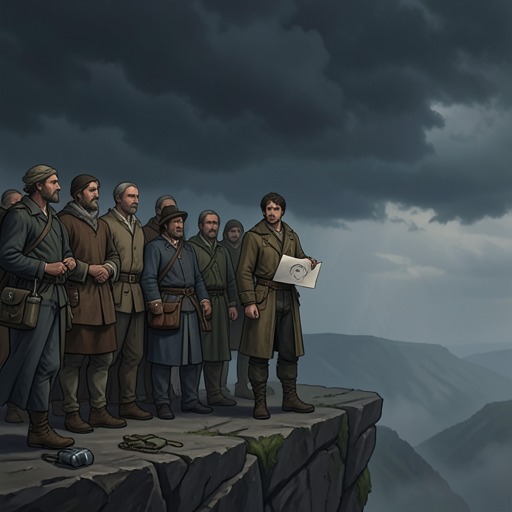
Angus MacWhirter
Towards ZeroAngus MacWhirter’s failed suicide attempt and unexpected return to purposeful life make him a figure through whom the novel examines despair, personal autonomy, and the unforeseen consequences of honesty. At first he regards survival as an indignity imposed by chance; later, work gives him a reason to proceed, though not a sudden return to optimism. His choice to consider going back to Saltcreek keeps the earlier crisis close even as his circumstances change.
Identity and Background
On January 11, MacWhirter lies in a hospital bed with a broken shoulder after an attempt to take his own life. The immediate interruption came from a tree on the cliff and a couple who had ventured out on a winter night. In the hospital, the nurse adjusts his pillows and makes him more comfortable; he responds only with a grunt. His physical recovery is accompanied by a pronounced sense of bitterness, not gratitude for having survived.
MacWhirter remembers having once been happy, with a good job and a wife he considered attractive. He describes himself as having few social ties and says he is not a friendly person. His account presents isolation not as a single sudden condition but as the outcome of several losses: employment, marriage, health, and the confidence that his efforts can improve his position. By the time of the hospital scene, he sees little in his life that might counterbalance those losses.
The Crisis and Its Causes
MacWhirter traces his downward course to his refusal to lie after a car accident. His employer, who had been driving, wanted him to give the insurance company a lower speed than the one MacWhirter believed to be true. MacWhirter refused. He understands this decision as a matter of principle, but also recognizes its cost: his employer took offence and ensured that he could not readily find another job.
His wife eventually left him for a man who had been his friend and was prospering. MacWhirter, by contrast, drifted between jobs and began drinking, which made it harder to keep work. He later took a physically demanding job hauling loads; the strain affected his health, and a doctor told him he would never regain his former strength. The accumulation matters to his reasoning: unemployment alone, or the end of his marriage alone, is not presented as the whole explanation. He sees his prospects narrowing across work, intimacy, and health until he concludes that there is no useful future for him.
In the hospital he is also preoccupied with the prospect of being taken before a police court for attempting suicide. He regards the possibility of official admonishment as an intrusion into a decision about his own life. He imagines that success would instead have led others to treat him as mentally unsound, a judgement he rejects. These are MacWhirter’s views of his situation, not an account of a court ruling: the scene establishes his anger at the prospect of legal and social judgement while showing how firmly he believes his decision had been rational.
Honesty, Work, and a Reversal
MacWhirter’s refusal to falsify the account of the accident is not merely a past incident; it becomes the quality that makes a new opportunity possible. Seven months after his attempt, an employer who has heard about his earlier conduct interviews him. The employer says that he wants people he can trust and offers him important work. MacWhirter accepts. The job is extremely well paid and promises a future, a sharp reversal from the period in which his former employer’s actions appeared to have shut off his prospects.
The reversal carries an irony MacWhirter can appreciate without turning it into triumph. His former employer’s denunciations of him for refusing to lie have helped bring his honesty to the attention of someone willing to employ him. MacWhirter recognizes the poetic justice, but the new position does not make him exuberant. He supposes he is fortunate, yet says in effect that fortune matters little to him. The job changes what he can do next, not at once how he feels about what has happened.
Survival and the Return to Saltcreek
When the new opportunity arrives, MacWhirter has no present intention of trying again to end his life. He approaches living methodically, one day after another, without enthusiasm or pleasure. He has also revised his understanding of despair: in retrospect, he believes suicide requires an intense additional shock of grief, desperation, or passion, rather than arising simply from the dull repetition of ordinary days. That distinction marks a change in his immediate state, but it does not turn survival into a cheerful recovery narrative.
His work will take him to South America, where he is due to sail at the end of September. Before leaving England, however, he has a week of leisure and wonders whether to remain in London or go elsewhere. The idea of Saltcreek comes to him, and he considers going there with grim amusement. The thought reconnects his impending journey with the place and circumstances of his earlier crisis, but the evidence establishes it as a plan under consideration, not a completed visit. His renewed employment points outward toward a future abroad; Saltcreek draws his attention back toward the past.
Character and Narrative Significance
MacWhirter’s story is shaped by the tension between principle and consequence. His honesty costs him his original job and contributes to the hardships that follow, yet it also becomes the basis of a later opportunity. The reversal does not suggest that his earlier suffering was deserved or easily repaired. Instead, it makes visible how the same quality can leave him exposed in one circumstance and trusted in another.
His trajectory also resists a simple equation between rescue and recovery. Chance prevents his death, but he is angry about surviving; a new job gives him direction, but he does not claim to be happy. The methodical willingness to continue is a limited change, important precisely because it is not presented as a cure for his losses. By considering Saltcreek before departing for South America, MacWhirter remains poised between the life that nearly ended and a future he is prepared, for now, to enter.