Angus MacWhirter’s suicidal despair
Towards ZeroAngus MacWhirter’s suicidal despair is presented as the culmination of material losses and a fierce conviction that he alone should decide whether his life is worth continuing. After surviving an attempt, he resents not only his ruined prospects but also the possibility that the law will judge him for trying to end his own life. His later return to work marks a change in conduct rather than a simple conversion to optimism: he becomes willing to continue, methodically, without claiming that his suffering has been erased.
Identity and Crisis
In the hospital, Angus is bitter and rebellious. He regards survival as an unwanted interruption: he had expected his life to end, and instead finds himself injured, dependent on care, and facing the prospect of being brought before a police court for attempted suicide. The contrast between what he considers a private decision and the public response sharpens his anger. He imagines that, had he died, others would have called him mentally unsound; he insists to himself that he had been thinking clearly and that his choice had seemed rational given his circumstances.
This is not presented as a passing mood detached from practical hardship. Angus sees himself as without health, employment, affection, money, or hope. His despair rests on the accumulation of losses, and his reasoning treats continued life as a problem to be assessed against what remains available to him. The hospital bed makes that reasoning newly contentious: he has survived, but survival has not yet supplied a reason he accepts for going on.
The Losses Behind His Despair
Angus explains the decline that preceded his crisis to a nurse. He had once been happy, with a good job and a wife he considered attractive. During a car accident, his employer, who had been driving, wanted Angus to say that the car had been travelling below thirty miles an hour. Angus says it had been nearer fifty. No one was killed, but he refused to give the false account his employer wanted, because he would not lie.
That refusal cost him his position. His employer resented it and, Angus says, made it difficult for him to find another job. His wife became tired of seeing him unemployed and left him for a man who had been Angus’s friend and was advancing in the world. Angus describes himself moving in the opposite direction. He drank somewhat, which made it harder to keep jobs, and eventually took strenuous hauling work that left his health permanently impaired. A doctor told him that he would never again be strong. In his account, the end of his marriage, his loss of work, and his physical decline reinforce one another until he can see little purpose in continuing.
Hospital, Law, and the Nurse’s Response
Angus’s anger after the attempt is directed partly at the institutions and assumptions surrounding it. He resents the prospect of being admonished by a magistrate for what he regards as an action concerning a life that belongs to him. His imagined contrast between public condemnation if he survives and posthumous classification as unsound if he dies conveys his sense that neither outcome would allow his judgment to be taken seriously. The passage records his view of the likely legal and social response; it does not establish what a court ultimately does.
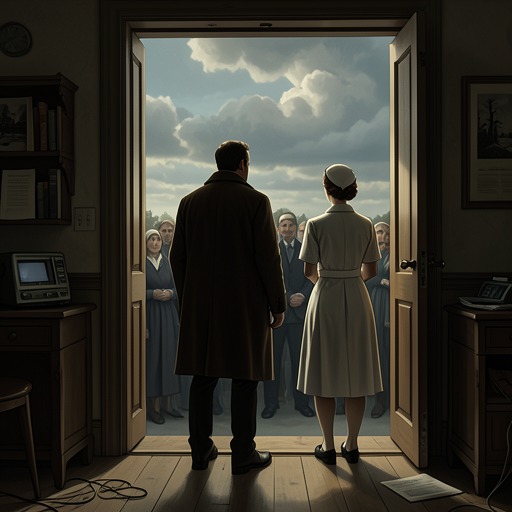
The nurse offers a small but consequential counterpoint. When Angus recounts refusing to lie, she tells him she thinks he was right. He answers by explaining that his integrity cost him his job and, in his telling, contributed to the losses that followed. When he concludes that his life had been of no use to himself or anyone else, she replies that he cannot know that. Her response does not remove his illness, unemployment, or grief, and the evidence does not show her solving those problems. It does, however, interrupt his certainty: her quiet disagreement amuses him, and he is already in a better temper. The change is modest, but it shows another person meeting his account with attention rather than condemnation.
Return to Living
Seven months after the attempt, Angus has obtained an interesting, extremely well-paid job that promises a future. The route to it carries an irony he recognizes: his former employer’s attacks on his character helped bring about his advancement. He considers himself fortunate, yet feels no exultation and is not particularly grateful that chance interrupted his attempt. The new position changes his circumstances without making him suddenly cheerful.
Instead, Angus accepts the task of living in a methodical, day-by-day spirit, without enthusiasm or pleasure. He says that the earlier phase has passed and that he has no present inclination to try again. He distinguishes this state from the despair that had overtaken him: in his later reflection, an abstract sense that life is dull would not by itself move him to take his life; he believes a further shock of grief or desperation would be needed. This is his assessment of his own condition, not a guarantee about what the future will bring.
His work is to take him out of England, with a voyage to South America planned for the end of September. Before leaving, he must assemble equipment and learn the complicated workings of the business, but he also has a week of leisure and has not decided how to spend it. Those concrete plans give his renewed life a direction, even as his attitude remains unsentimental. His arc therefore resists a neat cure: the attempt is followed first by resentment, then by a limited willingness to proceed, supported by a changed employment situation and an encounter in which someone refuses to accept his bleak conclusion as final.