Barrett
Towards ZeroBarrett is Lady Tressilian’s elderly maid, valued for years of devoted service and remembered as someone who helped bring up the person addressing her. Her long familiarity with the household makes her more than a servant in the background: when she becomes unable to respond, the loss of her ordinary presence affects Lady Tressilian’s access to help.
Identity and Household Role
Barrett is identified as Lady Tressilian’s maid and as elderly. A description of her emphasizes both the length and closeness of her service: she had been with Lady Tressilian for years and was regarded as a source of comfort as well as a fiercely devoted attendant. The same description associates her with bringing up the person being addressed, suggesting that her place in the household reaches back into that person’s upbringing. The evidence does not specify further details of that history, but it establishes a bond rooted in long familiarity rather than a merely recent employment.
That attachment is presented through another person’s affectionate, teasing appraisal of Barrett. The description combines a formidable public manner with strong loyalty, making her seem both an established authority in the household and a dependable source of care. The contrast helps explain why her condition matters to those around her: Barrett is not an interchangeable member of staff but a familiar presence on whom Lady Tressilian’s daily routine depends.
Her Place in Lady Tressilian’s Routine
Barrett’s duties connect her closely to Lady Tressilian’s ordinary needs. At one point she comes in and finds her mistress reclining with her eyes closed. Later, the household’s account of Barrett’s own condition is framed around the expected tea service: Lady Tressilian’s tea is ready, but Barrett has not come downstairs to take it in. The small routine makes the disruption legible. Her absence is noticed not in the abstract but because a familiar responsibility has gone unfulfilled.
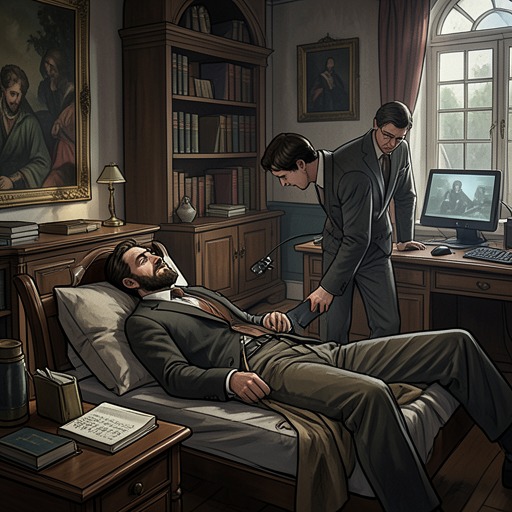
The account of Barrett’s last observed state gives a specific sequence. A household member had taken her a cup of tea more than an hour earlier and found her asleep; Barrett did not wake, though the visitor initially chose not to disturb her much. Five minutes before the later report, the visitor went in again because Barrett had still not come down and Lady Tressilian’s tea was waiting. Barrett remained deeply unresponsive, and the visitor could not rouse her. The repeated visit turns what first appeared to be sleep into an alarming change in her condition.
Coma and Its Immediate Consequence
Barrett is subsequently reported to have been found in a coma that morning. The account establishes the seriousness of her incapacity without explaining here how it began. In this state, she cannot perform her duties or respond to someone trying to reach her; the ordinary household expectation that she will be available no longer holds.
Superintendent Battle identifies a direct consequence for Lady Tressilian. If Lady Tressilian had cause for alarm, he reasons, her first action would have been to pull the bell and summon her maid. But Barrett was unable to hear. The bell-pull therefore points to a practical failure in the household’s usual means of calling for assistance: the person Lady Tressilian would expect to answer is incapacitated. The evidence does not establish what Lady Tressilian did or could have done at that moment, but it makes clear why Barrett’s unresponsiveness matters beyond her own health.
Narrative Significance and Limits
Barrett’s role in the available account is defined chiefly by service, attachment, and sudden absence. Her years in the household establish the relationship; the tea service gives that relationship an everyday form; and her coma changes the practical conditions under which Lady Tressilian can summon help. A familiar routine thus becomes part of the story’s account of vulnerability, without requiring Barrett to be present as an active participant in the later exchange about the bell.
The evidence offers only a narrow view of Barrett herself. It records how others describe her and what happens when she cannot carry out her expected duties, but it does not provide her own account, explain the cause of her coma, or establish her later recovery. Her significance should therefore be kept distinct from claims about her motives or what she knows: what is firmly shown is a longstanding, devoted attendant rendered unable to respond, and the consequential gap that creates in Lady Tressilian’s household.