Battle’s plan to lure Nevile into confessing
Towards ZeroSuperintendent Battle’s plan to lure Nevile Strange into confessing transforms a formal arrest into a calculated public test. After Audrey Strange is arrested for the murder of Camilla Tressilian, Battle moves the assembled company to a motor-launch and presents a fabricated account of a man climbing a rope from Gull’s Point. He then uses the account to narrow the field of suspects until the evidence points back to Nevile. The method succeeds not through a single decisive proof, but through a sequence of exclusions and accusations that finally draw Nevile into disclosing his revenge plot.
From arrest to experiment
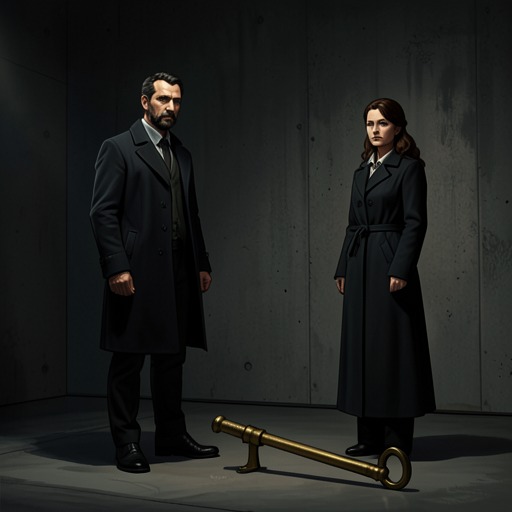
The plan begins in the drawing-room, where Audrey walks forward to meet Superintendent Battle. He formally tells her that she is under arrest for murdering Camilla Tressilian on September 12 and cautions her that her words may be used at trial. Audrey responds with relief, as though the arrest has brought an end to a strain she had been carrying. Nevile immediately tries to stop her from speaking. The moment places him beside the woman he has supposedly allowed the authorities to accuse, but Battle does not pursue that reaction in the room.
Instead, after Audrey leaves with Inspector James Leach, Battle redirects the gathering. He announces an experiment, says Angus MacWhirter is waiting at the ferry, and instructs the party to join him for a trip in a motor-launch. His manner is practical and controlled; the others’ puzzlement does not alter the schedule. The abrupt change of setting is essential to the ploy. Audrey’s arrest has made the danger to her immediate, while Battle’s unexplained summons creates a new situation in which he can put a theory before the group and observe how they respond.
The rope account and the narrowing of suspects
At the launch, Battle asks Angus MacWhirter to repeat the story he had given at the house. MacWhirter recounts that, after being rescued from a cliff the previous January, he wanted to revisit the place. On Monday night, at about eleven, he says he saw a rope hanging from a window of Gull’s Point into the sea and a man climbing it. The account offers the appearance of an outsider’s entry, and Mary Aldin quickly treats it as evidence of an ordinary burglar.
Battle blocks that conclusion. Even if the climber came from across the river, he argues, someone in the house must have made the rope available. He then adds a more pointed condition: a person across the water who was unaccounted for between half past ten and a quarter past eleven might have crossed by swimming and had help on the house side. The account is therefore not simply a report of a possible intruder. In Battle’s presentation, it becomes a framework for identifying who could have made the crossing and who could have arranged the rope.
Ted Latimer is the first person Battle tests against that framework. Battle suggests that Latimer could fit the absence from the other side of the river, and Latimer protests that he cannot swim. Battle has officers nearby in a dinghy establish that point, then sets Latimer aside. The episode shows Battle using elimination as part of the performance: the accusation is sharp enough to make Latimer react, but the practical test gives Battle grounds to remove him from the line of suspicion.
Battle next excludes Thomas Royde on a different basis. Royde’s arm is too impaired for the rope-climbing described in MacWhirter’s account. That leaves Nevile, whom Battle identifies as an athlete, mountain climber, and swimmer. Nevile had taken the 10:30 ferry, but no one can place him at the Easterhead Bay Hotel until 11:15, despite his account that he was looking for Latimer. Battle connects that interval to the proposed swim and points out that Nevile could have left the rope hanging from his own window. Each step makes the accusation more specific: the swimmer, the climber, and the person with access to the rope converge on the same suspect.
Pressure, motive, and confession
Nevile challenges the theory as fantastic and asks why he would have killed Camilla Tressilian or planted clues against himself. Battle answers by separating the murder’s immediate victim from its intended target. In his account, Nevile did not want Camilla dead for her own sake; he wanted Audrey to be hanged for leaving him for another man. Battle links that interpretation to Nevile’s childhood bow-and-arrow case and to a pattern of treating injury to himself as something that demanded punishment. He presents the murder as an elaborate attempt to make Audrey pay, not as an act driven by hostility toward Camilla.
Battle also explains the role of the clues. Their conspicuousness, including the emphasis on the niblick, was not evidence that Nevile had been framed by someone else; Battle calls it a crude attempt to direct suspicion. His accusation is that Nevile meant the signs to look like evidence against himself while believing he could still control the larger case and secure Audrey’s conviction. Battle presses the personal wound behind that design: Nevile had presented himself as the one who ended his marriage, while, according to Battle, he privately nursed resentment and married Kay Strange in part to sustain that public appearance.
Nevile first denies the accusations and insists that Battle is wrong about his sanity. Battle continues, deriding the plan as childish and emphasizing that Audrey may have understood what he intended. The exchange culminates in Nevile’s sudden, unrestrained outburst. He says the idea was clever and that he had considered every detail, then reveals that he had not anticipated Thomas Royde knowing the truth about Audrey and Adrian. He repeats his desire for Audrey to be hanged and makes clear that he wanted her to die afraid. His speech confirms the central elements of Battle’s account: the scheme was directed at Audrey, and the murder was part of the attempt to destroy her.
Outcome and narrative function
The confession is the result of Battle’s staged sequence rather than a quiet presentation of a completed case. MacWhirter’s fabricated testimony supplies the rope and the apparent outsider; Battle turns that possibility into a test, eliminates Latimer and Royde, and directs the remaining suspicion toward Nevile. The launch becomes a place where each new inference constricts the space for denial, while Battle’s calm, methodical manner contrasts with Nevile’s mounting agitation.
The plan also reverses the arrest scene. Audrey initially stands under a formal charge, and Nevile tries to prevent her from speaking; by the end, his own words expose the purpose of the accusation against her. Battle’s intervention does not merely identify the likely killer. It brings into the open the intended frame-up that made Audrey the apparent culprit, while Nevile’s collapse into quiet crying closes the confrontation without undoing the damage his plan was meant to cause.