Gull's Point bell-pull
Towards ZeroGull's Point bell-pull is Lady Tressilian's old-fashioned means of summoning Barrett, whose room is upstairs. A large tassel and wires running along the ceiling make the device a visible, physical link between the two rooms. Its apparent dependability becomes crucial after Lady Tressilian is found dead: the pull rests beside her hand, but Barrett is unconscious and cannot answer. Superintendent Battle's observation that the bell-pull does not fit turns an ordinary household fixture into a central question in the murder investigation.
Design and operation
The pull is large, old-fashioned, and finished with a huge tassel. When Mr. Treves gingerly tugs it, he remarks on it as a survival. Lady Tressilian explains the practical appeal: she has no faith in electric bells, which may be out of order even when repeatedly pressed. Her cord, she insists, never fails. It rings in Barrett's room upstairs, where the bell hangs over the maid's bed, and she can pull again if an answer is delayed.
The arrangement has a simple logic: Lady Tressilian need only pull the tassel, and a bell above Barrett's bed should bring the maid to her. Its wires, visible running along the ceiling, make the connection material rather than mysterious. Yet it is a connection that depends not only on the cord and bell working, but also on Barrett being able to hear and respond.
A routine call and its warning signs
After Mr. Treves leaves Lady Tressilian's room, he hears the bell pulled a second time and hears its tinkle somewhere above him. He looks up at the wires along the ceiling. Barrett comes hurriedly down a flight of stairs and passes him on her way to her mistress. The sequence demonstrates the bell-pull's ordinary operation: the signal sounds, Barrett receives it, and she answers in person. Mr. Treves continues downstairs without using the small lift on the way down, but his face is drawn into a frown of uncertainty. The scene leaves the device functioning as intended while giving its wires and repeated pull an unusual prominence.
The bell-pull after the murder
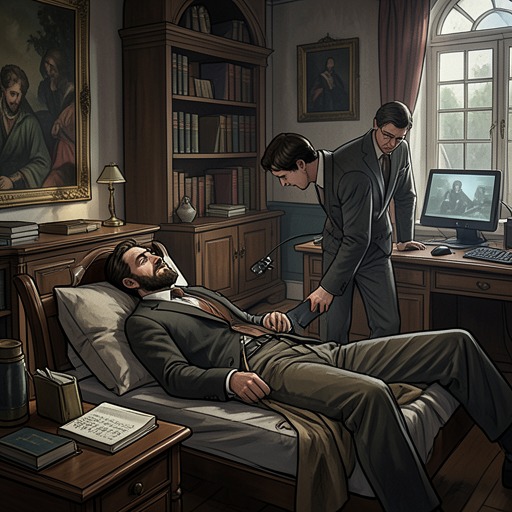
When Lady Tressilian is found dead, the tassel rests on the pillow near her hand. Superintendent Battle looks from the pull to the circumstances of the death and identifies what should have happened if she had felt alarmed: she would have summoned Barrett. But the maid is heavily drugged with a barbiturate and in a serious condition. Dr. Lazenby says that Barrett was not in the habit of taking sleeping draughts and has found that the drug was given in the senna-pod brew she drank every night.
The normal promise of the bell-pull is therefore reversed. Lady Tressilian could have pulled it repeatedly without Barrett hearing. A system celebrated for never failing cannot summon help when the person at its other end has been incapacitated. The evidence establishes that Barrett's inability to answer was taken care of, but does not, by itself, identify who arranged it. The cord's placement beside Lady Tressilian's hand makes the absence of a response newly significant: the means of calling for help was present, yet its human link had been disabled.
An object that does not fit
As Superintendent Battle and Inspector James Leach discuss the crime, Battle calls it brutal, masculine, athletic, and slightly stupid, then remarks that he does not like the bell-pull. Asked what troubles him, he answers that it does not fit. His unease is a clue rather than a solution: the pull is part of the scene, but its presence and role do not sit comfortably with his developing account of the murder. He also raises the question of who inherits Lady Tressilian's money, while Leach agrees that this must be investigated; neither observation settles what is wrong with the bell-pull.
The device carries two conflicting meanings through these scenes. In Lady Tressilian's explanation, it is dependable household equipment, preferred over unreliable electric bells. At the murder, it exposes the difference between a working signal and effective help: a call can ring and still go unanswered. Battle's concise judgment keeps that discrepancy open as an investigative problem, making the tasselled cord not just a remnant beside the victim but a material clue whose apparent simplicity is suspect.