Gull’s Point
Towards ZeroGull’s Point is the cliff-top house where Lady Tressilian lives and is murdered. Its setting links the old fishing village of Saltcreek to the newer resort across the river, while its steep approaches and everyday domestic arrangements give the investigation a sharply defined physical setting. The house is both a residence and a place whose doors, windows, grounds, and objects must be examined for what they can establish about access and opportunity.
Setting and Surroundings
Gull’s Point stands on a plateau of rock above the river Tern, with sheer cliffs falling to the water on two sides. The gardens and tennis court lie to the left of the house; the garage is separated from them, farther along the road on the opposite side. That arrangement places the garage outside the immediate grounds and makes the approach to the house part of the location’s distinctive geography. The building occupies a commanding but exposed position, rather than sitting within a continuous village street.
The house also faces a changing coastline. Across a narrow stretch of water stands the Easterhead Bay Hotel, almost directly opposite and conspicuously modern beside the old surroundings. Easterhead Bay has a broad sandy beach, modern bungalows, and the large hotel on its headland. Saltcreek, by contrast, is an old-fashioned fishing village spreading along a hillside. Its residents are conservative and deeply contemptuous of the resort and its summer visitors. The opposing settlements give Gull’s Point a position between two contrasting local worlds: the established village and the newer holiday development.
Lady Tressilian’s attachment to the older landscape is explicit. She is glad that Matthew never saw the hotel, which she regards as vulgar, and recalls the coastline as unspoilt in his time. The view from the house therefore carries more than geographical information: it sets the present resort against an earlier coast that she remembers as less developed. Gull’s Point overlooks both the river and this visible change in its surroundings.
Arrival and Household Layout
Mary Aldin brings Thomas Royde to Gull’s Point by car, turning the final corner before the house comes into view. She says she will put the car away and return, leaving Hurstall, the aged butler, to welcome Thomas. The arrival establishes a practical distinction between the route to the house and the garage, which lies farther along the road and across from the gardens and tennis court. Hurstall’s greeting, meanwhile, places the house within an established domestic routine and presents him as someone with an old connection to Thomas.
The grounds include a tennis court, while fishing tackle and two golf bags are kept in a cupboard inside the house. During the later police inquiries, Nevile Strange identifies one of the golf clubs as his and explains that only he and his wife play golf. His bag contains at least fourteen clubs. These details locate sporting equipment among the household’s ordinary possessions, but they also make the cupboard and its contents relevant to the officers’ examination. The house’s domestic objects are not separate from the inquiry: they become evidence to be identified and interpreted.
The Murder and the House’s Security
Lady Tressilian is described by Inspector James Leach as a well-known local invalid whose house hangs over the cliff at Saltcreek. After her murder, the police turn to the house and its means of access. Hurstall explains his system for locking up and maintains that he found the building untouched in the morning. The servants’ account yields little else, and the officers find no signs that an intruder has entered.
The front door complicates that account without contradicting it. It had been left on the latch rather than bolted: it could therefore be opened from outside with a key. Hurstall explains that it was left that way because Nevile had gone to Easterhead Bay and was expected back late. The arrangement connects the house’s security to the movements of its occupants. Hurstall thinks Nevile returned at about half past two; he also thinks someone came back with him, heard voices, then a car driving away, and finally heard the door close before Nevile went upstairs. His account supplies a sequence of sounds and movements, but remains qualified by his uncertainty about the other person.
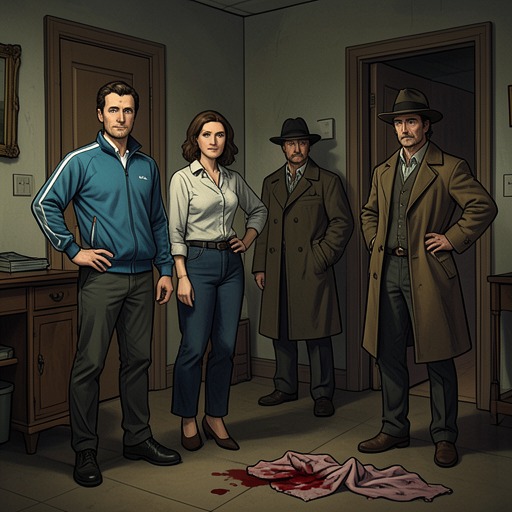
The police conduct fingerprinting at the house, first shepherding those present into the library, while Superintendent Battle and Inspector James Leach question the servants. Later, when the officers speak privately with Nevile, he sharply asks about the story of gloves outside his wife’s window. Battle answers only that the police have found curious things in the house. The exchange makes the dwelling itself the focus of an unsettled inquiry: its windows, access points, and objects are under scrutiny, while the significance of the discoveries has not yet been explained to Nevile.
A Landmark in the Wider Narrative
Gull’s Point remains visible beyond the immediate investigation. On a later visit to the area, Angus MacWhirter crosses by ferry to the Saltcreek side and walks uphill past the Balmoral Court Hotel. He passes Gull’s Point, recognizes its name on the painted door, and knows it as the house where the old woman was murdered. Hotel conversation and newspaper coverage have made the crime prominent, though MacWhirter is not interested in crime reporting and prefers world affairs. His passage turns the house into a public landmark as well as a private residence and crime scene.
From there, MacWhirter continues downhill past a small beach and fishing cottages, then follows the road as it gives way to a track climbing Stark Head. His return to the cliff connects the marked house to a different personal history: he has been to Stark Head before, during a period of desperation, and remembers being rescued by coastguards. On this later visit the earlier despair has passed, though he still feels anger about the rescue and its aftermath. Gull’s Point is not the site of that earlier crisis, but its place on the route makes it one element in a landscape MacWhirter revisits while reckoning with what has changed in himself.
The house’s narrative importance arises from the conjunction of geography and routine. Its position above water makes it immediately recognizable, its separation from the garage and division of grounds give it a precise physical plan, and its unlocked-on-the-latch front door provides a concrete question about entry. Later, the painted name and public talk preserve it in the surrounding community’s memory as the scene of Lady Tressilian’s murder. Gull’s Point thus shifts from home to investigative setting and finally to a local landmark associated with the crime.