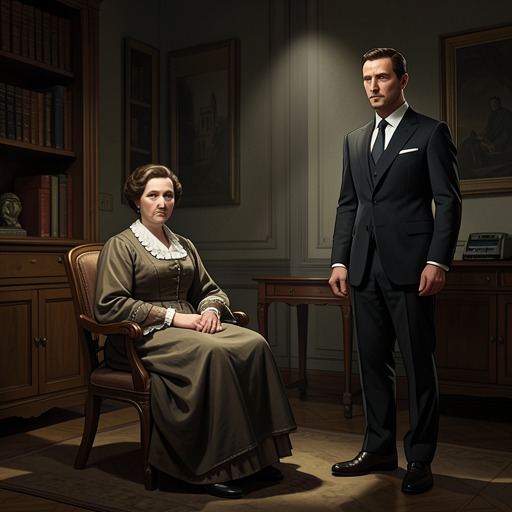
Lady Tressilian and Nevile Strange
Towards ZeroLady Tressilian and Nevile Strange share a family-like bond formed when she and Sir Matthew Tressilian cared for him. That affection makes Gull’s Point a home for Nevile, but it also gives Lady Tressilian a reason to speak plainly when she believes his conduct toward his wives is wrong. Their relationship is therefore both intimate and corrective: she treats him as someone belonging to her household, while refusing to let that belonging become permission to disregard his obligations.
Guardianship and a Sense of Home
Nevile recalls that Sir Matthew was his guardian and that Sir Matthew and Lady Tressilian looked after him. He describes Gull’s Point as his home in the qualified but deeply significant sense that it is as close to a home as any place is for him. The house is not merely a setting in which he visits an older family friend; it is part of his own history, shaped by the care he received there.
Lady Tressilian’s understanding of that history is similarly strong. She says Sir Matthew regarded Nevile as practically an adopted son, and she cannot imagine turning him out of the house, even when she judges his behavior badly. Her welcome is not an endorsement of everything he does. Rather, it expresses the durable obligation created by the household’s past: she can condemn his conduct and still regard him as one of their own.
Affection, Marriage, and Household Judgment
The relationship is tested by Nevile’s marriages. Lady Tressilian considers his first wife, Audrey Strange, charming and devoted to him, and she says she is fond of Audrey. She believes Nevile was very much at fault in the breakdown of that marriage. In her view, Audrey’s persistence in seeking to marry him contributed to his failure to reconsider, but that does not diminish her sympathy for Audrey after the separation.
Lady Tressilian’s opinion of Kay Strange is sharply different. She regards Kay as an unsuitable wife for Nevile, objecting to what she sees as a lack of background and roots. The contrast reveals how her affection for Nevile is bound up with her own ideas about a fitting marriage and a stable household. Her judgment is not neutral: she is openly partial to Audrey, whom she regards with warmth, and critical of the woman who became Nevile’s second wife.
That preference does not lead Lady Tressilian to reject Kay from the house. She recognizes that refusing to receive Nevile’s wife would create an open breach, and that Sir Matthew would have wanted Nevile to continue to think of Gull’s Point as home. She therefore accepts Kay’s presence despite her reservations. The decision shows the difference between her personal assessment and her conduct: disapproval does not erase the household duty she believes she owes to Nevile and the wishes she attributes to Sir Matthew.
A Boundary Against Nevile’s Plan
The strain becomes explicit when Lady Tressilian overhears Nevile and Kay arguing beneath her bedroom windows. She says she does not wish to listen to private conversations, but cannot avoid hearing them when the couple shout directly below her room. From what she hears, she understands that Nevile is proposing that Kay divorce him so that, in due course, he can marry Audrey again.
Lady Tressilian intervenes in unequivocal terms. She will not permit that proposed arrangement in her house, and she tells Nevile that Kay is his wife and has rights he cannot simply set aside. She insists that he has made his choice and must now accept the duty it carries. Her objection is more than a defense of Audrey or a statement of dislike for Kay: at this point she explicitly takes Kay’s side and treats Nevile’s present marriage as a real obligation, not a temporary obstacle to his preferred reunion.
Nevile apologizes for the scene but replies that the rest is his business. The exchange exposes a limit in their bond. He still addresses her as someone whose house and judgment matter, yet resists her claim to advise him. Lady Tressilian, for her part, does not soften the rebuke to preserve his comfort. Her authority arises from their history and from the practical fact that the confrontation occurs in her home, but she frames the issue as a question of what Nevile owes another person.
Inheritance and the Meaning of Obligation
Money gives their family connection a further, distinct dimension. Nevile explains that Sir Matthew left the property in trust for Lady Tressilian during her lifetime, with it to pass afterward to Nevile and his wife. He rejects the idea that his concern is merely an attempt to curry favor: he presents it instead as a question of affection and of understanding what Sir Matthew would have wanted. The inheritance arrangement thus links Nevile’s claim to Gull’s Point with the relationship that began when Sir Matthew and Lady Tressilian cared for him.
Later, during Superintendent Battle’s questioning, Nevile clarifies that a sum under discussion goes to Audrey because she was his wife when the will was made. Superintendent Battle asks whether, at the time of the divorce, Audrey was entitled to an allowance from Nevile. The question places marital support alongside the will and inheritance, but the available exchange does not establish the answer. It does, however, show that Nevile and Lady Tressilian’s family history sits within a wider web of legal and financial duties that cannot be reduced to personal affection alone.
Significance of the Bond
Lady Tressilian’s relationship with Nevile is defined by a tension between welcome and resistance. She preserves his place at Gull’s Point because she believes he belongs there and because she honors Sir Matthew’s wishes; she also refuses to let his status as a beloved, nearly adopted member of the family excuse his treatment of his wives. Her regard for Audrey and her criticism of Kay color her judgments, but her confrontation over Nevile’s plan turns on a more immediate principle: his existing marriage carries responsibilities.
For Nevile, Gull’s Point remains home even when its mistress opposes him. That contradiction gives their bond its force. Lady Tressilian offers continuity and belonging, but not unconditional agreement; Nevile invokes their shared history and Sir Matthew’s intentions, yet asserts his independence when her advice constrains him. Their relationship therefore joins affection to moral accountability, with the house itself standing as both a refuge from estrangement and the place where Lady Tressilian draws a firm boundary around what she will accept.