Lady Tressilian’s chronic invalidism
Towards ZeroLady Tressilian’s chronic invalidism is a persistent condition, not a surrender of mind or authority. Though her health is frail and she sometimes withdraws from life for long periods, she emerges mentally acute and incisive. The contrast between her physical dependence and formidable presence shapes both her daily life at Gull’s Point and her understanding of aging, death, and the people who care for her.
Illness and retained authority
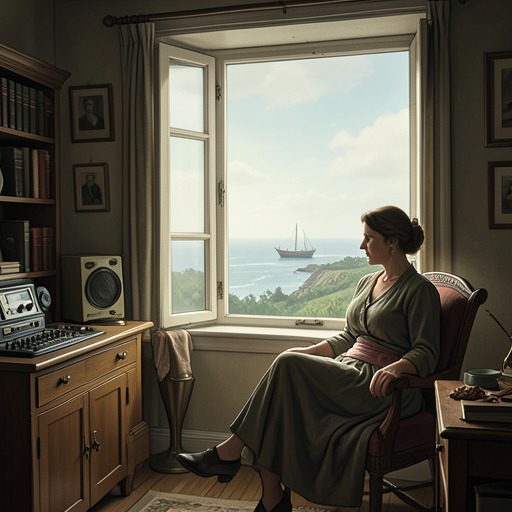
Lady Tressilian is over seventy and spends much of her time in bed, propped on pillows in a large bed set across a corner of her room. At times she lies with half-closed eyes in states the narration describes as semi-comas, appearing to retreat from life and its emotions. These spells do not define the full reach of her mind: when she emerges, her faculties are sharpened, and her tongue is incisive. Her invalidism therefore alternates between withdrawal and renewed engagement rather than reducing her to passivity.
The bedroom becomes a place from which she continues to exercise social authority. She holds court from her bed, and her forceful response to Nevile Strange’s letter demonstrates how readily she can turn that authority into judgment. Even the description of her profile emphasizes the effect of her gaze: she can look down her slender nose with telling force. The arrangement makes her physical limitation visible while refusing to equate it with intellectual weakness. Her body confines her to a room, but neither her opinions nor her capacity to influence the household are confined in the same way.
Aging, death, and dependence
Lady Tressilian’s account of illness is marked by a distinction between a quick death and a prolonged decline. After her husband drowned near the house, she initially hoped that she might not have long to live, particularly as her health began to fail. Instead, she experiences herself as one of the perpetual invalids who endure. She resents the prospect of illness gradually advancing, bringing greater helplessness and dependence on others, rather than allowing her to meet death directly and swiftly.
This is not presented as a generalized fear of mortality alone. Her distress concerns the manner in which dying seems to approach: slowly, through successive indignities and loss of independence. The phrase of death remaining at her shoulder gives her condition a sense of ongoing proximity without resolution. Her anger, including the gesture of thumping her pillow, makes that frustration active and bodily. The scene presents her as able to articulate what she fears, even as the dependence she describes limits what she can do about it.
Gull’s Point, memory, and care
Her attachment to Gull’s Point helps explain why illness does not lead her to leave the place where she lives. She and her husband had come there thirty years earlier; after he was drowned in a capsized dinghy almost before her eyes, other people expected her to sell the house and leave Saltcreek. She remained. The house keeps her husband’s presence close, and she says she would feel lonely and strange elsewhere. Her continued residence thus joins physical vulnerability to a deliberate attachment: the house is not merely where she is looked after but the setting in which her bereavement remains tangible.
That attachment has also altered the practical life of the household. After her husband’s death, she disposed of the boats and did away with the boat-house; guests now have to go to the ferry to hire a boat. This change is not evidence that she overcame her loss. Rather, the house continues to bear its consequences, while remaining the place she cannot imagine abandoning. Her illness and bereavement meet in this tension between dependence on a familiar home and the changes that grief has imposed upon it.
Care within that home is both personal and necessary. Mary Aldin, her distant cousin, lives with her and looks after her; the two women get on excellently, and Lady Tressilian recognizes herself as fortunate to have Mary. Barrett, who has served her for years, is described as devoted and a comfort to her. These relationships give concrete form to the dependence Lady Tressilian resents, without making care itself seem merely burdensome. Her fear concerns increasing helplessness, but the household also contains people whose loyalty makes continued life at home possible.
Effects on the household and narrative role
Lady Tressilian’s condition makes the household vulnerable to shocks. After Mr. Treves’s death, she is badly affected, and the event tells adversely on her health. The funeral takes place in London; Mary is thankful that this allows the older woman to turn her mind away from the sad event sooner than she otherwise might have done. In the following days, household life becomes nervous and difficult, while Mary feels tired and dispirited. The passage connects Lady Tressilian’s frailty not only to her own experience but also to the emotional and practical pressures carried by those around her.
The novel presents chronic invalidism through this mixture of limitation, temper, attachment, and reliance on others. Lady Tressilian can be dependent without becoming mentally diminished, and fiercely authoritative without being physically self-sufficient. Her experience is shaped by her own account of indignity and fear, by the care Mary Aldin and Barrett provide, and by the losses held within Gull’s Point. Illness consequently remains a continuing condition of household life rather than a single episode with a simple resolution.