Mr. Treves
Towards ZeroMr. Treves is a distinguished retired solicitor whose expertise gives unusual weight to his reflections on crime and causation in Towards Zero. His deliberate account of a suspected child murderer becomes more than an anecdote after his death is identified as murder: Mary Aldin and Superintendent Battle wonder whether he had recognized someone and told the story with a purpose.
Identity and Reputation
At nearly eighty, Mr. Treves has spent a long career in a famous firm of solicitors and is its best-known member. Though long retired from active practice, he remains exceptionally respected by fellow lawyers. His reputation rests not only on professional standing but on his experience settling delicate cases out of court and his knowledge of criminal matters and private histories. When he speaks among the lawyers gathered around the fireplace, the others listen in respectful silence.
That authority is joined to a pronounced reserve. People suggest that he should write his memoirs, but he knows that he has learned too much to do so. The contrast defines him: his knowledge makes him fascinating, while his discretion keeps that knowledge from becoming public. He is not presented as an active investigator in the present events, but his professional history makes his judgments difficult to dismiss.
At dinner at Gull’s Point, he notices the quality of the port and meal and the orderly management of the house, despite Lady Tressilian’s invalidism. He also prefers the old-fashioned custom of the ladies leaving the dining room when port is served, while recognizing that the younger people have their own habits. These observations present him as a man attentive to convention and detail, but not as someone who mistakes his preferences for authority over others.
A Theory of How Stories Begin
Mr. Treves gives the novel one of its central ideas about crime: a detective story should not begin with the murder, because the murder is its ending. The real story, he argues, starts earlier, with the events and choices that bring people to a particular place at a particular time. His examples emphasize small contingencies: a kitchen-maid’s quarrel changes where she works and makes her a principal witness for the defence; an exchange between brothers brings one of them to a new place; a constable’s attachment to a cook affects the timing of his rounds.
These examples make causation cumulative rather than simple. No single circumstance necessarily explains the eventual crime, but each may help bring people and events into alignment. Mr. Treves describes the process as converging on a point, until the moment arrives that he calls Zero Hour. The idea gives the novel’s title and structure a pointed meaning: the decisive event is the visible end of a history whose separate causes began elsewhere and earlier.
His theory also clarifies why he is an apt voice for the prologue. A room full of legal professionals is accustomed to looking backward from a case and assembling what happened. Mr. Treves asks them to look further back still, beyond the immediate crime, toward the dispersed lives and decisions that made it possible. His authority lends the idea professional credibility, while the later plot gives it practical force.
The Child-Murder Account
At dinner, Mr. Treves introduces a criminal case he considers genuinely interesting. He withholds the child’s age and sex, then describes two children playing with bows and arrows: one arrow strikes the other child in a vital place, and the child dies. At the inquest, the surviving child is distraught, and the death is treated as an accident. Mr. Treves says that the responsible adult chose not to act, because the future of a child was at stake and the child deserved the benefit of the doubt.
His own assessment is different. He believes the death was an ingenious murder planned in advance by a child, and says that a motive lay in teasing and unkind words that had fostered hatred. The account is striking precisely because it holds two judgments apart: the adult’s decision to protect a child from the consequences of an uncertain accusation, and Mr. Treves’s private conviction that the apparent accident concealed intention. He does not give details that would identify the child, and his refusal to state the child’s age or sex preserves the story’s uncertainty.
The manner of its telling later becomes significant. Mary remembers that Mr. Treves chose his words with great deliberation, seemed almost to draw the story into the conversation, and emphasized that he would recognize the person anywhere. She and Thomas Royde consider whether the account was simply a story or an indirect warning to somebody present. Mary’s recollection cannot establish whom, if anyone, Mr. Treves recognized; it does establish why the story acquires a second meaning after his death. His controlled delivery, initially a mark of professional care, now looks potentially purposeful.
Death and the Story’s Afterlife
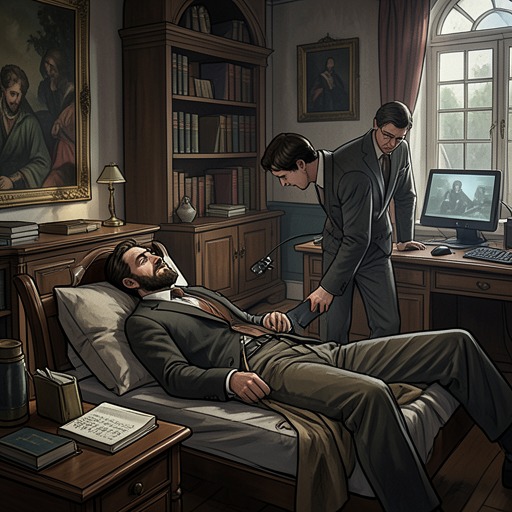
After the dinner, Lady Tressilian tells Mary that Mr. Treves is dead. She understands that he apparently did not undress the previous night and must have collapsed soon after reaching home. The initial report presents a sudden death; it is Superintendent Battle who identifies the possibility of murder, remarking that the crime was accomplished by hanging a placard on a lift. He calls it a quick and resourceful murder, while acknowledging that the plan might not have succeeded.
Mr. Treves’s death therefore changes the status of the child-murder account. Mary reports the dinner and story to Battle, who asks whether Mr. Treves said that the person he could recognize was a man or a woman. Mary realizes that he had expressly withheld both age and sex. Battle is deeply interested, and Mary’s memory becomes a line of inquiry rather than a settled solution. The account may point toward recognition, but the evidence provided through these recollections does not by itself disclose whom Mr. Treves suspected or what he intended to achieve by telling it.
His narrative role rests on this combination of insight and incompleteness. Mr. Treves articulates the book’s movement from scattered antecedents toward a fatal convergence, then becomes a victim in the very kind of crime whose causes he urged others to examine. Afterward, his carefully told story persists as a possible clue: respected expertise gives it weight, while his silence about the child’s identity leaves its meaning open. The convergence he described is thus mirrored in the plot, where an apparently separate anecdote and a sudden death are brought into relation by what the listeners remember.