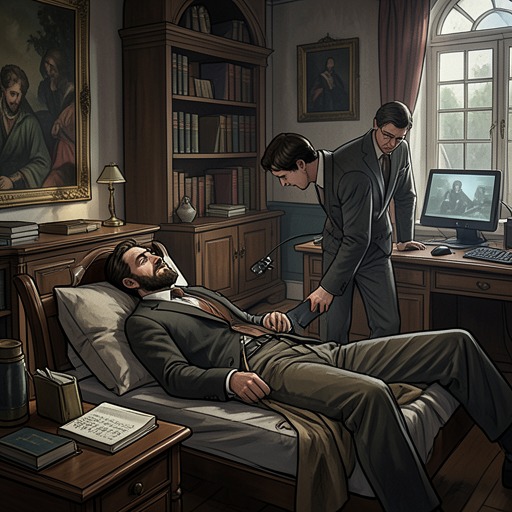
Mr. Treves’s death after climbing the hotel stairs
Towards ZeroMr. Treves’s death at the Easterhead Bay Hotel follows a chain of ordinary-seeming inconveniences that acquires a darker significance when checked against the facts: he had a weak heart, was placed on the top floor despite having reserved ground-floor rooms, and encountered a notice declaring the lift out of order. He died after apparently climbing the stairs, but the hotel’s account of the lift contradicted the notice. The episode therefore works both as a death attributed to a vulnerable heart and as a carefully bounded mystery clue: the circumstances invite scrutiny, while the evidence presented does not identify who displayed the notice or prove why it was there.
The room assignment and the risk
Mr. Treves had reserved two rooms on the ground floor by letter, explaining that his weak heart meant stairs were forbidden to him. On arrival, however, he was told that those rooms were unavailable. The explanation was that an old resident who had intended to go to Scotland that month had become ill and could not vacate them. Mr. Treves was instead given two rooms on the top floor. He acknowledged that they were pleasant, but his protest shows that the change was not merely a matter of preference: it placed him in a setting that conflicted with a specific medical limitation.
This arrangement establishes the physical risk before the fatal evening. Mr. Treves’s heart condition was not a detail supplied only after his death; he had already made it the reason for requesting accommodation without stairs. The circumstances thus give the later lift notice immediate practical force. For a guest who could not safely use the stairs, a lift failure would turn an inconvenience into a serious obstacle.
The notice and the ascent
When Mr. Treves reached the lift, he found a notice stating that it was out of order. He responded with annoyance at the prospect of walking up all the stairs. The notice appears to supply the direct cause of the ascent: with the lift presented as unavailable and his rooms on the top floor, he faced the very exertion his original booking was meant to avoid. The event’s sequence is clear in its essentials, though the evidence does not describe anyone watching him climb or establish every step between the notice and his arrival upstairs.
The contrast between the written warning and the hotel’s actual equipment becomes decisive in the later inquiry. Mary Aldin is told that the lift had not been out of order the previous day. A hotel representative says it was reliable and had not suffered a fault for about eighteen months. When Mrs. Rogers returns with the porter, Joe states emphatically that nothing had been wrong with it on the preceding night. There had been a placard of the kind Thomas Royde described, but it had been kept under the desk and had not been used for more than a year. The notice therefore cannot be treated as a reliable record of a genuine breakdown; its presence raises a question that the reported mechanical condition does not answer.
Collapse and the initial explanation
The first message to Mary Aldin reports that Mr. Treves is dead and that he collapsed as soon as he got in. His death is initially described as apparently due to his heart. A review of his prescriptions supports the view that his health was precarious, and the person discussing the case says that deaths in such heart cases are often sudden. The account also proposes that climbing three flights could almost certainly have brought about such an outcome, while questioning whether Mr. Treves would really have done so.
That hesitation matters. His known condition makes a sudden death medically plausible, and the ascent offers a possible immediate strain; yet both explanations depend on the circumstances of the journey upstairs. The later correction about the lift unsettles the apparent chain without erasing the medical explanation. The evidence supports a distinction between what is established and what remains unresolved: Mr. Treves had a weak heart, he encountered a false or unused lift notice, and he died after the reported climb; the record here does not disclose who put the notice in place or what that person intended.
The discrepancy’s significance
The event gains its narrative force from the gap between the visible explanation and the verified surroundings. At first, the lift notice makes Mr. Treves’s ascent seem like an unfortunate necessity, while his heart condition makes the fatal result appear tragically foreseeable. The hotel staff’s statements reverse the first impression: the lift had been working, and the sign was normally put away. What looked like a straightforward accident now contains an unexplained intervention in the conditions of his final journey.
That discrepancy is a clue, not a complete solution. It makes the route upstairs relevant to the investigation and gives the death a potential connection to deliberate action, but it does not, on its own, prove that Mr. Treves was killed or identify a culprit. By placing a mundane object—the lift placard—between the guest’s documented vulnerability and his death, the episode shows how a small alteration to an ordinary routine can change the meaning of an apparent natural end. The story’s uncertainty is part of the evidence: the reader is asked to reconsider the death, not to mistake suspicion for proof.