Mr. Treves’s weak heart
Towards ZeroMr. Treves’s weak heart is a chronic condition that governs where he sleeps, how he travels through buildings, and the care he takes to avoid exertion. His precautions are consistent and deliberate; when a hotel lift fails, the stairs become a possible source of the additional strain that his fragile health could not withstand.
Condition and Daily Precautions
At the Club, Lord describes Mr. Treves as having a bad heart and suggests that he might collapse at any moment. Young Lewis counters that Mr. Treves takes good care of himself. The exchange establishes both the seriousness of his condition and the routine vigilance surrounding it: his health is precarious, but his habits are designed to manage the danger. The contrast between a sudden possible collapse and the care he takes becomes important later, when a small disruption to those habits is considered as a possible physical strain.
Those arrangements appear in his home. After his Daimler brings him to a quiet square, a butler-valet helps him off with his coat, and he goes to his library, where a coal fire is burning. His bedroom is beyond it, on the same level; because of his heart, he never goes upstairs. The layout and domestic assistance make his caution concrete. Avoiding stairs is not merely a preference mentioned in passing but a settled condition of how his home and daily movements are organized.
Travel and Accommodation
When considering a stay at Saltcreek, Mr. Treves asks about practical provisions as well as the attraction of renewing his acquaintance with Lady Tressilian. He wants a garage for the car and accommodation for his chauffeur, but his own access needs are especially explicit: he says he must be careful walking uphill and would prefer ground-floor rooms, while asking whether the hotel has a lift. The plan depends on minimizing exertion and on having a way to move between floors without climbing.
At the Easterhead Bay Hotel, his booking does not produce the arrangement he had requested. He had reserved two ground-floor rooms by letter, but on arrival learns that they are unavailable because an old resident, Mr. Lucan, who had been due to go to Scotland, is ill and has not vacated them. Mr. Treves protests, then accepts two rooms on the top floor, which he considers pleasant. He reassures the others that the automatic lift is good and that he has suffered no inconvenience. The episode shows how his precautions rely not only on personal discipline but also on accommodation and functioning equipment: although the assigned rooms are far from his stated preference, the lift appears to make them usable.
The Lift Failure and Medical Risk
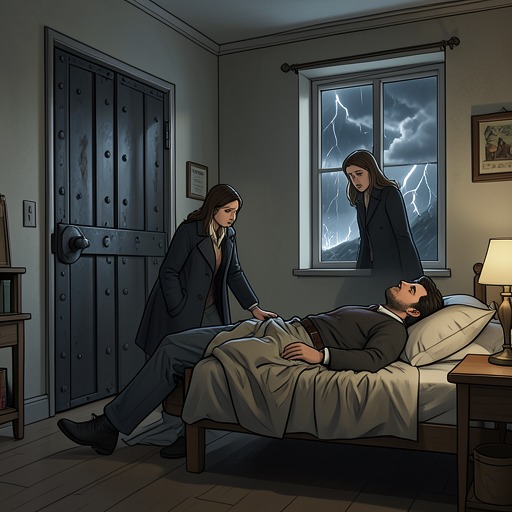
After Mr. Treves’s death, the doctor examines his prescriptions and describes him as having been in a very precarious state of health. He explains that heart cases can end suddenly and says he will communicate with Mr. Treves’s doctor in London. Mrs. Rogers recalls that Mr. Treves was always careful of himself and had received all the care available at the hotel. The doctor agrees, suggesting that some tiny additional strain may have been enough to precipitate the end.
Mary Aldin proposes walking upstairs as a possible strain. The doctor says that it might have caused the collapse and, if Mr. Treves had climbed the three flights, almost certainly would have. Mrs. Rogers is surprised: she insists that he always used the lift and was particularly careful about it. Mary then points out that the lift had been out of order the previous night. The exchange does not establish, in the available account, that Mr. Treves actually climbed the stairs; it makes the breakdown a consequential possibility and turns his established reliance on the lift into a question requiring investigation.
Narrative Significance
The heart condition links an apparently ordinary hotel inconvenience to a potentially fatal physical risk. A lift that had previously allowed Mr. Treves to stay on the top floor without difficulty could no longer be assumed to protect him; the possibility that he faced three flights of stairs gives the malfunction significance in retrospect. The discussion proceeds through specific details—his prior ground-floor reservation, the rooms reassigned to him, his consistent use of the lift, and its failure—rather than through a general account of his illness.
His habits therefore serve two functions in the narrative. They establish a credible vulnerability, and they provide a standard against which later claims about his movements can be tested. The doctor’s conditional assessment and Mrs. Rogers’s emphatic account do not themselves prove what happened, but together with Mary’s observation they sharpen the central uncertainty: whether the disruption to Mr. Treves’s careful routine exposed him to precisely the exertion his weak heart made dangerous.