Murder of Camilla Tressilian
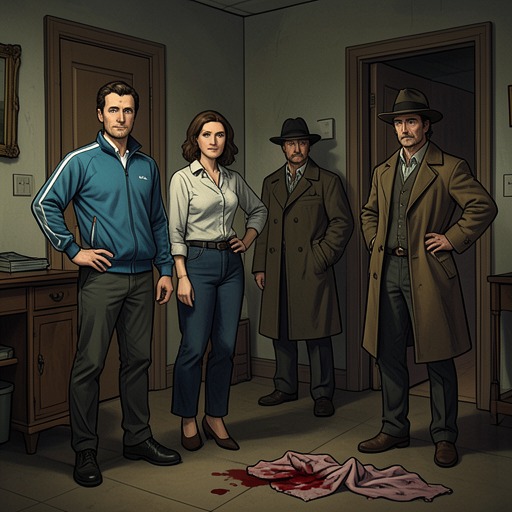
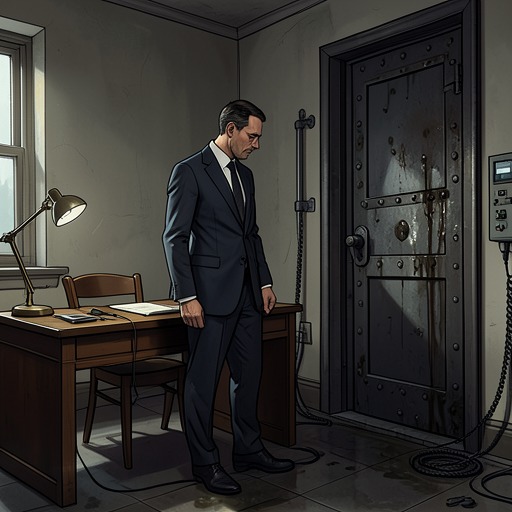
Towards ZeroMurder of Camilla Tressilian is the killing of Lady Tressilian by Nevile Strange, engineered not only to conceal the killer but to direct suspicion toward Audrey. Its design depends on ordinary objects made to serve a false story: a bell rung from outside the room, a route involving a rope and a swim, and a tennis racket altered into a concealed weapon. Superintendent Battle’s reconstruction shows how those elements combine into a planned alibi and an attempted frame-up.
Motive and Stakes
Battle links the murder to Nevile’s fixation on Audrey, his former wife. In confronting him, Battle describes a man whose love had turned to hatred after Audrey left him for another man, and whose response to injury was to demand punishment. The intended suffering was not, in Battle’s account, an incidental consequence of the scheme: Nevile wanted Audrey to bear a specially devised, prolonged punishment and to be blamed for the crime. The murder therefore serves two purposes at once: it kills Lady Tressilian, whom Battle describes as having been almost a mother to Nevile, and advances Nevile’s revenge against Audrey. Battle’s accusation emphasizes the contradiction at the center of the plan: Nevile had once loved Audrey, yet that history did not restrain him from making another woman the victim of a scheme directed against her.
The questioning also touches on money owed or bequeathed to Audrey. Nevile clarifies that a sum under the will was to go to Audrey because she had been his wife when the will was made; Battle then asks whether she was entitled to an allowance from him at the time of their divorce. These exchanges establish that the investigation considers the financial consequences of the former marriage, but they do not, by themselves, establish money as the murder’s motive. Battle’s explanation instead identifies revenge and Nevile’s desire to punish Audrey as the central purpose of the plot.
The False Bell and the Alibi
The bell call was a manufactured event. Lady Tressilian had not rung her bell, although the arrangement was meant to make it appear that she had summoned someone. Nevile operated the bell from the passage with a long pole; its wires ran along the ceiling. Barrett came downstairs in response and saw Nevile going down and out, then found Lady Tressilian alive. That apparent confirmation of life made the staged call useful: it placed Nevile in view at a moment when the household could believe the old woman was still safe.
The sequence also shaped suspicion. Nevile was initially treated as a suspect, but Barrett’s report that she had found Lady Tressilian alive appeared to clear him. Once that account seemed to settle the timing, there was less reason to examine closely when he had actually reached the hotel. Battle argues that the maid’s involvement was part of the deception: drugging Barrett did not reliably ensure that she would be incapacitated before a murder planned for before midnight. Instead, the staged bell and her response helped make the crime appear to be an inside job while giving Nevile a brief role as the obvious suspect, followed by an apparent exoneration.
The apparent route back was another part of the construction. The investigators knew Nevile had not returned by ferry and that no boats had been taken, leaving a swim as the remaining possibility. He was a powerful swimmer. Battle reconstructs Nevile’s return by a rope left hanging into his bedroom, where water on the floor had been noticed without its significance being understood. Nevile could then change into a blue coat and trousers, go to Lady Tressilian’s room, and return by the same route. The passage from his room to hers and back would have taken only a few minutes, according to Battle’s account. He had prepared the weapon beforehand, limiting the time needed at the scene.
The Weapon and Its Concealment
The murder weapon was a tennis racket altered to carry a heavy steel ball. Battle identifies the ball as one taken from a Victorian fender. The racket head had been sawn off, and the ball screwed into the handle, turning an everyday sporting object into a weapon that could be concealed among the household’s belongings.
The traces left after the killing exposed the alteration. The ball had been cleaned and returned to the fender, but a trace of blood remained on the screw. The racket’s handle and head had been joined again with adhesive surgical plaster. It was then put carelessly into the cupboard under the stairs, where it might have remained unnoticed among the other stored objects if investigators had not specifically been looking for an item of that kind. The contrast between the effort to restore the ball and the careless disposal of the racket gives the weapon’s concealment its importance: the objects were returned to familiar places, but not all the evidence was removed.
Reconstruction and Exposure
Battle’s account connects the false bell, the apparent departure, the swim, the rope, and the altered racket into a single sequence. After the murder, Nevile returned to Easterhead. The next morning, once the commotion began, he got back into Ted Latimer’s car. Battle says that the intervening night gave him time to clear traces and repair the racket. These actions extended the plan beyond the killing itself: the false alibi depended on controlling what witnesses believed, while the later cleanup depended on restoring objects and removing signs of the route.
One final detail explains why the attack appeared to have been made by a left-handed person. Nevile struck backhanded, and his backhand was his stronger point. The apparent handedness was therefore misleading rather than exculpatory; once Battle connected it to Nevile’s established strength, it fitted the rest of the reconstruction. Together, the physical traces and the staged timings reveal a crime built to make Audrey seem responsible while allowing Nevile to appear first suspect and then cleared. The murder’s decisive exposure comes from seeing that the supposed evidence of innocence—the bell call, Barrett’s report, and the apparent direction of the attack—was part of the design.