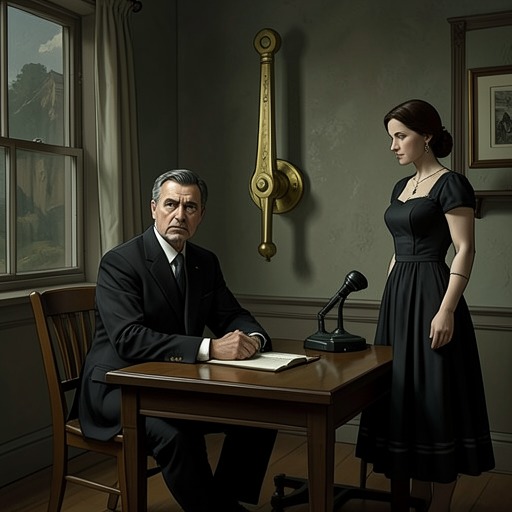
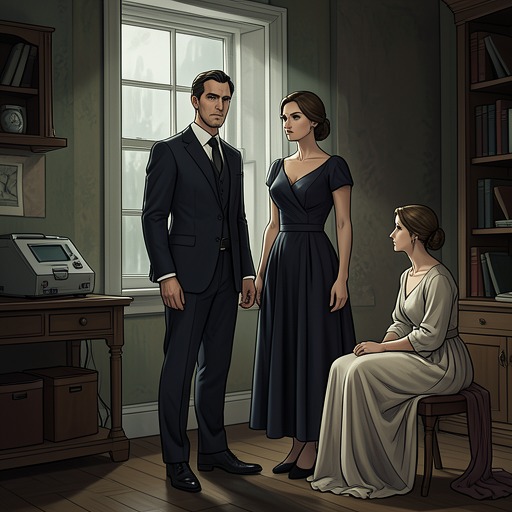
Nevile Strange and Kay Strange
Towards ZeroNevile Strange and Kay Strange’s marriage is presented first as part of a picture of enviable good fortune, then as a relationship unable to withstand Nevile’s unresolved feelings about Audrey Strange. Kay regards Audrey as an obstacle who should have accepted the end of her marriage; Nevile instead admits that he treated Audrey badly and ultimately tells Kay he believes he loved Audrey all along. Their rupture exposes how differently they understand the marriage and its ending.
Identity and public image
At thirty-three, Nevile is described as a familiar figure to the British public, a first-class tennis player and all-round sportsman with money, good health, and good looks. Although he had not reached the Wimbledon finals, he had progressed through opening rounds and twice reached the mixed-doubles semi-finals. He was also a scratch golfer, a fine swimmer, and an experienced climber in the Alps. The account places Kay beside these signs of success: Nevile had recently married an extremely beautiful wife and appeared to have no serious worries. Their union thus enters the story under the aspect of a fulfilled public ideal, an impression that later scenes unsettle.
That ideal is not simply domestic. Kay and Nevile share plans and social opportunities, including an invitation from Shirty to travel to Norway on a yacht at the end of June. They cannot accept, and Kay looks wistfully toward the trip while glancing cautiously at Nevile. The moment gives their marriage an everyday texture—shared plans, disappointment, and attention to one another—without resolving the unease that the cautious glance suggests. Against Nevile’s public reputation as a fortunate man, the small hesitation hints that the couple’s apparent ease does not tell the whole story.
Competing accounts of Audrey
Kay’s view of Audrey is openly dismissive. She argues that Audrey should have accepted Nevile’s departure gracefully rather than showing herself heartbroken, and describes her as unsuited to Nevile’s active, athletic life. In Kay’s account, the former wife’s distress is evidence of poor conduct and resentment, not a reason for Nevile to feel responsible. Her claim that a wife should give up a husband she cannot keep recasts the end of Nevile’s first marriage as a contest Audrey lost.
Nevile initially suggests that any jealousy would come from the other side, but then corrects himself. He says that he treated Audrey very badly and refuses to excuse that treatment as something he could not help. He also tells Kay that making amends might leave him happier about the past. The change is revealing: Kay frames Audrey’s response as a failure to accept the couple, while Nevile acknowledges his own part in causing the hurt. His admission does not establish that he and Kay had no genuine attachment, but it makes clear that the marriage rests beside an unresolved moral and emotional debt.
Strain within the marriage
In another confrontation, Nevile rebukes Kay for behaving in what he calls a hysterical way while they are guests in other people’s houses, and insists that she should know how to behave in public. Kay answers that Audrey is turning Nevile against her and seeking revenge. The exchange makes their conflict explicitly triangular: Kay interprets Nevile’s changing attitude through Audrey’s influence, whereas Nevile’s earlier admission locates responsibility in his own treatment of Audrey. Their disagreement is not only about which woman Nevile loves; it is also about whether Kay can regard his conduct as his own choice.
The contrast sharpens when Nevile approaches Audrey about returning to their former relationship. He asks whether they can go back to how things were and leave the intervening events behind. He says he will tell Kay the truth and appeal to her generosity, explaining that Audrey is the only woman he has ever loved. In speaking of Kay to Audrey, he presents their marriage as a mistake he intends to end rather than a bond he can continue honestly. The proposed reconciliation therefore places Kay, who has understood the marriage as a chosen and continuing commitment, in direct opposition to Nevile’s newly stated account of it.
Separation and its aftermath
When Nevile tells Kay that he cannot continue, he says he thinks he may have loved Audrey all along and describes his love for Kay as a kind of madness. He argues that he and Kay do not belong together and that he could not make her happy in the long run, asking to part as friends. His explanation is framed as an attempt to limit future unhappiness, but it also withdraws the assurances on which Kay understood their marriage to rest. The language of an amicable separation cannot make the decision mutual: Kay rejects the proposed divorce.
Kay says she married Nevile because she loved him and identifies her having followed him to Estoril as the point after which she believes he began to turn against her. She is not ashamed of having followed him; instead, she accuses him of wanting to think events were governed by fate rather than by her actions. She also insists that Audrey engineered the change and declares that she will not allow Nevile to return to his former wife. Her response combines a claim of personal devotion with suspicion of Audrey, leaving no room for the generous release Nevile has requested. After the scene, Nevile apologizes for what has happened but maintains that the rest is his own business. His reply asserts his right to decide, even as Kay’s refusal makes clear that the marriage cannot be ended by his decision alone in emotional terms.
The relationship also persists in the later discussion of divorce and money. Nevile clarifies that a sum under discussion goes to Audrey, who was his wife when the will was made. Superintendent Battle asks whether, at the time of the divorce, Audrey was entitled to an allowance from Nevile. The exchange does not specify the amount or settle the legal question, but it shows the former marriage continuing to shape financial arrangements after the separation from Kay. What began as a socially impressive match thus ends not in a clean break but in overlapping obligations: Nevile’s attempt to return to Audrey, Kay’s refusal to accept the divorce, and the continuing relevance of his prior marriage.