Nevile Strange’s Gull’s Point reunion
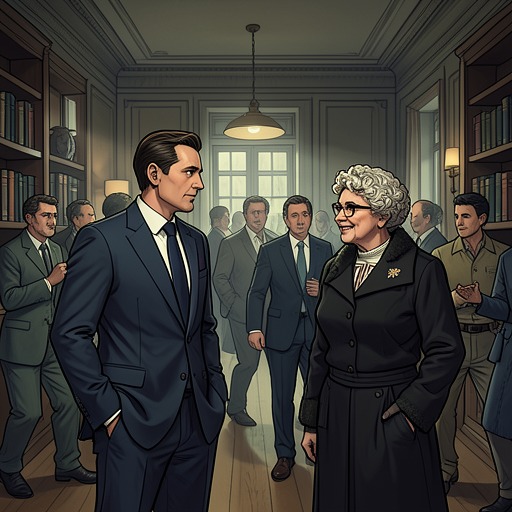
Towards ZeroNevile Strange’s Gull’s Point reunion is Nevile’s plan to have Kay Strange and Audrey Strange stay at Gull’s Point at the same time, recasting a potentially strained encounter as a modern exercise in friendliness. Its significance lies in the gap between that polished explanation and the unease surrounding the gathering: Lady Tressilian doubts the plan originated with Nevile, while Mary Aldin later describes the resulting household situation as difficult and says it is not working well.
The Proposal and Its Timing
Nevile first raises the reunion while Kay is considering a yachting trip. She has just remarked on giving it up to face the snubs of her husband’s prim Victorian relations; Nevile then suggests that they need not abandon the trip with Shirty if she wants it. When Kay asks what that means for Saltcreek and Gull’s Point, he proposes going there in early September. The change of plan turns on the tennis calendar: they cannot go in July or August because of the tournaments, but could finish at St. Loo in the last week of August and continue to Saltcreek.
Kay is startled by the prospect that she and Audrey would be at Gull’s Point together. Nevile rejects her sense that the idea is extraordinary, arguing that people nowadays can all be friends and that this would make matters simpler. He also appeals to Kay’s own earlier approval of the idea. The conversation thus gives the plan an air of mutual agreement, although Kay’s astonishment suggests that its personal consequences have not been made ordinary merely by calling them modern.
Audrey’s Invitation
Nevile later presents the proposal to Kay as his own idea, saying that he and Audrey had talked and that Audrey could not have been nicer. He describes wanting the two women to become friends and the group to get together at Gull’s Point, where it might happen naturally. Kay warmly responds to the thought of Audrey, and Nevile confirms that the arrangement was his idea.
Lady Tressilian, however, is unconvinced that Nevile devised the plan. On May 1, learning that Audrey is due to stay with the Darlingtons at Esbank on May 3, she suggests that Audrey be asked to lunch at Gull’s Point. When Audrey visits on May 5, Lady Tressilian explains that Nevile has proposed bringing himself and Kay in September, supposedly because he wants the two women to be friends and believes Audrey agrees. Audrey does not reject the suggestion; she asks whether it is really so preposterous. Her gentle response leaves the question of her feelings open rather than confirming Nevile’s account of her enthusiasm.
Lady Tressilian’s Decision
Lady Tressilian asks Audrey directly whether she wants the arrangement. Audrey offers to come another time, saying any time will suit her, but Lady Tressilian insists that she will come in September as she always does and that Nevile and Kay will come too. She presents her decision as an accommodation to changing modern life, while her earlier suspicion that the proposal is unlike Nevile shows that she has not simply accepted his version of events.
The reunion is therefore settled less through a shared declaration of comfort than through Lady Tressilian’s authority over the invitation. Audrey agrees to the visit, and Lady Tressilian closes discussion of the matter. The outward arrangement is clear: Audrey’s customary September visit will coincide with Nevile and Kay’s stay. What remains unsettled is whether the intended friendship is genuinely desired or can be produced by putting the three of them under one roof.
The Gathering’s Uneasy Reality
When Mary Aldin discusses the household with Thomas Royde, she identifies Audrey as being there and Nevile with his wife as present too. Royde immediately recognizes the situation as awkward. Mary emphasizes that the arrangement was Nevile’s idea, then explains its rationale as a modern reaction: everyone should be sensible and friendly together. Her qualification is decisive—she does not think it is working very well.
That later assessment sharpens the contrast built into the proposal. Nevile had described shared residence as a simple, natural way to turn the former and present marriages into a friendly group; Mary’s report instead registers strain as an existing condition. The reunion’s stated purpose is social ease, but its actual importance is that it gathers people whose relations cannot be made uncomplicated by the language of modern friendliness.