Superintendent Battle
Towards ZeroSuperintendent Battle’s defining quality is the contrast between an almost unreadable exterior and a forceful, discriminating intelligence. He approaches the investigation of Lady Tressilian’s death not as a blunt search for a culprit, but as a problem whose apparent simplicity conceals a more carefully arranged purpose. His attention to a small stain, a doctor’s uncertainty, a will, and a disputed timeline helps redirect the case toward the person and motive at its centre.
Identity and Bearing
Battle is introduced at breakfast, reading a letter his wife has handed him in tears. His face gives almost nothing away: it is compared to carved wood, solid and durable, and his jaw is set. The description distinguishes him from a conventionally brilliant detective. His authority instead comes from an indefinable but unmistakable forcefulness, coupled with patience enough to read a letter slowly and carefully before acting.
That composure does not mean he is untouched by ordinary disappointments. When police business disrupts his holiday, he complains about losing it; later, the narrative makes clear that he had enjoyed his leave and still had three days remaining. A change in the weather had already disappointed him, but he had otherwise been fortunate. This domestic scale gives his professional authority a human counterpoint: duty is not presented as effortless or as his sole concern.
Family and Personal Obligations
Battle’s relationship with his daughter brings his professional judgment into direct contact with paternal feeling. He insists that he knows she is not a thief, not simply because he is her father, but because he is a policeman. His reasoning distinguishes between people who yield to an overwhelming temptation and habitual takers; he places his daughter in neither category. He instead identifies her as an unusual kind of liar. The distinction is important: he does not confuse dishonesty with theft, nor does his affection prevent him from naming the deception he sees.
His family life also appears through his wife’s tearful delivery of the letter he reads at breakfast. The passage gives no further account of its contents, but its placement beside his impassive face establishes a quiet contrast between private distress and the controlled manner with which he receives it. Battle’s restraint is therefore not an absence of human ties; it is the outward discipline with which he meets them.
Holiday Interrupted and Police Work
The investigation brings Battle into consultation with Major Robert Mitchell, the Chief Constable, and his nephew, Inspector Jim Leach. The familial connection does not displace the formal police context: the three speak gravely about the case. Battle’s own holiday has been interrupted, but he moves from complaint to sustained scrutiny of the evidence.
His questions are carefully calibrated. When a doctor discusses the suspected weapon, Battle asks whether the doctor could swear that it was the weapon. The question does not dismiss the doctor’s view; it marks the difference between a plausible identification and evidence that can be asserted with certainty. Later, after another point appears to have settled an issue, Battle tests that apparent conclusion rather than allowing the inquiry to stop at the first satisfactory explanation.
Battle can also draw a boundary around what others are entitled to demand of him. After apologising for a scene, he makes clear that the remaining matter is his business. The brief exchange presents a controlled professional confidence: he acknowledges conduct that requires an apology without surrendering responsibility for the investigation.
Evidence and the Hidden Design
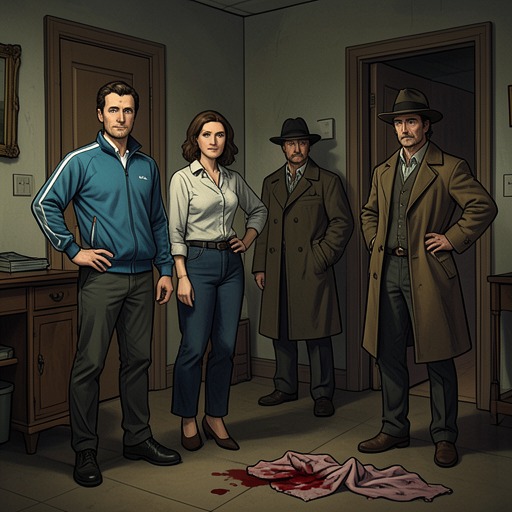
Battle’s most concrete investigative contribution in the supplied scenes begins with a small stain on a screw. He proposes that it may be blood left behind after the knob itself was cleaned and wiped, and connects the overlooked mark to the object he believes struck Lady Tressilian. His conclusion remains an investigator’s strong inference rather than a courtroom certainty, as his earlier question to the doctor makes clear. He directs Jones to search the house again, this time with a precise object of attention. The method is both material and procedural: a minute trace gives the search a new focus.
At the same time, Battle resists treating the apparent brutality of the crime as the whole explanation. He describes the case as displaying a hidden, finely managed hand behind its straightforward surface. That perception prepares the later distinction he draws between Lady Tressilian’s death and the murderer’s principal objective. He tells Mary Aldin that the death was incidental to the main object, which was the murder of Audrey Strange. The distinction changes the scale of the inquiry: the visible killing is not, in his account, the final measure of the design.
Testing Motive and Opportunity
Battle examines the financial and personal circumstances surrounding Audrey Strange as well as the physical clues. When Nevile Strange clarifies that money under the will goes to Audrey, his former wife at the time the will was made, Battle immediately asks whether she was entitled to an allowance from him after their divorce. The question places the will alongside the obligations created by the marriage and its dissolution. It does not itself establish a motive, but it shows Battle testing the relationship between inheritance and the financial position of the person targeted by the larger scheme.
He also turns to opportunity. In confronting Nevile, Battle recalls that he took the 10.30 ferry but that no one can swear to seeing him at the Easterhead Hotel until 11.15, despite his account of looking for Ted Latimer. Battle sets the gap between the claimed movements and the available confirmation before his subject without treating the claim as proven fact. The pressure comes from the precise interval and the absence of corroboration.
Together, these interventions define Battle’s narrative role. He moves from a possible weapon to the trace it may have left, from a death to the larger purpose it may have served, and from a stated journey to the part of its timing that witnesses cannot confirm. His authority rests less on theatrical brilliance than on the steady separation of what is known, what is inferred, and what still requires another search or question.