The convergence of causes toward zero
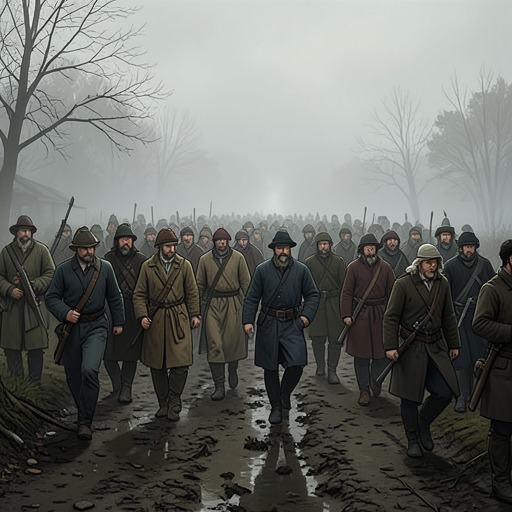
Towards ZeroThe convergence of causes toward zero describes a pattern in which scattered histories, choices, and circumstances meet at a decisive time and place. Its central reversal is that murder is not where the story begins but where its accumulated causes arrive. Mr. Treves gives the idea its clearest form: people who seem to belong to separate worlds are drawn together, each contributing a small part to an outcome that none of them necessarily sees in advance. The concept makes the final crime legible not as an isolated act but as the point at which many lines of causation cross.
A murder with a long prehistory
Mr. Treves contrasts the usual detective story, which opens with a murder, with the longer history that makes the crime possible. In his account, the relevant beginning may lie years earlier, in events that place particular people together at a particular time. The murder is therefore an ending in a structural sense: it completes a convergence already under way. His formulation shifts attention from the single decisive act to the network of prior circumstances that gives that act its setting and consequences.
He illustrates the network through small, contingent causes. A kitchen maid, after pinching her young man, leaves her situation in a huff and later becomes the principal witness for the defence at a murder trial. A restaurant proprietor from Italy comes to exchange places with his brother for a month; because the brother is nearly blind, he would not have seen what the visitor’s sharp eyes notice. A constable, meanwhile, is late on his beat because he is sweet on the cook at No. 48. These circumstances differ in scale and intention, but each alters what someone can see, where someone will be, or what evidence will eventually reach a court. Mr. Treves’s point is not that every participant understands the chain, but that small divergences can become consequential when they meet.
The imagined endpoint is a London murder trial on a grey November day. People from Lancashire, Scotland, Italy, and the American Middle West, among other places, are gathered within one legal proceeding. Their different origins and roles become parts of a common account: each has contributed something, and the accumulated story culminates in a trial for murder. The courtroom supplies a retrospective frame for the scattered causes, revealing how lives that appeared unrelated have become mutually relevant.
The decisive place and time
The movement toward zero is not simply a list of causes; it is a convergence toward a specific point. Mr. Treves describes the separate lines as drawing together until the moment arrives, which he calls Zero Hour. The phrase gives the pattern the force of a deadline: before it, circumstances accumulate; at it, their consequences become active together. His repetition of the idea, followed by a shudder, momentarily gives the abstract pattern an ominous personal charge. The scene does not establish why he shudders, but it places foreboding beside his account of converging events.
A young nurse offers a complementary version of the same principle. She argues that a person may matter simply by being in a certain place at a certain time, without knowing what their presence accomplishes. Her example is a man walking along a road on a September night and thereby saving someone from a terrible death. The possibility is tentative in the narration, and the nurse’s belief that some of her family have the sight does not turn the idea into a confirmed supernatural explanation. Instead, her vision extends the concept beyond criminal causation: an apparently ordinary presence can enter a chain of events whose importance remains unknown to the person involved.
The plan behind the apparent accidents
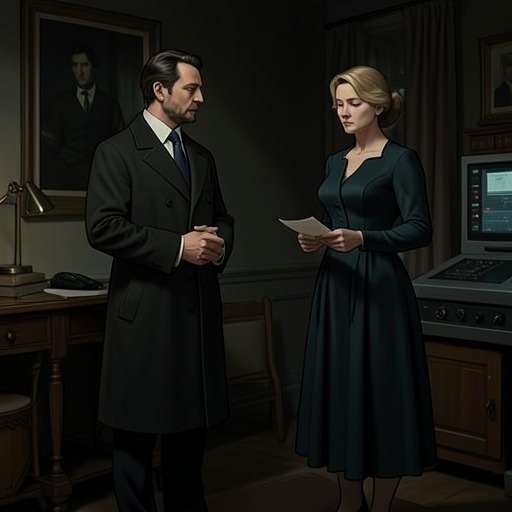
The convergence also has a deliberate counterpart. In a scene dated March 8th, an unidentified figure writes out a detailed project for murder. The writer’s purpose is clear, and the scheme takes account of possible reactions and unforeseen events rather than relying on a single rigid sequence. Its time, place, method, and victim are treated as elements of one design. The passage thus sets purposeful orchestration beside Mr. Treves’s account of unintended contingencies: some lines in the convergence arise from chance or ordinary choices, while another is being consciously arranged to exploit what people may do.
The writer reviews the plan, finds its main lines clear, and traces a date in September. The paper is then torn up and every piece carried to the fire and destroyed; the scheme survives only in its creator’s mind. The contrast between the meticulous written plan and its complete physical erasure makes the idea of convergence more unsettling. A chain of events may be carefully prepared while the evidence of that preparation disappears. The reader is shown the existence and broad logic of the design, but not the writer’s identity or the plan’s full particulars in this passage.
Mr. Treves inside the pattern
After leaving the Club, Mr. Treves returns home, sits by the fire in his library, and continues thinking about the kind of story he has described. He imagines beginning one with an elderly gentleman opening his letters and moving, without knowing it, toward zero. The imagined figure closely resembles the situation he occupies: Mr. Treves himself is an elderly gentleman seated by a fire, opening his mail. The resemblance makes his theory briefly fold back upon its speaker, turning an abstract account of causation into a possible position within the pattern.
As he opens an envelope, however, his expression changes and his attention returns from romance to reality. The passage gives no basis for identifying the letter’s contents, so its importance lies in the interruption rather than any disclosed message. Mr. Treves has imagined a person unaware of the drama being prepared around him; the change in his expression marks a moment when thought gives way to something immediate, without yet explaining what that reality means.
Narrative significance
The concept joins two scales of explanation. At the broad scale, people and circumstances converge until a murder and its trial become possible. At the intimate scale, a maid’s departure, a temporary exchange between brothers, a constable’s delay, or an unknowing person’s presence can redirect what happens. Against these contingencies stands a planner who studies reactions and tries to bring the good and evil in others into alignment with one design. The tension is between a world no single person fully controls and an intelligence attempting to control its point of convergence.
By insisting that the story begins long before the murder, Mr. Treves supplies a way to read the crime as both an event and the culmination of a history. Zero is not merely the instant of violence: it is the point at which dispersed causes become inseparable from one another. His image of converging lines therefore links the novel’s detective-story structure to its concern with consequence, hidden preparation, and the uncertain importance of ordinary actions.