
The Chinese Worker’s Shadow
Train DreamsThis flow traces how the failed execution attempt returns throughout Grainier’s life as guilt, fear, and a theory of punishment.
increasing Bearing strength in each event
 decreasing
Bearing strength in each eventdecreasingAccusation
Accusation
Company Suspicion
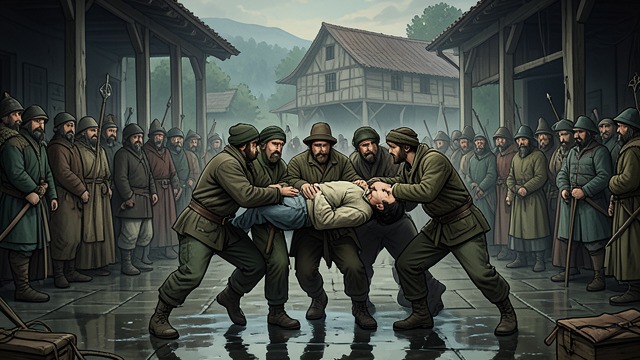
A Chinese railroad worker is accused of stealing from company stores. Management and laborers treat the accusation as sufficient grounds for coercion.
No investigation stabilizes the facts. The crowd’s certainty grows from racial hostility, hierarchy, and fear of resistance.
Forced March
Grainier helps drag the worker toward the bridge. His bodily participation turns institutional suspicion into immediate violence.
Escape Across Beams
Escape Across Beams
Reversed Power
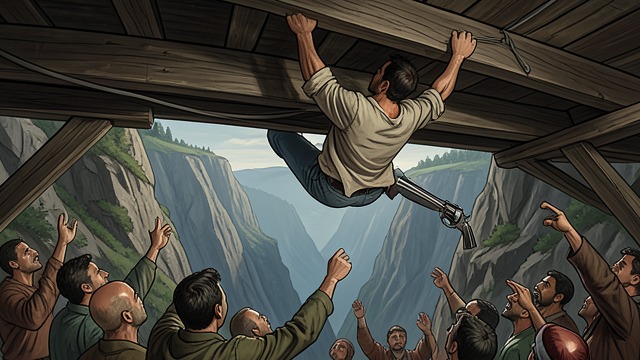
The worker clings to the bridge structure and moves hand over hand above the gorge. His physical skill defeats the men who thought they controlled him.
Some workers cheer his escape while others demand that he be stopped. The mob’s unity breaks when violence becomes visibly absurd.
Failed Gunfire
Mr. Sears fires a black-powder revolver without effect. Industrial authority is exposed as both lethal and incompetent.
Curse Theory
Curse Theory
Retrospective Link
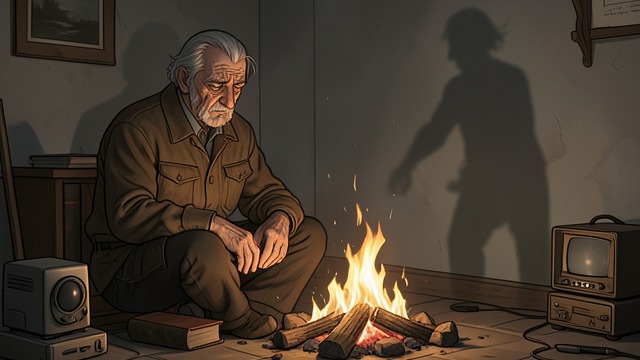
Grainier connects the worker’s supposed curse to the destruction of his family. The fire becomes, in his mind, an answer to an earlier moral offense.
This theory gives random catastrophe a shape. It also preserves the worker’s power long after his disappearance.
Unequal Punishment
Grainier believes the punishment exceeds the crime. His guilt is therefore not absolved by suffering; suffering confirms that he remains implicated.
summer 1917
the same afternoon
after the 1920 fire
