
The Great Fire’s Ecology
Train DreamsThis flow traces how fire changes the valley’s plants, animals, sounds, and human meanings.
increasing Bearing strength in each event
 decreasing
Bearing strength in each eventdecreasingSterile Burn
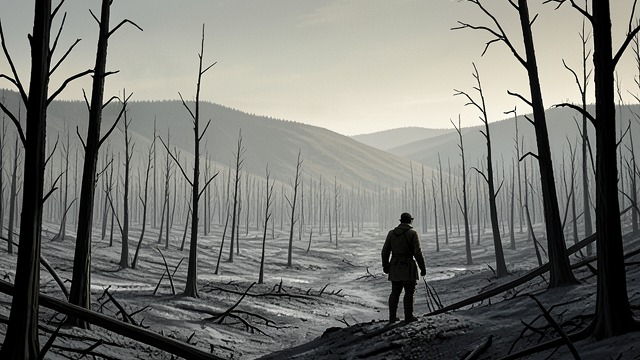
Sterile Burn
Gray Valley
The fire leaves ash, smoke, black trunks, and no visible animal or plant life. Grainier experiences the valley as a world emptied of its former grammar.
The destruction is not merely scenic. It removes food, shelter, memory, and the physical evidence of his family.
Absolute Impression
He understands that nothing could have escaped except the fastest animals and those with wings. The fire appears total because it has erased every ordinary sign of continuity.
Morel Economy
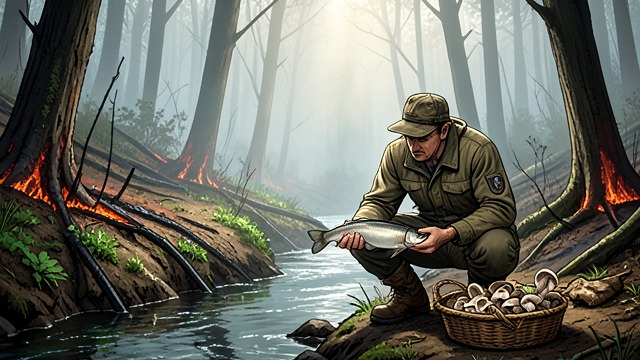
Morel Economy
Edible Renewal
Grainier survives on morels and trout as the burned ground begins to produce new growth. Destruction becomes the condition for a temporary food economy.
The mushrooms are described as flavorful, making survival unexpectedly pleasurable. The valley offers nourishment without restoring the old household.
Human Adaptation
He learns to live with what fire has made available. His survival is therefore ecological rather than heroic.
Changed Soundscape
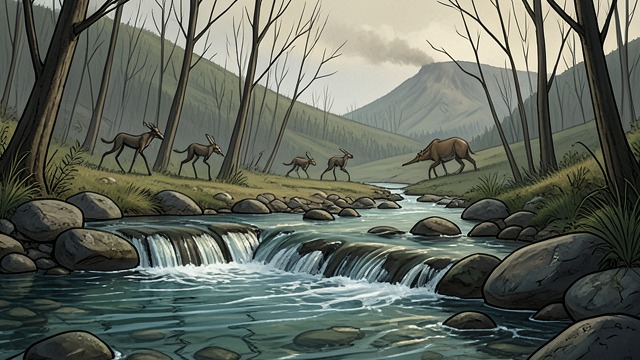
Changed Soundscape
Vanishing Wolves
Grainier hears wolves less often and from farther away, while coyotes increase and rabbits decline. Ecological change is registered through sound as much as sight.
The valley’s animal balance has shifted with the forest. What returns is not a restoration but a new arrangement.
Troutless River
Long stretches of the Moyea River lose their trout. Even the water that remains familiar carries a different life.
late summer 1920
spring 1921
the 1930s
