
The Fire and Its Afterlife
Train DreamsThis flow follows the 1920 Moyea Valley fire from immediate catastrophe through ecological renewal and spiritual reinterpretation.
increasing Bearing strength in each event
 decreasing
Bearing strength in each eventdecreasingApproaching Fire

Approaching Fire
Refugee Town
Grainier returns from work to find Bonners Ferry crowded with people displaced by the fire. Nobody can tell him what happened to his family.
The refugees’ survival produces a disturbing mixture of relief and indifference. Grainier’s private emergency exists inside a public disaster too large to absorb his grief.
Search Through Smoke
He walks toward the cabin through ash, smoke, and dead forest. The journey converts anxiety into a physical encounter with annihilation.
Ashen Homesite
Ashen Homesite
Material Ruin
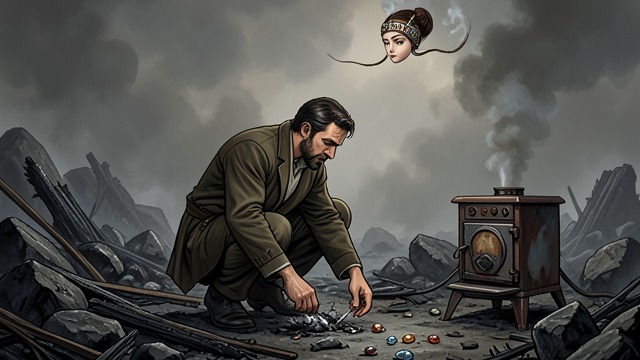
Grainier finds the cabin reduced to ash, a warped stove, and scattered stones. The absence of bodies makes the destruction both conclusive and haunted.
He searches for the Bible and finds no trace of it. The missing book becomes an argument against the protection he once expected from God.
Unstable Consolation
He imagines chocolates scattered across the clearing and sees Gladys Grainier’s bonnet flying overhead. Hallucination becomes a provisional way to remain attached to the lost household.
Green Return
Green Return
New Growth
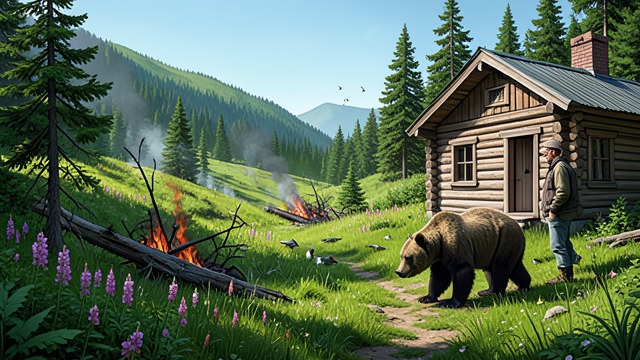
Fireweed, jack pine, flowers, insects, bears, and birds return to the burned valley. The landscape heals without restoring what existed before.
Grainier initially sees himself as nearly alone, then learns that ecological life has already resumed around him. Recovery is impersonal but undeniable.
Rebuilt Dwelling
He raises a second cabin from fire-killed spruce. Rebuilding does not cancel the fire; it gives grief a place in which to continue.
summer 1920
September 1920
spring and summer 1921
