Arn Peeples
Train DreamsArn Peeples is the oldest man in the logging camp and one of its most memorable figures, a frail, shrunken wanderer whose life seems to contain the whole rough mythology of the American frontier. He has worked in Arizona mines, sawed timber across logging country for decades, and now survives among younger men who regard him as both a nuisance and a repository of improbable experience. His final death, caused by a falling branch from a standing larch, gives terrible force to his own knowledge that trees can be friends only until the moment they become killers.
Identity and Background
Arn Peeples came up from the Southwest after working in the mines of Arizona and claimed to have seen and spoken with the Earp brothers in Tombstone, whom he described as “crazy trash.” He also told of having witnessed John Jacob Warren, supposedly the richest man in Arizona, lose his entire fortune after drunkenly wagering the Copper Queen Mine that he could outrun a three-year-old stallion. The logging men had never heard of Warren, but the story suited Peeples’s appetite for spectacular reversals: a powerful man becomes ridiculous, then ruined, and ends reduced to his “drop-bottoms.”
Peeples was not presented as a habitual liar. He made few claims to know famous people beyond the Earp brothers, and his stories carried the uncertain authority of a life spent moving through dangerous, isolated work. He called all his comrades “Minnesota fellers,” although, as far as anyone could ascertain, none of them had ever seen Minnesota. The nickname is characteristic of his speech: affectionate or mocking, casually invented, and detached from ordinary accuracy.
Life in the Logging Camp
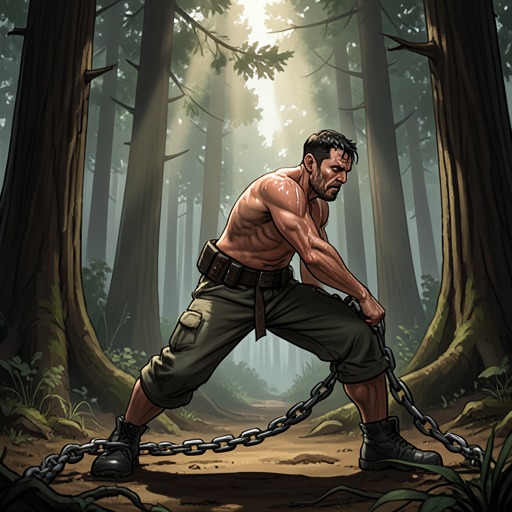
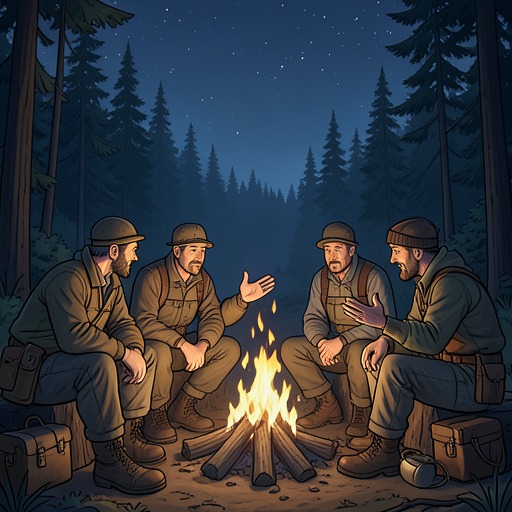
The logging gang worked in a vast operation where thirty-five to more than forty men felled giant spruce, removed branches, cut trunks into eighteen-foot lengths, and hauled them toward the landing. Robert Grainier served as a choker in the woods, looping cables around the logs, and Peeples belonged to the same dangerous world of sawyers, limbers, buckers, horses, steam machinery, pitch, sweat, and shouted warnings. The men worked from sunrise until suppertime and slept close to the place where exhaustion overtook them, in patched tents whose canvas had reportedly once served Union infantry during the Civil War and later the U.S. Cavalry.
Peeples enjoyed proclaiming his fitness for punishing heat. He said, “I’m made for this summer logging,” and contrasted the camp’s weather with his experience near Bisbee, Arizona, where the thermometer reached 116 degrees and, in his formulation, every degree was a foot long. He insisted that there had been no shade even though the temperature was given as a measurement in the shade. His boast makes him comic, but it also places him within the camp’s culture of endurance, where bodily hardship is converted into status and storytelling is another form of labor.
His most recognizable boast concerned the hatchet: “Just let me at that hatchet, boys,” he liked to say, promising that when he began chopping, the chips from the previous day would still be unsettled when the men returned in the morning. Yet Peeples was now too old and frail for sustained hard work. He often stayed out of the way, yammering while the younger men fought the forest. His value lay less in ordinary production than in the specialized knowledge he had accumulated.
Powder Monkey and Camp Rituals
When a tunnel had to be driven through a bluff, Peeples became the powder monkey. He set charges and blasted deeper into the rock, while other men cleared away the rubble after each explosion. He followed exactly the procedures he had learned in the Mule Mountains of southern Arizona, treating established habit as protection against the uncertainty of explosives. His method was practical, but also superstitious: repetition gave danger a ritual shape.
The most revealing instance came when a charge failed to fire. Work stopped throughout the woods, even among men half a mile away, because everyone understood that a dud demanded silence and caution. Peeples emptied his pockets of a brass watch, a tin comb, and a silver toothpick, placed the objects on a stump, and entered the tunnel without looking back. When he returned and turned the screws again, the dynamite finally exploded with a heavy report. The men cheered as dust burst from the tunnel and powdered rock fell over them. The episode makes Peeples both a specialist and a performer: the camp’s collective fear gathers around his solitary return, then releases itself in celebration when he survives.
Death and Aftermath
Peeples’s own death came not through dynamite but through a “widowmaker,” a dead branch falling from a tall larch. The branch struck the back of his head and knocked him senseless. He recovered consciousness and seemed well enough at first, complaining only that his spine felt “knotty amongst the knuckles” and that he wanted to walk “suchways—crooked.” The strange phrases register bodily disorientation without converting it into a clear diagnosis.
Over the next several days he suffered dizzy spells and became dreamy and forgetful. On Sunday he remained in bed with chills and fever. By Monday morning he was dead, lying beneath the covers with the appearance of such comfort that the captain thought the men should lower him into the grave bed and all. The quiet domesticity of the scene contrasts with the violence associated with logging. Peeples had imagined death as smoke, noise, and blasting rock; instead, it arrived from above in a branch and ended in a bed.
The irony is exact. Peeples had warned that a tree could kill even the most skillful sawyer, and he had said that a standing tree might be a friend only when left alone. His death descended from precisely such a tree. The forest is therefore not merely the setting of his death but the agent that completes his own argument about work, danger, and misplaced trust.
At the grave, Peeples’s best friend Billy remembered him as a fundamentally honest man who had never cheated or stolen, not even a piece of candy as a child. Billy turned that plain testimony into a moral lesson about being square with others. The captain, however, could not grant the men a day away from work: the company and the war demanded their labor. Spruce was still urgently needed because of the European war, and the captain believed the armistice was only a pause before renewed slaughter. Peeples’s burial thus becomes inseparable from industrial necessity. Even death cannot fully interrupt production.
Narrative Role and Significance
Peeples embodies the camp’s accumulated memory: Arizona mines, frontier lawmen, ruined fortunes, old military tents, blasting techniques, and the dangers of timber. His stories enlarge the logging camp beyond its immediate geography while also exposing the instability of masculine legend. The men listen to claims that may be unverifiable, yet Peeples’s practical warnings prove more reliable than his historical anecdotes.
His character is built through contradiction. He is a frail old man who boasts of extreme heat, an idler who once possessed formidable working skills, a superstitious technician who handles explosives, and a talker whose final condition leaves him speaking in delirious fragments. The camp knows him through repeated phrases and eccentric assertions, but his death reveals a deeper coherence: every story circles back to risk, chance, and the thin boundary between mastery and catastrophe. Arn Peeples is remembered not because he conquers the forest, but because the forest finally answers him in its own language.