Arn Peeples's death
Train DreamsArn Peeples's death is a logging-camp accident that turns the forest's familiar materials against one of its most experienced workers. A dead branch from a tall larch strikes Arn Peeples across the back of the head, leaving him initially conscious and apparently recoverable but setting in motion a short illness that ends in death. The event fulfills his own warning that a tree might behave like a friend only when left alone: once human work enters the forest, every standing trunk and falling limb can become part of a war against the men who cut it.
Causes and Background
Arn Peeples belongs to the dangerous labor system of the woods, where Robert Grainier works as a choker among sawyers, limbers, and buckers. The crews fell giant spruce, strip the branches, cut the trunks into eighteen-foot lengths, and loop cables around them so horses can drag them toward the landing. At the landing, an old wood-burning Steam donkey operates two iron drums, paying out and winding in cable while logs move toward railroad flatcars and the Robinson Gorge crossing. Arn Peeples knows this environment as both craft and threat. He explains that even an excellent sawyer may judge ninety-nine falls correctly, while the hundredth can send a fifty-ton tree uphill or backward into the worker. He recalls a five-ton log that leapt from a cart and killed six horses, making clear that weight, momentum, and imperfect control govern the camp more decisively than skill alone.
The gang itself numbers between thirty-five and more than forty men, laboring from sunrise to supper while changing the mountainside through felling and bucking. Their bodies absorb the work: pitch sticks in their beards, sweat carries dust into the creases of their necks and joints, and the smell of resin burns the throat and eyes. Arn Peeples is not merely a commentator on this danger. He sets dynamite charges and enters tunnels when a charge fails, placing his brass watch, tin comb, and silver toothpick on a stump before returning into the darkness. The men know that such a failure could kill him in smoke and noise, yet the camp's strongest image of danger is not the explosive accident they anticipate.
What Happens
Arn Peeples is struck across the back of the head by a dead branch falling from a tall larch. The branch is a widowmaker, a name that makes the accident sound both technical and ominously exact. The blow knocks him senseless, but he soon recovers enough to appear almost well. He complains that his spine feels “knotty amongst the knuckles” and says, “I want to walk suchways—crooked.” These bodily fragments register an injury whose seriousness is not immediately visible. He suffers dizzy spells, becomes dreamy and forgetful over the next several days, and then spends Sunday in bed with chills and fever.
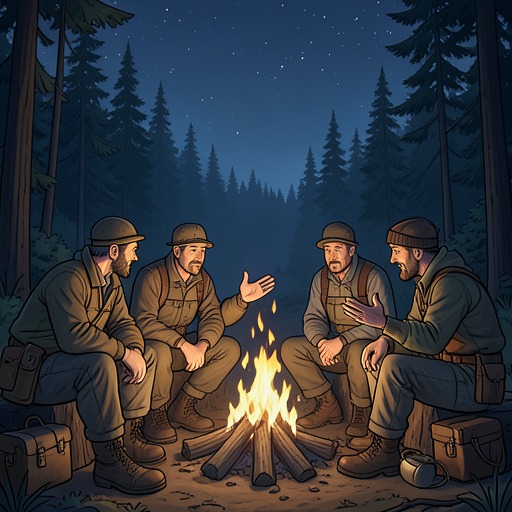
On Monday morning Arn Peeples is found dead in bed, the covers pulled up beneath his chin. The captain describes him as lying in “such a sight of comfort” that the men should lower him into a grave without disturbing the bed. The calmness of this image sharply contrasts with the violent possibilities associated with Arn Peeples's work. The man expected to leave the world in dynamite smoke instead dies indoors, after an apparently survivable blow has quietly altered his brain and body.
Immediate Consequences
Arn Peeples's death is followed by a widening sickness in the camp. His friend Billy speaks at the grave, saying that Arn Peeples never cheated or stole and had lived to a considerable age; the brief eulogy turns his character into a practical moral lesson about being square with others. The captain wants to suspend work for a day, but company demands and the wartime appetite for spruce prevent an extended pause. The laborers therefore bury their companion and return almost immediately to the job that exposed them to the danger.
That night the men reconstruct Arn Peeples's last hours and debate the cause of his decline. They wonder whether the head injury addled his brain or whether the sudden fever was responsible. His delirium produces broken cries such as “right reverend rising rockies!” and “Caution! Caution!”, along with calls to spirits from his past and reports of visits from his sister and her husband, both long dead. The camp's discussion cannot establish a single explanation, so his death remains suspended between physical trauma, fever, memory, and hallucination.
Two days after the burial, twelve-year-old Harold, the captain's son, suffers a dizzy spell while spreading dogfish oil on the skids. His collapse nearly places him beneath the horses and their load, but Robert Grainier pulls him away by the leg of his pants. Harold develops a fever and becomes delirious, while Billy also develops chills and raves through the night, repeatedly calling his own name. The captain concludes that the camp is facing an influenza epidemic and closes the operation. By Sunday the job is shut down, the last logs have been sent down the mountain, and six additional men are ill. On Monday each worker receives a four-dollar bonus and is told to leave.
Memory and Wider Significance
The captain's fear is shaped by his childhood experience of the 1897 influenza, when all thirteen of his siblings died in a single week. Arn Peeples's death thus becomes the first visible point in a chain of sickness that joins accidental injury to epidemic vulnerability. The forest does not kill through one mechanism alone: falling branches, explosives, machinery, animals, fever, and company pressure all belong to the same precarious world of labor. The work continues because the company needs spruce, even though the men are already exposed to hazards that cannot be fully calculated or contained.
Arn Peeples's death also establishes a pattern by which bodily damage remains in Robert Grainier's later life. Grainier survives the camp crisis, but his own working body eventually records the costs of the woods: a wild limb knocks his jaw crooked, his joints deteriorate, and a locked shoulder or unstable knee makes him unfit for timber work. Arn Peeples's widowmaker is therefore not an isolated piece of bad luck. It anticipates the slow accumulation of injury through which logging converts human strength into infrastructure and leaves the worker carrying the forest's violence long after the trees have been moved.
The event's final irony lies in its reversal of Arn Peeples's practical wisdom. He had warned that a tree could treat a person as a friend when left alone, yet his death descends from a standing tree rather than from the charge, tunnel, or log-handling machinery that seemed more obviously lethal. The forest's danger is consequently both spectacular and ordinary: it may erupt in a roar, but it may also arrive as one unnoticed dead branch, followed by dizziness, fever, and a grave that the company cannot afford to contemplate for long.