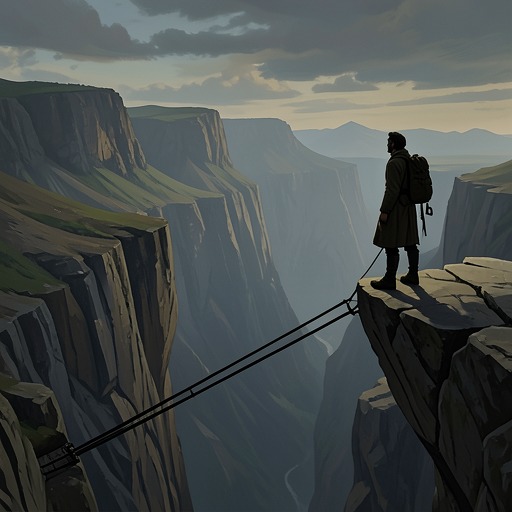
Attempted execution of the Chinese railroad laborer
Train DreamsThe Attempted execution of the Chinese railroad laborer is an episode in which an accusation of theft becomes an improvised lynching at an unfinished railway bridge. Robert Grainier’s brief participation is decisive: although he helps restrain the prisoner, the laborer’s resistance and escape prevent the intended killing, while Grainier’s later remembrance turns the incident into a moral wound that he connects to the destruction of his family and home.
Accusation and Collective Violence
In the summer of 1917, a Chinese laborer was caught, or merely accused, of stealing from the company stores of the Spokane International Railway in the Idaho Panhandle. The uncertainty surrounding the accusation is important because the men act before any impartial judgment appears. Three members of the railroad gang seize the laborer and drag him up the long bank toward the bridge then under construction, a trestle rising above the Moyea River. The company’s authority is represented by Mr. Sears, a member of management, who joins the physical restraint rather than stopping it.
The prisoner’s speech is incomprehensible to the men around him, but his body communicates unmistakably. He twists and ships like an animal trapped in a sack, striking backward with his one free fist at the worker gripping him by the neck. Mr. Sears, pale and exhausted, admits the physical difficulty of reaching the top of the bank. Grainier, seeing the group in distress, lends assistance and takes hold of one of the laborer’s bare feet. His involvement begins less as a declared decision than as an act of entering the group’s labor, yet the labor is already carrying a human being toward a lethal purpose.
The Struggle on the Bridge
The party reaches the middle of the last completed span, about sixty feet above the rapids, and tries to throw the laborer over the side. He defeats their attempt by clinging to their arms and legs, weeping and speaking in what the men cannot understand. The violence becomes confused and contagious. One worker loses his grip and sits gasping in the dirt after being kicked in the eye; another says that the act was only for fun and urges his companion to abandon it. The explanation does not erase the danger. The men’s fear, embarrassment, and commitment to the group combine until the possibility of killing him seems more powerful than the original accusation.
Grainier then takes charge of the prisoner’s free-flailing legs and holds both feet tightly. His declaration, “I’ve got the bastard, and I’m your man!” places him momentarily inside the executioners’ solidarity. The words show not a private hatred of the laborer but a hazardous desire to be useful to the men around him. The scene makes collective violence appear as a work task: the men struggle, exchange orders, lose their footing, and divide physical responsibilities as though they were handling equipment rather than a person.
The laborer finally releases his hold on the men and catches the beam beneath him with one hand. Because his captors are trying to rid themselves of him, he kicks free easily, dangles over the gorge, and begins moving hand-over-hand along the skeleton of the next span. A worker balances on a beam and kicks at his fingers, but the laborer drops from beam to beam through the crosshatched structure like a circus performer. Some of the gang cheer his escape, while others, uncertain why he is being pursued, shout that the villain should be stopped. The contradictory responses expose the group’s unstable justification: even those who no longer understand the charge can repeat the language of punishment.
Mr. Sears removes a large, old four-shot black-powder revolver from his belt and fires all four shots. None has any effect. By then the laborer has vanished. The attempt therefore fails through the prisoner’s physical resourcefulness and the attackers’ confusion, not through any recognized change of heart or intervention by the railway company.
The Bridge, Labor, and Institutional Power
The attempted killing occurs in the same setting that soon becomes a monument to railway progress. Forty-one days later, the first locomotive crosses the 112-foot interval over the sixty-foot-deep gorge on the completed bridge. Mr. Sears stands beside the engine and raises the same four-shooter to signal the crossing. The gun that failed to kill the Chinese laborer is thus also associated with the official inauguration of infrastructure. Its two uses place coercion and industrial achievement within one continuous scene of company power.
The bridge, later called the Eleven-Mile Cutoff Bridge, eliminates a long curve around the gorge and saves the Spokane International Railway from maintaining eleven miles of rails and ties. Its economic purpose is expressed in the language of efficiency, while the earlier assault reveals the human hierarchy beneath that efficiency. A company manager and railroad laborers can treat an accused worker as disposable while building a structure intended to make the railway more profitable and manageable. The unfinished trestle is consequently both a workplace and a potential execution site, showing how industrial infrastructure can connect regions while exposing vulnerable workers to violence.
Grainier is drawn by the scale of such undertakings. After the bridge is completed, he seeks other massive construction and extraction projects, including repairs on the Robinson Gorge Bridge and timber work with the Simpson Company. In the forest, crews of more than thirty-five and sometimes more than forty men fell and buck giant spruce, using horses, cables, rails, and a Steam donkey to transform trees into transportable logs. That labor culture helps explain the episode’s brutal practicality: men accustomed to coordinating bodies, tools, animals, and machinery can carry the same command structure into an act of violence, with the company’s authority present but morally absent.
Memory, Guilt, and Causation
The incident remains fixed in Grainier’s memory. He can recall the exact moment for the rest of his life, and the memory returns alongside his regret over another dying man, William Coswell Haley, whom he failed to help. Years later, as he works as a freighter along the Kootenai River, the image of the Chinese railroad hand he almost helped to kill again paralyzes him. The narrative thus refuses to leave the attempted execution as an isolated adventure. It becomes one of the actions through which Grainier measures his own failure to protect others.
After the 1920 Moyea Valley fire destroys his home and apparently kills Gladys Grainier and Kate Grainier, Grainier gives the earlier assault a punitive meaning. He becomes convinced that the Chinese laborer escaped and called down a curse that incinerated his wife and daughter. He believes the punishment was too great, but the belief nevertheless binds the bridge episode to the later catastrophe. The connection is not established as an objective supernatural fact; it is Grainier’s explanation for an unbearable sequence of guilt, loss, and coincidence. The failed killing survives within him as an unfinished act whose consequences, in his imagination, extend far beyond the bridge.
The later fire’s physical aftermath intensifies this moral association. Grainier walks twenty miles along the Moyea River Road through smoke and ash toward the homesite, finds the valley burned into gray, white, and black silence, and calls repeatedly for Gladys and Kate. Ten days later, he rides the Spokane International through the gutted valley, where the train makes a great noise but cannot awaken the dead landscape. Against this devastation, the laborer’s escape acquires the force of a withheld judgment: the man who was treated as expendable survives, while Grainier’s family disappears without a trace.
Narrative Significance
The episode establishes a pattern in which labor, racialized accusation, and industrial power converge. The Chinese laborer is rendered linguistically unintelligible to the white workers, and that inability to understand becomes part of the justification for treating him as a threat. Yet the laborer is the most competent person in the scene: he resists the restraint, exploits the unfinished bridge’s structure, and escapes the gunfire. His agency interrupts the group’s story about him as a thief and villain.
For Grainier, the event marks the difference between merely belonging to a group and accepting responsibility for what the group does. He begins by helping because the men seem to need assistance, then announces his loyalty while holding the prisoner’s legs. The memory later strips away that situational excuse. His continued remorse shows that the attempted execution is not absorbed into the ordinary violence of railroad work, even though it occurs amid the same gestures of hauling, gripping, balancing, and obeying. The bridge’s inaugural crossing celebrates the finished structure; Grainier’s lifelong recollection preserves the human crisis hidden within its construction.