China Basin
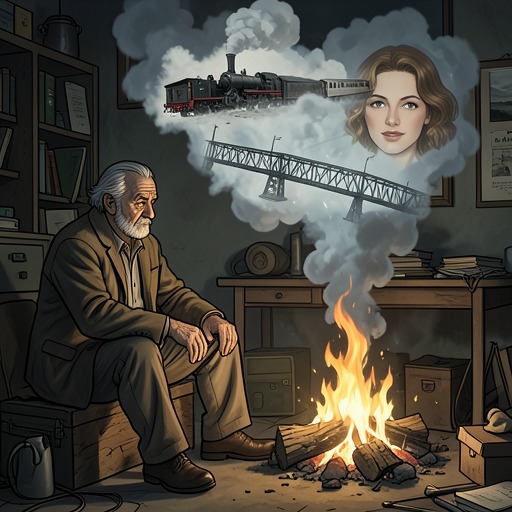
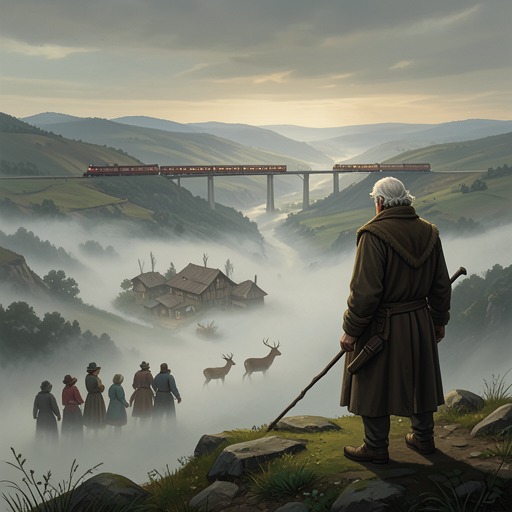
Train DreamsChina Basin is a former Chinese community beside the Kootenai River in Montana, roughly thirty miles west of Troy and Libby. Its history is introduced through the childhood memory of Robert Grainier and later becomes bound to his near-participation in violence against a Chinese railroad laborer, making the place a geographical reminder of how displacement and racial hostility shape the region’s social landscape.
Origins in Expulsion
China Basin emerged after more than a hundred Chinese families were driven from Fry. As a child, Robert Grainier watched the deportation from a street near the Kootenai River: men carrying axes, pistols, and shotguns guarded three flatcars while the families climbed aboard, keeping their children away from the exposed edges. The adults sat at the outer sides of the groups with their knees drawn up and their hands clasped around their shins as the train carried them away.
The destination did not initially matter to Grainier. Only decades later, when he was a grown railroad worker who had come very near killing a Chinese man, did he understand that many of the displaced families had ended up beside the Kootenai River in the place called China Basin. The community therefore enters the narrative as a delayed recognition: a childhood scene of collective removal acquires its full moral significance only after Grainier finds himself implicated in the same racial order that had expelled those families.
A Community Made by Railroad Power
The formation of China Basin is inseparable from the railroad economy that reorganized the Idaho Panhandle. The families were removed through a rail yard, and their movement was accomplished by the same transportation system that later carried Grainier to bridge and logging jobs. Railroad expansion connects towns, workers, and timber markets, but it also serves as an instrument for separating an unwanted population from a settled community.
By the time Grainier was working on bridges, China Basin had dispersed. Only a few Chinese residents remained here and there in the surrounding area, and people were no longer afraid of them. This later quiet does not erase the earlier coercion. Instead, the disappearance of the community makes the consequences of expulsion less visible: a concentrated population has been scattered, and the absence of open fear can be mistaken for social resolution.
Connection to the 1917 Violence
China Basin casts a retrospective shadow over the 1917 attempt on the life of a Chinese laborer accused of stealing from the Spokane International Railway company stores. Grainier joined three railroad men who dragged the prisoner up the long bank toward a bridge under construction above the Moyea River. The group intended to throw him from the trestle, and when he escaped along the unfinished bridge structure, Mr. Sears fired a four-shot black-powder revolver at him without effect.
Grainier’s participation is marked by both physical commitment and startled self-recognition. He seized the laborer’s feet while the men struggled to restrain him, then tightened his hold and declared himself part of the group. The scene turns the historical background of China Basin into an immediate ethical crisis: the displaced community is not merely part of the region’s past, because the violence that produced it remains available in the conduct of ordinary workers.
The laborer’s rapid speech is treated by the white workers as incomprehensible and terrifying, while his resistance is visible in precise physical actions: he twists, strikes backward, clings to the men’s limbs, grabs a beam, and moves hand-over-hand along the bridge. The contrast between his intelligible struggle for survival and the workers’ confused explanation that the attack was “just for fun” exposes the instability of their justification. China Basin thus stands behind a scene in which racial othering turns a person into a target while collective fear and group excitement make attempted murder seem permissible.
Later Echoes Along the Kootenai
China Basin belongs to a wider network of Kootenai River settlements and crossings repeatedly altered by extraction, fire, and rail traffic. Grainier’s later work takes him through bridges and logging operations in the region, where large gangs reshape mountainsides and railways carry timber away. The same infrastructure that displaced Chinese families also supports the industrial transformation of the surrounding forest and valley.
The region’s Native presence remains visible in later episodes involving Kootenai people. Kootenai Bob lives near the railway and dies after lying unconscious across the tracks, where several trains pass over him. His people then search the right-of-way for fragments of his body and collect what they find in painted leather pouches for burial. The railway is therefore both a connective system and a site of catastrophic vulnerability, while the careful recovery of Bob’s remains contrasts with the earlier treatment of the Chinese laborer as disposable prey.
At a fairground in Bonners Ferry, two Kootenai women display wolfish pups and a bobcat, and a passerby dismisses one pup as a dog-of-wolf that will never be Christianized. Such encounters show that the area’s Indigenous and mixed communities continue to be viewed through racialized and fantastical descriptions. China Basin’s history is part of this larger pattern in which minority communities are made visible as curiosities, threats, or remnants while their own histories are largely narrated by others.
Historical and Narrative Significance
China Basin is less a fully described town than a remembered consequence of forced migration. Its importance lies in the connection between a childhood spectacle, a later act of anti-Chinese violence, and the eventual dispersal of the community. The place gives geographical form to the book’s recurring movement of people through railroad corridors: families are deported, laborers are recruited and endangered, and communities are scattered as companies and settlers reorganize the land.
The location also complicates any simple story of frontier progress. Railways, bridges, and timber operations bring movement and employment, yet they depend on coercion, racial hierarchy, and the conversion of inhabited landscapes into industrial routes. China Basin remains significant precisely because its later disappearance does not signal that the underlying violence has ended; it records how a community can be removed, dispersed, and gradually transformed into an obscure place-name while the institutions that enabled its removal continue to structure the region.