Dog-of-wolf hybrids
Train DreamsDog-of-wolf hybrids occupy an uncertain border between the domestic animal and the wolf pack. They first appear when Robert Grainier’s wandering red-haired female dog returns to his camp, settles in a corner of his cabin, and gives birth to four pups that look markedly wolfish. The hybrids are not presented as a stable species with a settled identity. Instead, their appearance prompts competing accounts: a Kootenai rule about wolf reproduction, Grainier’s hope that one pup truly carries wolf blood, and later stories that turn mixed animals into agents of supernatural menace.
Origin and Local Knowledge
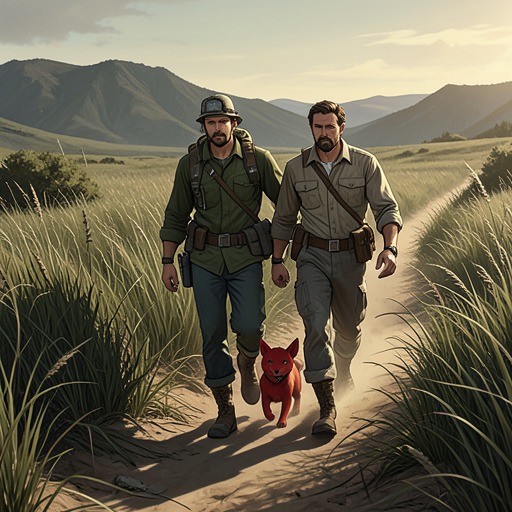
The possibility of a dog-of-wolf begins with the red dog’s unexplained mobility. After accompanying Grainier intermittently through his post-fire camp, she wanders for days at a time, then returns to whelp four pups. Three leave almost immediately after weaning, while one clumsy male remains with its mother. Grainier is convinced that this surviving pup was sired by a wolf, although the narrative supplies no biological confirmation. Its wolfish appearance is therefore an observation, while its ancestry remains an interpretation shaped by the animals’ movements and the surrounding wilderness.
Grainier takes the question to Kootenai Bob, a longtime acquaintance who is sober, dependable, and familiar with local knowledge. Bob explains that the Kootenai people hold that only one pair in a wolf den produces pups: the chief male alone mates, and the she-wolf he selects is the only female in the pack to come into heat. Grainier proposes that the red dog might have encountered the chief wolf at precisely such a moment. Bob does not dismiss the possibility. He allows that the mating might have happened because of its novelty, then names the result a dog-of-wolf and suggests that Grainier may have started his own pack. The hybrid thus enters the story through conversation, not scientific proof: it is a creature produced jointly by animal behavior, remembered custom, and human speculation.
The Surviving Pup and the Failure of Domestication
The surviving male seems to possess the appearance of wolf ancestry without displaying the expected social behavior. At dusk, wolf packs call from the surrounding mountains, including distant ranges on the British Columbia side, but the pup never whimpers in response. Grainier decides that the animal must be taught its own nature. He kneels beside it and howls; when the pup remains seated, with a small pink tongue protruding from its closed mouth, Grainier howls again by himself across the gorge and the nearly invisible river.
The lesson fails as a lesson in wolf identity but succeeds as an emotional ritual for Grainier. He continues howling whenever the distant packs begin, not because the pup has learned to answer, but because the act relieves something heavy in his heart. The human voice joins the wolves in a private evening chorus, while the hybrid remains silent. The scene reverses the expected hierarchy: the supposedly mixed creature does not recover a wild nature, whereas the bereaved man temporarily enters an animal register to release his grief.
Kootenai Bob interprets Grainier’s howling as evidence of the danger of proximity between humans and wolves. He repeats the saying, "There’s not a wolf alive that can’t tame a man." The saying makes the hybrid significant even before it performs any extraordinary action. It suggests that taming runs in both directions and that contact with the wild may alter the human observer as much as the animal. Before autumn, the pup disappears. Grainier hopes it has crossed into Canada to join its brothers, but he must also imagine the ordinary dangers of the wild: a hawk or coyotes may have killed it. Its disappearance leaves the animal’s nature unresolved rather than confirming either its wolfhood or its survival.
From Hybrid Animal to Wolf-People
Later accounts enlarge the dog-of-wolf from a doubtful animal cross into a whole vocabulary of boundary creatures. Peterson, a surveyor for the Spokane International Railway, tells Grainier that his own dog vanished for thirteen days after escaping through a window and working its way from the porch to the yard and then into the woods. When it returned, it was nearly wild and scarcely recognized its owner. Peterson attributes the change to contact with the wolf-girl and says that the dog had been confabulating with her. In this account, a dog’s altered behavior becomes evidence of communication between domestic animals and a wolf-human world.
Kootenai Bob intensifies Peterson’s fear by examining the dog closely and claiming to see the wolf-girl’s image in the black of its eyes. He advises Peterson to shoot it before it brings the wolf-girl into his home and leaves him vulnerable to wolves. Peterson follows the logic of the warning when he tries to subdue the animal with a rifle. The dog slips its rope, backs away from him with deliberate-seeming knowledge of his intention, and then knocks him down when he swings the rifle by its barrel. The gun fires, striking Peterson in the shoulder and chest. The dog-of-wolf is therefore associated not simply with wildness but with intelligence that exceeds ordinary training and turns human violence back upon its wielder.
Peterson’s story also supplies the hybrid with a reproductive and religious mythology. He reports that the wolf-girl was seen leading a pack and that one witness described a bloody mass hanging between her legs. Bob speculates that it might have been an afterbirth or part of a wolf child torn from her womb. The story fuses animal reproduction with human birth, making hybrid offspring the imagined consequence of a creature who cannot be placed securely as woman, wolf, or person. The Kootenai vocabulary cited in the conversation includes animal people such as coyote-person and bear-person, while white speakers turn related possibilities into half-wolves, wolf-people, monsters, and signs of demonic influence.
Rumor, Display, and Social Fear
The rumors surrounding the wolf-girl and possible hybrid pups circulate through witnesses, travelers, and public talk rather than through direct communal knowledge. A sheriff examines several people who claim to have seen the creature and finds them frank and sober. Their testimony leads him to judge the creature female, but the judgment does not settle the matter. Instead, it generates fears that she will whelp more hybrid pups and that the resulting wolf-people will attract the Devil and bring evil over the valley. The imagined remedy is extreme: fire and blood are said to be the only means of purging the region. The hybrid becomes a projection surface for anxieties about reproduction, racial and cultural boundaries, religious difference, and the loss of control over the landscape.
The social force of these stories is temporary and opportunistic. During election season, political controversies concerning the silver standard and railroad land seizures displace the mysteries in the hills. The rumors do not disappear because they have been disproved; they simply lose public attention. Their circulation reveals a community that can transform uncertainty into a moral emergency, then redirect its attention when another public controversy becomes more useful.
A later fairground scene gives the hybrid a commercial and theatrical form. Grainier encounters two Kootenai women displaying very wolfish pups in a feed sack alongside a bobcat in a willow cage. A departing spectator dismisses one dog-of-wolf as an animal that will never be Christianized. The remark converts mixed ancestry into a problem of religious and cultural assimilation. The pups are exhibited as curiosities, while the surrounding language makes them evidence of a contested boundary between the Christian social order and animals imagined as pagan, witchy, or beyond divine creation.
Ecological and Narrative Significance
The dog-of-wolf hybrids belong to a landscape where animals continually cross human expectations. After the Moyea Valley fire, wolves answer one another across the peaks, bears outnumber people on the roads, and the red dog survives on goat’s milk, fish heads, and whatever she can catch. Later the wolves grow less frequent and retreat farther away, while coyotes multiply and rabbits diminish. Against this ecological change, the hybrid is an emblem of unstable animal relations: domestic dogs accompany human survivors, wolves mark the recovering wilderness, and mixed offspring expose the impossibility of keeping those worlds entirely separate.
The book repeatedly places the hybrid beside other stories of animal intelligence and animal-human contact. A prospector survives an explosion because his dog seeks help, and Peterson is shot by his own dog after trying to beat it. A wolf-boy appears as part of a 1935 theater show, wearing a fur mask and a costume that only appears to be fur. These episodes shift the dog-of-wolf between lived encounter, local legend, sideshow performance, and fearful testimony. The creature’s power lies less in a confirmed supernatural identity than in the way different observers use it to explain what they cannot comfortably classify.
The surviving pup’s silence finally matters as much as its wolfish appearance. Grainier wants it to become what he believes it is, but the animal refuses the expected call of the pack and disappears without a witnessed fate. The hybrid therefore remains a failed domestication and an incomplete return to the wild. It does not resolve the boundary between dog and wolf, animal and person, or nature and culture. Instead, it preserves that boundary as a question embodied in fur, behavior, rumor, and the human need to name what belongs nowhere completely.