Eleven-Mile Cutoff Bridge
Train DreamsEleven-Mile Cutoff Bridge is a railway trestle over the Moyea River gorge and one of the defining structures in Robert Grainier’s working life. Its first locomotive crossing turns months of dangerous labor into a public triumph, yet Grainier’s unexplained sadness at the moment of success gives the bridge a double significance: it is both an emblem of collective engineering and a reminder that industrial progress is built through exhausting, hazardous work and the reshaping of the natural world.
Construction and Physical Setting
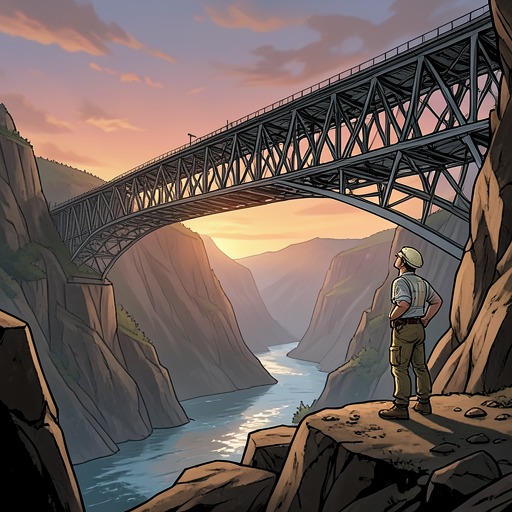
Forty-one days before the inaugural crossing, Robert Grainier and the railroad gang had been building across a gorge where 112 feet of air separated the sides and the river lay 60 feet below. The bridge eliminated a long curve around the gorge and through an adjacent pass, saving the Spokane International Railway the burden of maintaining an eleven-mile stretch of rails and ties. Its name, Eleven-Mile Cutoff Bridge, therefore describes not merely its location but its economic function: the structure shortened the railway’s route and reduced the infrastructure that the company had to maintain.
The bridge belonged to a system of railway construction that made apparently impassable terrain available to industrial movement. Grainier’s work on it exposed him to the scale of such undertakings and awakened a lasting desire to participate in projects that cleared portions of the forest and suspended massive wooden trestles over chasms. The bridge thus marks the beginning of his attraction to large engineered structures, a fascination that later took him to the Robinson Gorge Bridge repair project.
First Locomotive Crossing
The inaugural crossing is staged as a carefully controlled collective performance. Grainier stood among the railroad gang while Mr. Sears stood beside the single locomotive and raised a four-shooter as the signal to begin. At the sound of the gun, the engineer released the brake, jumped out, and allowed the machine to proceed very slowly across the tracks and over the Moyea River. A second man waited at the far side to jump aboard and stop the locomotive before it reached the end of the track.
The crossing depended on coordinated human action as much as on the bridge itself. The locomotive moved cautiously over the open depth, while the waiting worker provided the final safeguard against its running beyond the completed line. When the machine reached the other side, the men shouted, cheered, and whooped. Their celebration registers the bridge as a communal achievement rather than the accomplishment of a solitary engineer or company official.
Robert Grainier joined the cheering, but he also felt sad and could not explain why. The emotional contradiction unsettles the scene’s apparent triumph. The bridge has fulfilled its practical purpose, yet its success does not produce uncomplicated happiness. The workers’ celebration and Grainier’s sorrow occupy the same moment, making the crossing an image of progress that contains an unspoken cost.
Labor and Industrial Network
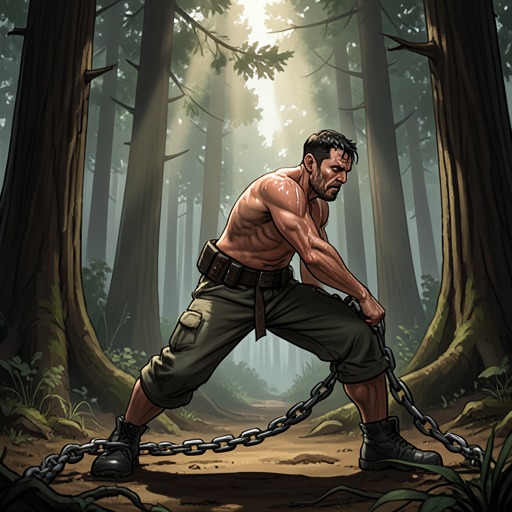
The bridge was the visible result of a wider labor process. Grainier’s railroad work led him toward the timber operations of the Simpson Company, where more than forty men, and never fewer than thirty-five, fought the forest from sunrise until suppertime. They felled giant spruce, stripped the limbs, cut the trunks into eighteen-foot lengths, and used six-horse teams to bring the logs within reach of the railway landing. The gang’s labor changed the mountainsides as decisively as the bridge changed the route through the gorge.
At the landing, an old wood-burning Steam donkey operated two iron drums, one paying out cable and the other winding it in. The machine dragged logs toward the railway while sending out its hook for the next choker. Flatcars then carried the timber across the Robinson Gorge and down the mountain toward the railway network linking the region with the rest of the continent. The Eleven-Mile Cutoff Bridge therefore belongs to a material chain in which forests, bodies, animals, engines, tracks, and bridges were organized into the movement of timber and the expansion of transportation.
The work was physically punishing and dangerous. Pitch clung to the workers’ beards, sweat washed dust from their clothing and packed it into the folds of their bodies, and the smell of resin irritated their throats and eyes. Arn Peeples warned that a tree could kill a skilled sawyer even after ninety-nine accurate judgments about how it would fall; once the blade entered the wood, he said, the worker had a war on his hands. His own death, struck by a falling branch known as a “widowmaker,” confirms the danger that his warnings had described. The bridge’s solid appearance thus rests on a labor environment in which industrial achievement and sudden death are inseparable.
Later Bridges and Historical Memory
The Eleven-Mile Cutoff Bridge became the first of several railway bridges on which Grainier worked. In 1920, he joined repairs on the Robinson Gorge Bridge in northwestern Washington, a larger and older structure spanning a gorge 208 feet deep and 804 feet wide. That bridge was nearly thirty years old, wobbly, and terrifying; no one even rode the log cars across it, and the brakeman had to catch the car at the far end. Compared with the Eleven-Mile crossing, the Robinson Gorge structure shows that monumental infrastructure does not permanently conquer danger. Bridges age, become unstable, and require renewed labor.
Decades later, in 1962 or 1963, Grainier watched young ironworkers on a new trestle where U.S. Highway 2 crossed the deepest gorge of the Moyea River. The new highway went straight across the chasm several hundred feet above the river, replacing the old road’s long detour to a shallow crossing. The young workers tossed their hard hats onto a safety net thirty or forty feet below and jumped after them, while Grainier remembered his own years on girders and recognized that his aging body could no longer climb as it once had. The newer trestle allows him to measure the passage of time through successive forms of infrastructure: the bridge he helped build, the bridge he repaired, and the highway bridge observed from the ground.
Route, Disaster, and Significance
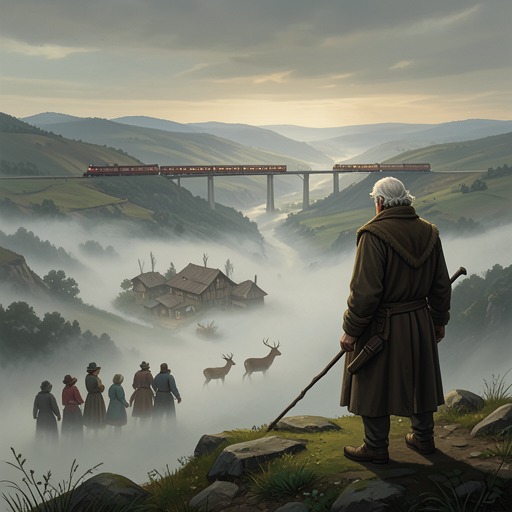
The bridge’s meaning extends beyond construction because the railway also carries people through a landscape exposed to disaster and death. When the 1920 Moyea Valley fire destroyed the valley, the Spokane International Railway stopped at Bonners Ferry until the blaze subsided and rain soaked the Idaho Panhandle. Ten days later, Grainier rode the train through the burned valley, seeing a black and motionless world beneath a vivid evening sky. The train made a great noise but could not wake the dead landscape. Railway movement continued, but it could not restore the homes, animals, plants, or family that the fire had taken.
The railway could also become a death scene. In 1930, Kootenai Bob, intoxicated during the United States Prohibition, wandered onto the tracks and was run over by four or five trains. His remains were scattered along a quarter mile of right-of-way before members of his people gathered fragments that the crows had left. The tracks and bridges that organize commerce and travel therefore remain vulnerable to human loss; the same transportation system that carries workers and goods can also expose bodies to mechanical violence.
The bridge’s influence persists in Grainier’s later mobility. His work as a freighter took him along Highway 2 to communities without close railway access, and one journey began with a rendezvous in Troy, Montana, before he and Eddie Sauer traveled toward Noxon, Montana, with horses, a wagon, and a Ford Model T. The contrast between horse transport, automobiles, railways, and bridges places the Eleven-Mile Cutoff Bridge within a long history of rural modernization rather than presenting it as an isolated marvel. It is a practical shortcut, a monument to collective labor, a gateway for timber and people, and a structure whose triumph is shadowed by the violence and impermanence surrounding it.