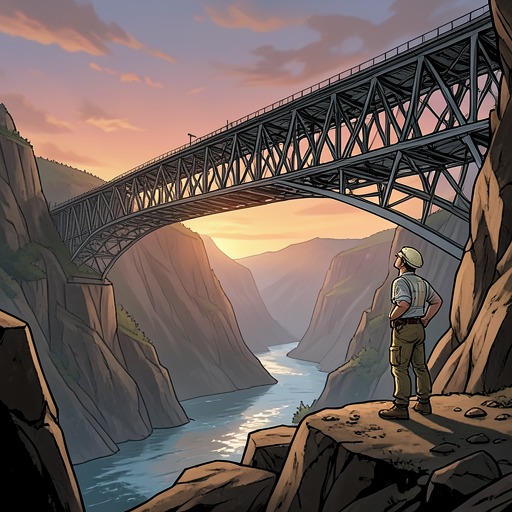
Eleven-Mile Cutoff Bridge First Locomotive Crossing
Train DreamsEleven-Mile Cutoff Bridge First Locomotive Crossing marks the moment when Robert Grainier and his railroad gang transformed a previously impassable gorge into a functioning railway route. Forty-one days after the bridge work was completed, a single locomotive crossed the 112-foot span above a gorge 60 feet deep, inaugurating a structure that shortened the Spokane International’s route by eliminating an eleven-mile curve around the gorge and through an adjacent pass. The event is outwardly triumphant, but Grainier’s unexplained sadness gives the ceremony a durable ambiguity: the bridge is a human victory over distance and terrain, yet its achievement cannot be separated from the labor and danger that made it possible.
Construction and Purpose
The bridge was built to replace a longer route around the gorge. Its name, Eleven-Mile Cutoff Bridge, refers to the eleven-mile stretch of rails and ties that the new crossing allowed the Spokane International to avoid maintaining. The project therefore had a precise economic and logistical purpose: it reduced the railway’s obligations while making a direct passage across the Moyea possible. The bridge’s value lay not only in its physical span but in the network of labor, transport, and maintenance costs that it reorganized.
The crossing also belongs to Robert Grainier’s attraction to large public works. After witnessing the locomotive pass over the completed bridge, he became hungry to join other undertakings in which swarms of men cut away sections of forest and assembled enormous trestles over chasms. In 1920 he went to northwestern Washington to help repair the Robinson Gorge Bridge, an even more daunting structure spanning a gorge 208 feet deep and 804 feet wide. That later bridge was nearly thirty years old, wobbly, and so frightening that neither passengers nor even its engineer rode the cars across; the brakeman caught the train at the far end. The Eleven-Mile crossing thus becomes the first major instance of a pattern in Grainier’s working life: infrastructure fascinates him precisely where scale and danger meet.
The Crossing
The inaugural passage took place with Grainier standing among the railroad gang. Mr. Sears stood beside the locomotive and raised a four-shooter as the signal to begin. At the gunshot, the engineer released the brake, jumped out of the machine, and let the single engine move very slowly over the tracks. The workers shouted the locomotive onward as it crossed the Moyea and approached the end of the newly laid line, where a second man waited to board and stop it before it ran out of track.
The action is carefully collective rather than heroic in the individual sense. One man gives the signal, another handles the brake, the machine proceeds under supervision, and the waiting worker prevents it from overshooting the track. The gang’s cheering supplies the emotional surface of the scene: the men shout, whoop, and celebrate the bridge they have made. Grainier joins them, cheering and hollering even though he cannot explain why he feels sad. His participation and his inward disquiet occupy the same moment, preventing the crossing from becoming a simple celebration of progress.
Labor Behind the Machine
The bridge’s brief crossing condenses a much longer process of organized physical labor. Grainier’s experience on the Eleven-Mile Cutoff leads him toward work where men remove portions of the forest and construct massive wooden trestles in spaces that seem impossible to bridge. The later logging operations show the material system supporting such railway projects: men fell spruce, strip the branches, cut the trunks into eighteen-foot lengths, and loop cables around them so six-horse teams can drag the logs within reach of the railway landing.
At the landing, a giant wood-burning steam donkey uses one iron drum to pay out cable and another to wind it in, hauling logs toward the landing while sending out its hook for the next choker. The railroad flatcars then carry the timber across Robinson Gorge and down the mountain toward the continental railway connections. This machinery reveals the bridge not as an isolated object but as part of a chain joining forests, horses, cables, steam power, railway cars, and distant markets. Grainier’s later hauling work along Highway 2 extends the same pattern into another form of transport: when communities lack close railway access, he uses a team and wagon to move goods between them.
The work exacts a bodily price. In the logging camps, gangs sometimes contain more than forty men and never fewer than thirty-five, laboring from sunrise until suppertime while felling and bucking giant spruce. Pitch sticks in their beards, sweat carries dust into the creases of their necks and joints, and the odor of pitch abrades throats and stings eyes. The men sleep almost where they fall, most in heavily patched tents whose canvas originally came from Union infantry tents used during the Civil War. The crossing’s controlled spectacle therefore rests on a labor regime in which danger, exhaustion, and old equipment are absorbed into the background of industrial achievement.
Risk and Aftermath
The bridge inaugurates a form of progress that repeatedly exposes workers to sudden death. Arn Peeples warns that even a skilled sawyer can judge a tree’s fall correctly ninety-nine times and be killed on the hundredth. He recalls a five-ton log jumping from a cart and tumbling over six horses, killing all of them. His conclusion is that once the blade bites into a tree, the work becomes a war. The bridge crossing does not itself produce a death, but its significance is shadowed by this surrounding knowledge of how quickly construction and extraction can turn lethal.
Arn Peeples’s own death makes that danger brutally literal. A dead branch from a tall larch, a snag known as a widowmaker, strikes him across the back of the head. He briefly seems to recover, then suffers dizziness, fever, and delirium before being found dead in bed, covered up to the chin. His death comes from the very forest the men are transforming, demonstrating that the natural world is not merely raw material or scenery but an active source of unpredictable violence. At his burial, the captain says the men cannot stop work because the company and the war require spruce; the demand created by the war in Europe continues to govern the camp even after the armistice.
The infrastructure celebrated by the crossing also becomes a route through catastrophe. In the summer of 1920, Grainier returns from the Robinson Gorge job with four hundred dollars and travels through Coeur d'Alene, Idaho, and the Panhandle toward his home, only to find the Moyea Valley consumed by fire. The same railway system that carries him toward home also stops in Bonners Ferry until the blaze subsides and rain soaks the Panhandle. He walks twenty miles along the Moyea River Road through ash and smoke, then later rides the Spokane International through the burned valley. The train makes a great noise through the black, motionless landscape but cannot awaken the dead world below it. The bridge’s promise of connection is therefore set against the railway’s inability to restore what industrial and natural forces have destroyed.
Railway lines also become scenes of death. In 1930, Kootenai Bob, drunk after being deceived into believing that lemonade would cancel the effects of beer, wanders onto the tracks and is run over by four or five trains. By the following afternoon, crows have drawn attention to his remains, which are scattered for a quarter mile along the right-of-way. Members of his people collect fragments of flesh, bone, and cloth in painted leather pouches for burial. The railway that enables crossings, timber transport, and Grainier’s own travel thus carries a recurrent double meaning: it binds distant places together while exposing people to the force and indifference of the machines moving along it.
Narrative Significance
The first locomotive crossing changes Grainier’s relation to work. He feels sorrow without knowing its cause, yet the spectacle also awakens a lasting desire to participate in projects of still greater size. That mixture becomes characteristic of his life: he is drawn to undertakings that promise order, connection, and achievement, while remaining vulnerable to the loneliness, bodily damage, displacement, and death embedded in them.
The event also establishes a contrast between the machine’s slow, carefully supervised movement and the immense consequences of the system it represents. The locomotive crawls across the bridge while men shout it onward, but the bridge immediately alters the railway’s geography and maintenance burden. Later, the same regional network carries timber from forests, supports the movement of refugees and travelers, and becomes the site where Kootenai Bob is killed. The crossing is consequently neither a self-contained engineering success nor a purely personal memory. It is the visible beginning of an infrastructure that reorganizes labor, landscape, mobility, and mortality across the Moyea region.