Fry, Idaho
Train DreamsFry, Idaho is the formative town of Robert Grainier’s childhood and the first landscape through which the narrative connects an individual life to the larger upheavals of the Idaho Panhandle. It is a place of arrival, forced departure, flood, schooling, and memory: Grainier reaches it as an abandoned or displaced child, witnesses the expulsion of Chinese families from its railroad yard, and carries the town’s unresolved history into his adult encounter with racial violence.
Arrival and Uncertain Origins
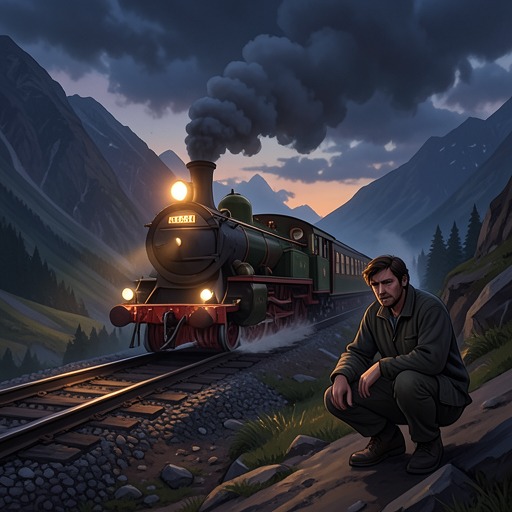
Fry, Idaho is where the six- or seven-year-old Robert Grainier disembarks after several days on the Great Northern Railroad. The details of his birth and parentage are already obscure: he may have been born in 1886 in Utah or Canada, and no one ever tells him what happened to his original parents. His destination is pinned to his chest on the back of a store receipt, and although conductors feed him after he consumes his provisions on the first day, the journey soon becomes indistinguishable from the forgetting that governs his earliest life.
He arrives to join relatives whose accounts of him do not agree. One cousin says he came from northeastern Canada and spoke only French; two others insist he was a Mormon from Utah. Even the family relationship is unstable, since one cousin denies being his cousin while another identifies their mother as Grainier’s aunt. In Fry, the child enters a new household without a settled history or a reliable name for his origins. He calls his uncle Robert Grainier, the First, Father, and by the time he thinks to ask his aunt and uncle who he is, both have died.
A Town of Expulsion and Flood
Grainier’s earliest memory in Fry is not domestic but public and political. Standing beside his uncle near the Kootenai River, he watches the mass deportation of a hundred or more Chinese families. At the Bonner Lumber Company railroad yard, men armed with axes, pistols, and shotguns supervise the families as they climb onto three flatcars, herding their children toward the center of the open cars. The scene makes the town a place where racial belonging is enforced through organized intimidation and removal.
Most of the expelled families eventually settle about thirty miles west, in Montana, between Troy and Libby, in the riverside area later known as China Basin. By the time Grainier works on bridges, that community has dispersed and only a few Chinese residents remain in the surrounding region. The memory nevertheless persists as a hidden prehistory to his adult participation in the 1917 Chinese Railroad Worker Killing Attempt. The child who watches Chinese families driven away from Fry later comes very near killing a Chinese laborer himself, making the town an origin point for a moral and historical continuity that Grainier only understands decades afterward.
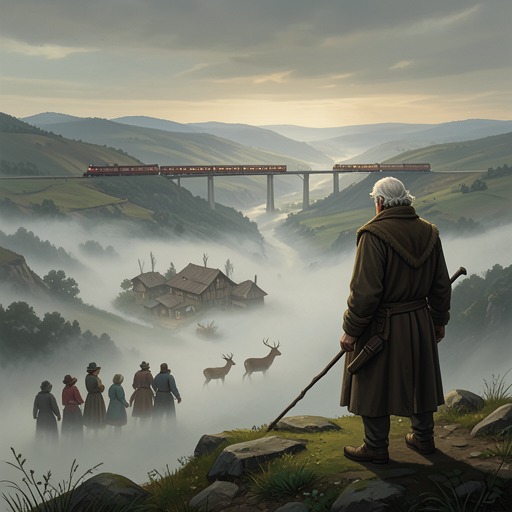
The Kootenai River also defines Fry through its periodic violence. Grainier remembers a flood that breaks over the banks and inundates the lower town. Frail structures wash away, while the post office is undermined and carried downstream. He recalls being lifted by someone, perhaps his father, above the heads of a crowd so that he can watch the building sail away. Canadians later find the post office stranded on lowlands a hundred miles downriver in British Columbia. The town’s institutions therefore appear as vulnerable and movable as its people: families are deported by rail, and the post office is carried off by water.
Family, School, and Early Formation
Grainier lives in Fry with his new family and attends the Bonners Ferry schoolhouse after Fry and Eatonville are combined under the name Bonners Ferry in 1899. He is never a scholar, but he learns to decipher writing and handle numbers, abilities that help him make his way in the world. The education is practical rather than transformative, giving him enough literacy for survival without altering his marginal position.
After the deaths of his aunt and uncle, he lives during his teens with his eldest cousin Suzanne and her family. He leaves school in his early teens and, with no parents remaining to discipline him, becomes a layabout. The transition reveals how little institutional or familial structure surrounds him. Fry provides a household and a school, but neither supplies a complete account of his past or a stable direction for his future.
Railway Violence and Historical Continuity
Fry’s railroad yard and river setting anticipate the later bridge scene in which Grainier assists a group of Spokane International Railway workers and managers who accuse a Chinese laborer of stealing from the company stores. The men drag the prisoner toward a bridge under construction above the Moyea River, and their initial intention hardens into an attempt to throw him from the trestle. Grainier holds one of the laborer’s feet, then both, even declaring himself aligned with the men as he struggles to restrain him. The laborer escapes by clinging to the beam and moving downward across the unfinished structure while Mr. Sears fires a four-shot black-powder revolver without effect.
The contrast between Grainier’s childhood witness and his adult action is central to Fry’s significance. The town’s earlier expulsion of Chinese families is presented as a collective public act, while the later attempted killing unfolds among laborers, company authority, and a watching gang. In both cases, rail infrastructure serves as the mechanism that reorganizes people: it carries deported families away, brings Grainier into Idaho, and supplies the bridge from which the accused laborer is nearly thrown.
Memory, Community, and Disappearance
Fry remains part of a wider network of places connected by the Kootenai River and the railway. Kootenai Bob later dies beneath successive trains near Meadow Creek, and the Great Northern Railway slows and sounds its whistle so that the Kootenai people can search the tracks for fragments of his body. The river and railway thus carry two recurring forms of displacement through Grainier’s life: water scatters buildings, families, and communities, while trains transport children and laborers and finally reduce a man’s remains to a quarter-mile stretch of right-of-way.
The town also remains a site of changing visibility. The Chinese community once expelled from Fry becomes dispersed, and later Chinese residents are no longer feared in the same way. Yet the narrative does not present this disappearance as resolution. Fry’s social order is built through the removal of people whose presence had been treated as intolerable, while Grainier himself begins there as a child whose own origins have been removed from communal memory. Its decisive importance lies in that parallel: Fry is both the place that receives him and the place that teaches him, before he can understand it, how belonging is made by exclusion.