Grainier's 1927 Biplane Flight
Train DreamsGrainier's 1927 Biplane Flight is Robert Grainier's first and only journey through the air, undertaken at a county fair after his working life in the woods has begun to close. For four dollars, he accepts a ride in a fragile biplane and is carried from the familiar scale of roads, rails, horses, and wagons into a realm where the earth tilts, the stomach lags behind, and memory briefly gathers what ordinary life has left scattered. The flight ends safely, but its deepest consequence is inward: during the plane's plunge, Grainier sees Gladys and Kate, glimpses an unremembered childhood, and feels that the mysteries of his life have momentarily answered themselves.
Circumstances and Decision
Grainier takes the flight after riding the Great Northern to Spokane with nearly five hundred dollars in his pocket, enough to pay off the team and wagon he has acquired. He visits the county fair, expecting diversion, but his first decision there proves consequential: in a field, two men from Alberta have parked an airplane and are selling rides for four dollars a passenger. The price is high, and few people volunteer, yet Grainier cannot resist the opportunity. The ride becomes an interruption in a life otherwise defined by manual labor, freight hauling, and cautious movement along roads and railways.
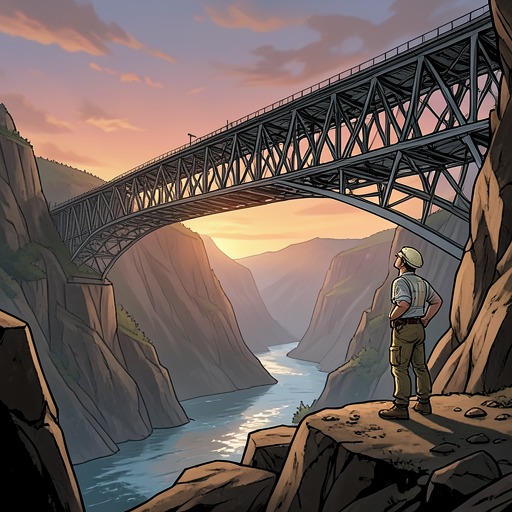
The decision also belongs to a larger pattern in Grainier's experience. He has worked on the Eleven-Mile Cutoff and the Robinson Gorge Bridge, among undertakings that transform forests and chasms through collective labor. In the woods, the Simpson Company moves timber with horses, cables, rails, and the immense Steam donkey; the gang's work changes mountainsides through coordinated physical effort. The airplane presents a different technological scale. Grainier is not building it, driving it, or using it for work. He is simply placing his body inside an unfamiliar machine and consenting to be lifted beyond the ground that has always measured his life.
The Aircraft and the Ascent
The pilot is a young Albertan, no more than about twenty, dressed in a brown oversuit with metal buttons. He gives Grainier goggles and helps him aboard, telling him, “Climb on over. Get something under your butt,” a practical instruction that reduces the extraordinary machine to the immediate problem of sitting securely. Grainier takes a bench behind the pilot. At first, even the six feet separating him from the ground seems high enough, while the two wings appear made of the frailest material.
He cannot understand how the aircraft flies while its wings remain still. Its movement seems to come from the propeller creating its own gale, driven into motion by the pilot's grim father, who turns it with his hands. The scene places the new machine beside older forms of labor rather than presenting it as abstract progress: the aircraft requires bodies, improvised preparation, and a family partnership before it can rise. Grainier, accustomed to horses and wagon roads, encounters flight through the same practical, tactile world that has shaped him.
Once airborne, he experiences amazement before comprehension. He rises high above the fairgrounds while his stomach remains somewhere below, unable to catch up. The ground turns sideways, and the ordinary distinctions of up and down disappear. The biplane rights itself and climbs in a slow, rackety spiral, resembling a wagon winding around a mountain. This comparison is characteristic of Grainier's perception: even in the sky, the unknown is approached through the known forms of roads, wagons, and mountain labor.
The pilot then looks back at Grainier, his cap and goggles making him resemble a raccoon, and shouts before turning forward again. The plane begins to descend steeply, like a hawk. Its engine becomes almost silent, and Grainier's organs are driven back against his spine. The ride changes value at this instant. What began as curiosity and exhilaration becomes a confrontation with apparent death, and the machine's modern promise is inseparable from mechanical vulnerability and bodily fear.
Vision, Memory, and Return
During the plunge, Grainier sees Gladys and Kate drinking Hood's Sarsaparilla in their small cabin on a summer evening. The vision brings his lost family into the most violent moment of the flight, joining domestic intimacy to the sensation of falling. He also sees another cabin he has never remembered before, places belonging to a hidden childhood, a vast golden wheat field, heat shimmering above a road, arms encircling him, and a woman's crooning voice. The sequence does not supply a stable biography or explain the missing past; instead, it gives form to memories that have remained inaccessible during ordinary waking life.
For a moment, these images seem to answer the mysteries of Grainier's existence. The answer is not a recoverable fact about his parents or birthplace, but an overwhelming convergence of place, touch, voice, family, and landscape. The flight therefore becomes a passage through the unresolved structure of his identity. Grainier began life as a child sent by train to Idaho with no reliable account of where he came from, and he later carries that uncertainty into old age. In the air, the descent briefly produces a vision of coherence, though the narrative does not confirm the vision as literal revelation.
The present world returns when the engine roars and the plane levels off. It circles the fairgrounds once and lands so abruptly that Grainier feels his throat nearly jump out of his mouth. The experience has moved from wonder to disorientation, from mortal terror to a temporary opening in memory, and finally back to the fairground's physical ground. The return does not erase the vision; it leaves Grainier with an experience that ordinary language and ordinary travel cannot fully contain.
Aftermath and Significance
When the young pilot helps him overboard, Grainier rolls down the fuselage and tries to steady himself on a wing that is itself unsteady. He asks, “What was all that durn hollering about?” The pilot explains, “I was telling you, ‘This is a nosedive!’” Grainier thanks him, shakes his hand, and leaves the field. His response is characteristically plain and courteous. He does not turn the ride into a heroic achievement, nor does he claim to have mastered the machine. He has endured it, received its vision, and returned to the ground.
The flight remains the only aircraft journey of Grainier's life. His later existence includes regular train travel, many automobile rides, and television during his final decade, but the airplane is singular. It stands between the older technologies that formed his working world and the mass-mediated modernity that increasingly surrounds him. The contrast is especially sharp because Grainier's life is otherwise materially modest: he owns one acre, two horses, and a wagon, never buys a firearm, never speaks into a telephone, and never becomes drunk. His encounter with the biplane is thus not evidence of a transformed lifestyle. It is a brief, irreversible contact with a new dimension of experience.
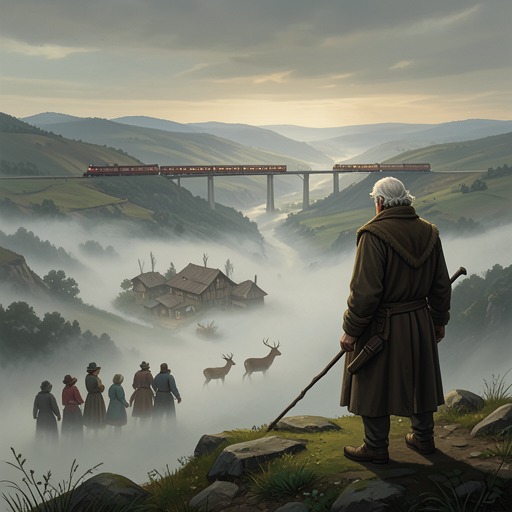
The event also becomes part of Grainier's unstable chronology. Late in life, he is certain that the evening when he saw the World’s Fattest Man was the same day he stood in Troy, Montana, near a railway car carrying Elvis Presley, although he had arrived too late to see Presley and knew the scene only through what townspeople told him. He also remembers having seen a wonder horse, a wolf-boy, and having flown in the air in 1927. His life story begins with a train ride he cannot remember and ends with his standing outside a train containing Elvis Presley. The biplane flight belongs to this chain of technological and spectacular encounters, but unlike the Presley sighting it is directly lived, and unlike the train ride of childhood it is retained as a vivid bodily memory.
Within the broader narrative, the flight is an episodic adventure rather than a conventional triumph. Grainier's low social position and long history of work place him at the edge of institutions that reshape the region: railways, timber companies, fairs, theaters, and machines. The biplane briefly reverses his usual relation to technology. He is no longer the worker who clears forest for rails or hauls goods along routes without railway access; he becomes a passenger carried by a device whose movement he cannot explain. Yet the event does not produce permanent advancement. It gives him instead a compressed revelation: fear opens onto love, machinery opens onto memory, and the sky returns him to the same isolated life, now marked by an experience that no horse, wagon, or train could provide.