Horses
Train DreamsHorses are the principal animal infrastructure of Robert Grainier’s working life. They haul timber from forests to railways, pull freight wagons between isolated communities, carry the dead and the displaced, and finally become the basis of Grainier’s modest independence. Their labor is practical and bodily, but the narrative also gives them temperament, endurance, fear, age, and vulnerability. Through them, the transformation of the Moyea Valley from forest frontier to road-and-rail economy is registered at ground level: in cable work, six-horse teams, frozen rivers, overloaded wagons, and the shrinking strength of both animals and man.
Horses in Timber Work
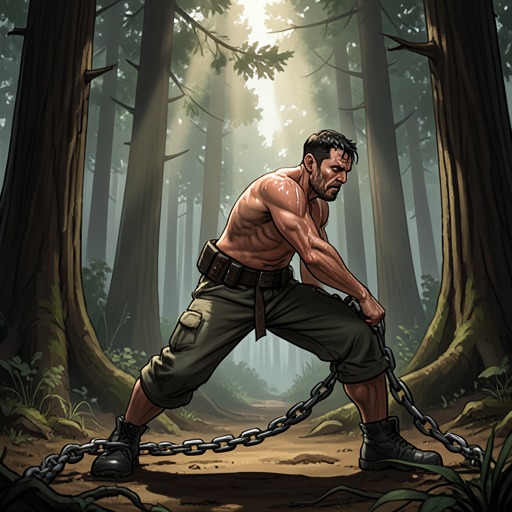
In the logging country, horses were essential links between the forest and the railway. At the Simpson Company’s operations near Robinson Gorge, rails served only to move timber out of the forest, while more than forty men used six-horse teams to drag logs along temporary corduroy roads until the timber came within reach of the railway landing. Grainier worked as a choker in the woods, looping cables around eighteen-foot logs after sawyers felled the spruce and other workers limbed and bucked them. The horses then supplied the force that drew the logs toward the landing.
Their work unfolded beside machinery of enormous scale. At the landing, a wood-burning Steam donkey used iron drums and cable to pull logs toward the railway, while horses moved over the skid road in a kind of immense silence, their sounds swallowed by the booming engine and the roar of its vapors. The contrast is revealing: the Steam donkey represents concentrated mechanical power, whereas the teams embody slower, distributed strength. Together they converted the forest into loads that could be placed on flatcars and carried across the Robinson Gorge Bridge toward the continent-wide railway system.
The Eleven-Mile Cutoff Bridge and the Robinson Gorge Bridge place horses within a larger infrastructure of extraction. Grainier’s first locomotive crossing over the Eleven-Mile Cutoff Bridge made him eager to join still larger undertakings, and his later work repairing the immense Robinson Gorge Bridge led into timber hauling. The bridges and railways could span chasms, but they could not replace the animals’ work in the forest, where logs still had to be brought to the landing by teams. Horses therefore occupy the uncelebrated middle ground between wild trees and industrial transport.
Recovery and the Return to Hauling
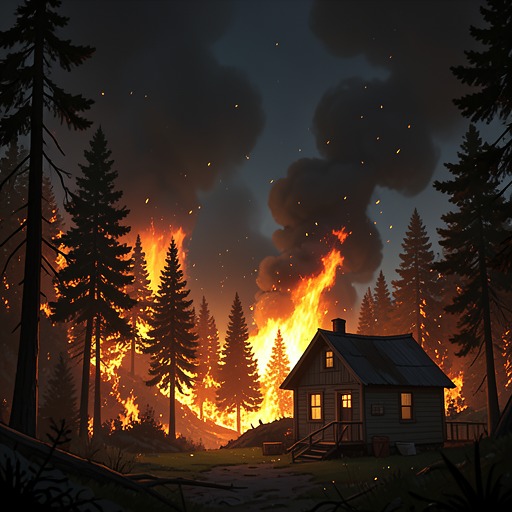
After the Moyea Valley fire destroyed Grainier’s home, he first survived through improvised settlement, keeping a red-haired dog, a nanny goat, and chickens. By the following spring, animals had begun returning to the burned valley: butterflies rose from bear sign, bears crossed the muddy roads, and huckleberries were returning to the blackened hills. Grainier responded by returning as well, using a rented horse to bring five dozen small fire-killed spruce onto his clearing so that he could build a new cabin. The horse made possible the first material stage of reconstruction, carrying the timber that turned a scorched campsite into a future home.
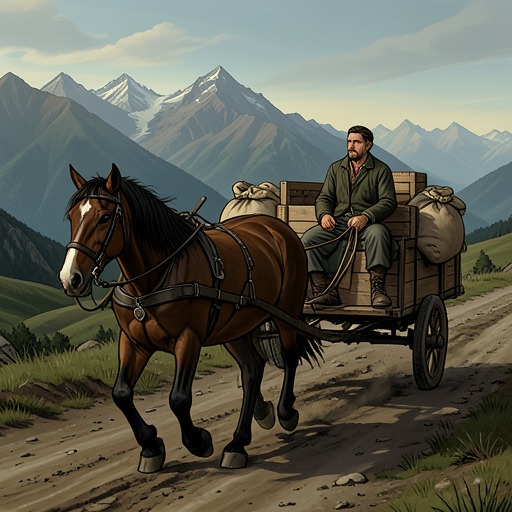
The logging work that had supported him was temporary, but horses opened another form of livelihood. After transporting the body of Hank Pinkham to Helmer’s cemetery, Grainier leased the Pinkhams’ mares and wagon and spent the rest of the fall and part of the winter working as a freighter. Most jobs took him east and west along Highway 2, serving small communities without close railway access. The wagon carried goods and connected settlements that the railways did not directly serve; hauling became both a business and a way of seeing the daily follies and endeavors of his neighbors.
Grainier enjoyed this work enough to contract with the Pinkhams to buy the horses and wagon by installments for three hundred dollars. The purchase marked a decisive shift from hired labor in the woods to independent transport. His livelihood remained modest and physically demanding, but the team gave him an economic identity beyond that of a solitary survivor. The horses became the means by which he could remain connected to towns while continuing to live in the remote valley.
Temperament, Cooperation, and Danger
The horses are not passive vehicles. During Grainier’s journey with Eddie Sauer to move Claire Thompson from Noxon, Montana, to Sandpoint, Idaho, Grainier drove his mares while Eddie used a modified Ford Model T. Grainier kept ahead because the mares disliked the automobile and also seemed to dislike Eddie. When Eddie came roaring up behind them with his horn squawking, the horses nearly stampeded. Grainier warned him that the mares had endured many kinds of commotion but could not tolerate the horn. Their reaction exposes the friction between older animal-powered transport and the newer automobile: the road is shared, but the two systems do not occupy it comfortably.
The same journey shows how much human movement still depended on the horses’ strength. Claire Thompson’s household goods included heavy locked trunks, tools, and kitchen equipment. The wagon took as much as the mares could pull, while the Model T carried another precarious heap, including mattresses, two children, and a small dog. The automobile repeatedly labored on the long rises and boiled over, requiring water from gallon jugs, while Grainier’s team maintained the slower rhythm of the road. The caravan’s progress depended on managing the different capacities and temperaments of the animals and machines.
Horses also enter moments of death and communal obligation. Grainier and Mr. Pinkham struggled to load young Hank Pinkham’s heavy corpse into the wagon, using two long boards as ramps before the mares pulled the conveyance to the cemetery. Grainier then accepted further hauling work from Helmer, transporting a coffin and lumber. The team thus carried not only commodities but the physical consequences of mortality, joining private grief to the ordinary logistics of rural life.
Aging, Partnership, and Decline
In his later years, Grainier boarded the mares in town during winter. They were elderly logging horses, described as being in roughly the same condition and situation as their owner, yet they remained intelligent with the wagon and more than strong enough for the work. The comparison makes their partnership explicit. Neither man nor animals belonged to the vigorous world of heavy logging anymore, but all still retained practical knowledge and residual strength. The horses’ aging becomes a quiet counterpart to Grainier’s own diminishing body.
Grainier’s final summer in the Washington woods ended when a wild limb knocked his jaw crooked and his joints deteriorated. His shoulder could lock until another person pulled it free, and his knee increasingly buckled sideways, making it dangerous to trust him with the other end of a load. He finally told his employer that he had become too difficult a worker to pay and left the woods after salvaging lumber from old laborers’ shacks. The end of his career as a woodsman did not immediately end his relation to horses; instead, the team and wagon represented the work he could still control, even as logging became impossible.
The horses therefore define a boundary between bodily independence and dependence. Grainier could no longer rely on his own strength for every task, but he could still organize a journey, manage a wagon, and make a living through the animals’ endurance. His economy was not abstract: it rested on feeding, boarding, directing, and trusting two old mares. Their strength allowed him to preserve a form of bachelorhood and remote residence that would otherwise have become untenable.
Horses and the Changed Valley
The animals’ changing environment records the long aftermath of the fire. The burned valley did not return to its former spruce forest. Jack pine replaced the grand spruce, coyotes became more numerous, rabbits scarcer, and trout disappeared from long stretches of the Moyea River. Wolves were heard less often and from farther away. Horses belong to this altered ecology as domestic laborers rather than as creatures of the recovering wild, yet their movements still connect the human settlement to the damaged landscape.
Their presence also contrasts with the animals Grainier hears or encounters at the margins of settlement. Wolves answer his voice from the peaks after the fire; the red dog follows and disappears; bears and butterflies return to the burn; later, the wolves and coyotes gather in a vast nocturnal chorus. Against these mobile and increasingly distant forms of wildlife, the horses remain tied to roads, stables, wagons, and human contracts. They are not simply symbols of nature, but working beings whose usefulness depends on a social and material world that is itself changing.
After Grainier’s final return to his remote home, he continued spending summers and falls there even when arthritis and rheumatism made ordinary chores difficult and winter isolation dangerous. The old mares, like the cabin and the wagon, made that seasonal pattern possible. His life ended without heirs and without anyone noticing his death for months, but the horses had helped sustain the long interval before that disappearance: they carried timber, bodies, household goods, and the means of his own continued existence.