Kate Grainier
Train DreamsKate Grainier begins as the infant daughter of Robert Grainier and Gladys Grainier, a child whose brief domestic presence gives shape to the family life destroyed by the fire. In the summer of 1917 she is four months old, entirely bald, and suffering from the same rheumy illness as her mother: crusted eyes, a bubbling discharge at her nostrils, and noisy suckling at Gladys’s breast. She does not seem to recognize Robert when he returns with Hood’s Sarsaparilla for the household. Her vulnerability is emphasized not as an abstract innocence but through the small routines of care that surround her, including Gladys’s habit of letting the baby taste the sweet tonic and later feeding her cold boiled oats from the end of a finger. Kate is therefore introduced as both a particular child and the center of Robert and Gladys’s ordinary obligations.
Family and Early Identity
Kate’s place in the family is defined by dependence and by Robert’s anxious attempt to imagine what she understands. He wonders whether she knows as much as a dog-pup, while Gladys answers that a dog-pup can survive after its mother weans it. The comparison quietly places Kate between human infancy and animal self-sufficiency, a tension that becomes decisive after the fire. At this stage, however, she is still wholly embedded in the mother-child bond: Gladys nurses her, watches her illness, and organizes the household around her care.
Kate’s identity is also shadowed by an earlier history of racial violence. Robert’s first memory is of watching the mass deportation of more than a hundred Chinese families from Fry, a spectacle carried out by armed men near the Bonner Lumber Company’s railroad yard. Decades later, when Robert nearly participates in killing a Chinese railroad laborer, that buried image returns to his understanding of himself. Kate’s later fate becomes entangled with his guilt: after the fire, he believes the laborer cursed the family, and he repeatedly interprets the destruction of his home as punishment for the violence he helped enact. Kate thus becomes the absent child through whom Robert’s private grief and his historical conscience are joined.
The Fire and Disappearance
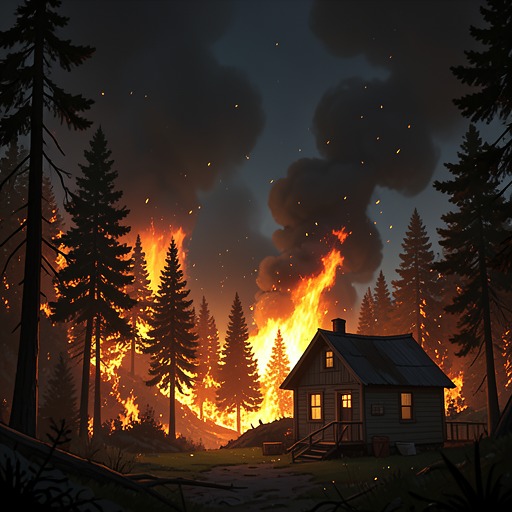
When the Moyea Valley fire reaches the cabin, Gladys attempts to escape with Kate pressed against her chest. The account preserved through Gladys’s visitation is precise about the child’s last known human circumstances. Gladys first carries the Bible and a red box of chocolates along with the baby, then abandons both objects while descending the rocky bluff; after breaking her back in a fall, she can no longer move her legs and works at the knot of her bodice until the child is free. Kate crawls away along the shore while Gladys is lifted and claimed by the water.
The fire consumes the cabin and the surrounding forest, but it does not consume Kate. Gladys’s spirit reveals that she has lost her future to death while losing her child to life: Kate did not come among the dead but escaped into the burned landscape. Robert initially cannot understand how such a survival could have occurred without becoming a public story. He searches the ruined homesite for evidence and finds none. The sight of jack pines already sprouting from the ashes intensifies his grief, because he can imagine Kate only as something that never lived long enough to grow. His spoken lament that she never grew up to a sprout makes the child part of the fire’s new ecology even before he knows she remains alive.
The Wolf-Girl Encounter
Years later, during a moonlit night when wolves, coyotes, and other animals fill the valley with an apparently limitless chorus, a pack floods Robert’s clearing. The animals brush past him in the doorway and vanish except for one injured survivor: a creature that immediately appears to him as a human female child. She lies panting on her side, bent in both arms and legs, with the whistle of her breathing resembling a frightened pup. Her eyes shine green like a wolf’s, her face is wolf-like but hairless, and she watches Robert with animal terror rather than meeting his gaze.
Robert asks whether she is Kate, but the creature offers no confirming sign. His recognition is intuitive and absolute: she is his daughter despite everything that contradicts the identification. She is nearly bald, with hair surviving only in patches, and her left leg is shattered, with splintered bloody bone protruding below the knee. She has crawled on three limbs while dragging the ruined leg behind her. When Robert approaches, she growls, barks, and snaps; then she appears to fade from herself, though she remains alive and watchful. The name Kate-no-longer captures the reversal. The child Robert lost has returned, but not as a recovered version of the infant he remembers.
Robert’s response is marked by care, fear, and incapacity. He searches for a weapon before approaching her, carrying a club and a hurricane lamp into the clearing, yet he does not attack. He hopes for recognition and tries to make contact, but the wolf-girl remains fixed in dread. Near daylight she leaves through the window. Robert watches her crawl toward the river, stopping to twist around and bite at the bindings on her injured leg as a wolf or dog might. He intends to track her and bring her back, but never does. Their reunion therefore ends not in restoration but in a second separation, one produced by the unbridgeable distance between paternal recognition and the child’s altered existence.
Human, Animal, and Disability
Kate’s transformation resists a simple division between human and animal. The narrative gives her a human body and familial identity while emphasizing wolf eyes, a wolf-like face, animal movement, barking, snapping, and an instinctive retreat from Robert. She is not merely disguised as an animal; her survival has made the categories unstable. The surrounding world already contains stories of wolfish dogs, animal intelligence, rescues, and creatures that seem to cross the boundary between species. Kootenai knowledge holds that a wolf pack is governed by a single breeding pair, and Kootenai Bob suggests that an anomalous litter might produce a dog-of-wolf or even the beginning of a new pack. Later, Peterson explains being shot by his own dog through a local story that the animal had been confabulating with the wolf-girl. These reports turn Kate into a circulating figure of regional folklore before she is directly encountered.
Her broken leg is equally important as a lived condition rather than only a sign of strangeness. The injury determines how she moves, limits her speed, and exposes the practical cost of her escape from the fire. Yet the environment is not adapted to her human needs, and Robert cannot provide a stable means of rescue or rehabilitation. His failure to follow her leaves her injured body in motion toward the river, where the story refuses to disclose what happens next. Kate’s disability is therefore bound to the larger question of whether survival can count as rescue when the survivor has been forced into an existence the human community cannot recognize or support.
Narrative Significance and Afterlife
Kate is the decisive secret of Robert’s grief. For years he believes that both wife and daughter died in the fire and that his own participation in the attempted killing of the Chinese laborer brought supernatural punishment upon them. Gladys’s visitation revises that belief: Gladys died, but Kate escaped. The revelation does not heal Robert, because it replaces a definite death with an uncertain life. He receives knowledge without gaining possession, reunion without recovery, and proof of survival without a future in which father and daughter can live together.
Kate also gives the book’s animal motifs their deepest personal force. Robert howls with distant wolves after the fire, partly because the sound draws something heavy out of his heart. The wolves are at once a surrounding population, a source of legend, and the possible social world into which Kate has entered. Stories of wolfish pups at a fair, a staged wolf-boy at the Rex Theater, and dogs credited with extraordinary intelligence echo the wolf-girl without resolving her nature. These repetitions keep Kate suspended between eyewitness reality and communal tale.
The story finally preserves Kate as Kate-no-longer: not a recovered child, not a confirmed supernatural being, and not a simple emblem of Robert’s mourning. Her existence exposes the violence of treating human identity as something guaranteed by appearance, speech, or conformity. Robert can recognize her, but recognition alone cannot return her to the family, repair her body, or translate her life back into human terms. Kate’s significance lies in that failure of restoration. She survives the fire by entering a form of life that remains visible to the narrative but almost unreachable to the people who loved her.