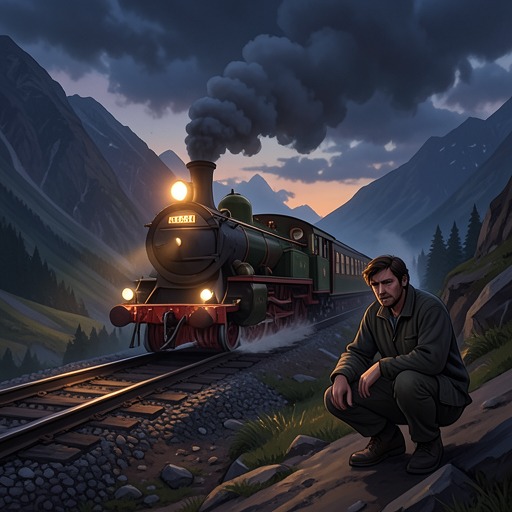
Kootenai Bob's Death Under the Trains
Train DreamsKootenai Bob's Death Under the Trains is the violent death of Grainier's Kootenai friend in 1930, when intoxication leads him onto the railway tracks and a succession of trains runs over him. The event is not only a death by machinery: its aftermath joins industrial indifference, Indigenous mourning, animal cries, and Grainier's lifelong attachment to the burned Moyea Valley. What begins as a fatal episode of drink ends by giving his solitary life a vow and a place.
Causes and Background
Kootenai Bob had been a longstanding friend and local presence in Grainier's life. His death occurred after ranch hands visiting from British Columbia persuaded him to drink a supposedly harmless mixture of lemonade and beer. They claimed that the lemon juice would cancel the beer's effects. Kootenai Bob believed them partly because the United States was deep into Prohibition, while liquor remained permitted in Canada, making the visitors seem authoritative about alcohol. The harmlessness they promised was therefore built on deception, misplaced trust, and the border's contrasting laws.
The drink did not remain shandy for long. By the time Grainier found Kootenai Bob sitting outside the hotel in Meadow Creek toward evening, he was embracing an eight-quart canning pan filled with beer and lapping from it like an animal. He had been drinking throughout the afternoon, had repeatedly urinated on himself, and had lost the power of speech. The scene strips away the ordinary social identity of the respected local man: the intoxicated body is reduced to thirst, repetition, and helplessness, while the railway nearby remains a functioning system indifferent to his condition.
What Happens
After dark, Kootenai Bob wandered roughly a mile up the tracks and lay unconscious across the ties. A succession of trains passed over him. Four or five trains crossed the place before late the next afternoon, when a gathering multitude of crows led someone to investigate. The death is thus extended across time rather than presented as a single instant. The railway turns the body into a dispersed remnant, and the repeated trains make industrial movement itself the agent of his dismemberment.
By the time people reached the site, Kootenai Bob had been scattered for a quarter mile along the right-of-way. The practical geography of the tracks became the geography of the dead man. His remains were not gathered by officials in the account; instead, members of his people moved along the bare ground beside the rails over the following days, searching for pieces of flesh, bone, and cloth that the crows had left behind. They placed these small tokens in brightly painted leather pouches, carrying them away for burial with a fitting ceremony.
Immediate Consequences
The death altered the behavior of the Great Northern Railway. During the two or three days after Kootenai Bob was killed, while his people continued searching the tracks, trains approaching from the Meadow Creek crossing sounded a series of long blasts and moved slowly through the area. Railway management had ordered this change to give the Kootenai people time to collect what they could without further disarrangement. The same infrastructure that destroyed the body was temporarily made to accommodate its recovery. The whistles announce both the continuing power of the railway and a limited institutional recognition of the mourners' claim to the dead.
The event also produced an extraordinary disturbance in the surrounding animal world. It was mid-November, before the first snow, with brief bright days and clear cold nights. The train whistle set the coyotes howling, then drew in the wolves. Grainier's red dog was somewhere beyond his sight as well. On the night of the full moon, the cries seemed to come from hundreds of wolves and coyotes, perhaps joined by owls, eagles, and every other voiced creature on the peaks and ridges overlooking the Moyea River. The sound was continuous, hysterical, and pitiable, as if the landscape itself had become unable to settle after the death.
Grainier's Vow and the Event's Meaning
Grainier did not explain to others what kept drawing him back to his remote cabin, but the text identifies the reason: about ten years after the region burned, Kootenai Bob's death shocked him into vowing to stay. The vow gives the railway death a delayed consequence. Kootenai Bob does not simply disappear from the plot; his scattered body, the searching mourners, and the prolonged whistles become the hidden foundation of Grainier's later persistence in a valley whose plants, animals, and human history have all been transformed.
That persistence is especially significant because Grainier's home lies in a landscape already marked by industrial expansion and catastrophe. He had helped construct the Eleven-Mile Cutoff Bridge, whose first locomotive crossing turned a gorge into a route of commercial efficiency, and he had later worked around the Robinson Gorge Bridge and the timber machinery of the Simpson Company. Railways carry laborers, timber, settlers, and spectacle, but they also create sites of exclusion, violence, and death. Grainier's earlier participation in an attempt on the life of a Chinese laborer near the bridge under construction makes the later death of Kootenai Bob part of a broader pattern in which bodies marked as marginal are exposed to collective violence or to the machinery of economic order.
Narrative and Thematic Significance
The event is narrated through concrete remnants rather than explanation: the eight-quart pan, the tracks, the crows, the quarter-mile spread of remains, and the painted leather pouches. These details refuse to make death abstract. At the same time, the repeated train whistles and the animals' answering cries enlarge the death beyond the individual. The railway speaks in mechanical blasts; the wolves and coyotes answer in an ungovernable chorus. Between them, the Kootenai mourners perform the patient work of restoring personhood to what the trains have scattered.
For Grainier, the death also becomes a memory that changes the meaning of solitude. He had questioned whether his life in the woods made him a hermit, but Kootenai Bob's death binds that life to witness and obligation rather than mere withdrawal. The night chorus leaves him unable to sleep, watching the moonlit mountains and hearing what seems like a vast pronouncement or an alarm at the end of the world. When wolves rush into his clearing and touch him before vanishing, the valley's grief becomes physically immediate. The event's final significance therefore lies in its transformation of a railway fatality into a covenant: Grainier remains where disaster, machinery, Indigenous mourning, and the voices of the animals have made the land impossible to regard as empty.