Kootenai Bob's death beneath the trains
Train DreamsKootenai Bob's death beneath the trains is the 1930 death of Kootenai Bob after a day of unprecedented drinking, an accident that ends with his body scattered along the tracks and his people gathering what remained. The event is not treated as an isolated misfortune: its immediate violence, the railway's impersonal power, and the Kootenai response become the emotional and symbolic foundation for Robert Grainier's vow to remain in the damaged valley.
Causes and Circumstances
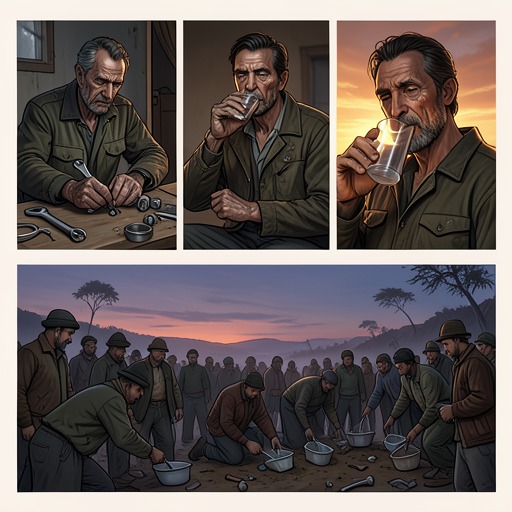
Kootenai Bob had been sober throughout his life until ranch hands visiting from British Columbia persuaded him to drink shandy, a mixture of lemonade and beer. They assured him that the lemon juice would cancel the beer's effects. The advice seemed credible to him because the United States was more than a decade into Prohibition, while liquor remained permitted in Canada, making the Canadian visitors appear knowledgeable about alcohol. The supposed protection of the lemonade disappeared as Bob continued drinking beer from an eight-quart canning pan.
Robert Grainier found Kootenai Bob outside the hotel in Meadow Creek toward evening. Bob had wrapped his legs around the pan and was lapping at the beer like a thirsty animal. He had been drinking all afternoon, had repeatedly urinated on himself, and had lost the power of speech. The scene combines humiliation with an ominous loss of human control: a respected companion is reduced to bodily appetite and helplessness before he wanders away from the hotel.
Death on the Railway
After dark, Kootenai Bob managed to travel roughly a mile up the tracks. He lay unconscious across the ties, directly within the path of the trains, and was run over by a succession of them. Four or five trains passed over him before late the next afternoon, when a gathering multitude of crows led someone to investigate. The railway that elsewhere carries workers, timber, passengers, and the machinery of modern life becomes here an apparatus of repeated destruction. Bob's death is therefore not a single impact but a prolonged process in which the traffic continues until the body has been dispersed.
By the time the site was examined, Kootenai Bob had been strewn for a quarter mile along the right-of-way. The scale of the dispersal makes the death both brutally physical and strangely impersonal: the tracks divide the remains as efficiently as they transport freight. Yet the narrative does not leave Bob as anonymous wreckage. The material details of the body become the grounds for a communal act of recognition.
Recovery and Communal Mourning
For the next several days, members of Kootenai Bob's tribe moved along the blank patch of earth beside the rails, locating the small remnants of flesh, bone, and cloth that the crows had missed. They collected these fragments in brightly and beautifully painted leather pouches, then carried them away to be buried with a fitting ceremony. The recovery reverses the railway's fragmentation. Where the trains have scattered Bob across industrial space, his people gather him piece by piece and restore him to a cultural and ceremonial order.
The company also altered the movement of the railway in response. During the two or three days after Kootenai Bob was killed, Great Northern trains blew a series of long whistle blasts from the Meadow Creek crossing until they were well north, and proceeded slowly through the area under management orders. The purpose was to give the Kootenai tribe time to collect what they could of their brother without further disarrangement. The railway could not undo the death, but its operators temporarily acknowledged that ordinary speed and schedule had become incompatible with the work of mourning.
The Howling Nights
The death was followed by several cold, clear autumn nights in mid-November, before the first snow. The moon rose near midnight above Queen Mountain and remained visible into the morning. Against this bright, spare landscape, the train whistle set off a raucous response from the coyotes and then the wolves. Grainier's red dog was also somewhere outside, though Grainier had not seen her for days. The sounds grew fullest and maddest on the night of the full moon.
The wolves and coyotes howled without letup throughout the night, seeming to number in the hundreds. Other creatures may have joined them—owls, eagles, or every animal with a voice along the peaks and ridges above the Moyea River—but Grainier could not identify them. He experienced the chorus as a vast pronouncement, perhaps an alarm announcing the end of the world. The train's whistles, intended to slow human traffic for the recovery of the dead, thus become the trigger for an immense nonhuman lament.
Grainier's Vow and Narrative Significance
The experience changed Robert Grainier's relation to the valley. Even in his last years, when arthritis and rheumatism made ordinary tasks difficult and winter isolation could have killed him, he continued to spend every summer and fall at his remote home. He never explained what drew him back. The narrative identifies the truth as a vow made roughly ten years after the great fire and shocked into existence by the aftermath of Kootenai Bob's death.
This connection gives the event a significance beyond its immediate plot. The Moyea Valley has already been transformed by industrial logging and by the fire that destroyed Grainier's home, while the railway remains the instrument through which people and materials move through the region. Kootenai Bob's death exposes the human cost hidden within that infrastructure: the same tracks that connect distant places can erase an individual body, while institutional procedure can only slow the trains after the fact. The Kootenai recovery and the nocturnal chorus answer that violence with memory, ceremony, and sound.
The event also occupies a pivotal place in Grainier's life story. His existence stretches from an unremembered childhood train journey through bridges, logging operations, automobiles, a 1927 biplane flight, films, television, and the later appearance of Elvis Presley near a train. Yet the death of Kootenai Bob is the episode that gives his continued return to the wilderness its deepest cause. In a life repeatedly carried forward by modern transport, the scattered body beside the rails becomes the reason he chooses to remain in one ruined place.