Kootenai wolf-pack breeding rule
Train DreamsThe Kootenai wolf-pack breeding rule is a traditional account of wolf reproduction associated with Kootenai Bob. It holds that only one pair in a wolf den produces pups: the chief male, described as the leader of the wolf tribe, mates with the only she-wolf in the pack who comes into heat. The rule gives the wolves a social order modeled on rank, exclusivity, and controlled reproduction, but its importance in the story lies less in zoological certainty than in the way it organizes human attempts to understand the border between domestic dogs, wild wolves, and human society.
Definition and Transmission
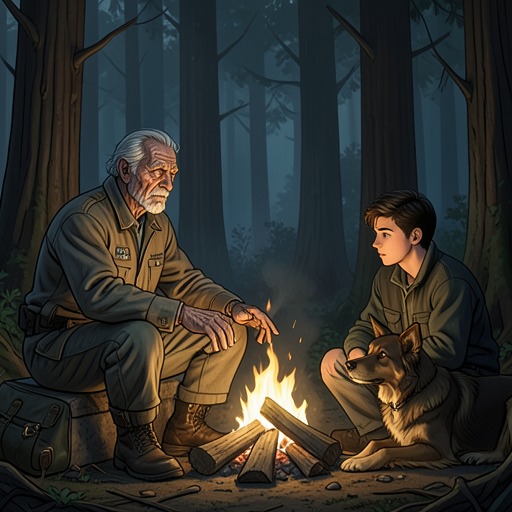
Kootenai Bob explains the rule to Robert Grainier at the Meadow Creek store after Grainier’s wandering red-haired dog gives birth to four pups that look remarkably wolfish. Bob is presented as a steady man who has always refused liquor, works regularly in town, and has known Grainier for many years. His account therefore arrives not as an anonymous rumor but as knowledge offered within a long-standing relationship, even though the narrative leaves open how literally it should be taken.
According to Bob, no other male wolf can mate in the den, and no other female enters heat. The chief wolf alone sires the litters, while the chosen she-wolf alone bears them. This structure makes the wolf pack appear less like an undifferentiated mass of animals than like a ruled community with a reproductive law. It also gives Bob a vocabulary for distinguishing ordinary dogs from beings that might carry the social and biological inheritance of wolves.
Application to Grainier’s Puppies
Grainier asks whether his dog could have encountered a wolf pack precisely when she was coming into heat, allowing the king wolf to mount her because of the novelty of the experience. Bob answers cautiously that it might be possible. From that qualified possibility he names the result a dog-of-wolf and suggests that Grainier may have started his own pack.
The rule thus turns an uncertain litter into a charged event. Three puppies wander away soon after the mother weans them, while one uncoordinated male remains near her. Grainier is convinced that this remaining pup is descended from a wolf, but the animal never answers the distant wolves that sing at dusk, including packs as far away as the Selkirks on the British Columbia side. Grainier interprets the silence as a failure of the creature to grow toward its own nature and tries to teach it by howling beside it.
The lesson does not work. The pup merely sits with its pink tongue showing, and later disappears before autumn. Grainier hopes it crossed into Canada to join its brothers but assumes that it may instead have become food for a hawk or the coyotes. The breeding rule therefore produces no stable scientific conclusion or successful new pack; it produces an unresolved hybrid possibility, suspended between inheritance, environment, and human expectation.
From Breeding Law to Animal Agency
The rule acquires a wider force when Grainier continues howling with the distant wolves. He does so partly because the practice brings relief, flushing out the heaviness that gathers in his heart. Bob answers that this is exactly what happens, repeating the proverb, “There’s not a wolf alive that can’t tame a man.” The breeding rule and the saying work together: wolves are not merely creatures to be classified, but a society whose laws and calls can draw humans into altered behavior.
Later stories extend this logic to other dogs. Peterson claims that his own dog shot him after returning from a thirteen-day absence, during which it had supposedly gone into the woods and become nearly wild. Peterson believes the dog had been confabulating with the wolf-girl, and he repeats Bob’s warning that the animal should have been killed before it could summon her into the house. In this retelling, contact with wolves becomes a form of communication and transformation. The dog is no longer safely contained by its domestic identity; its apparent knowledge and violence are attributed to a relationship with the wild.
The surrounding lore also places the rule within a broader Kootenai language of animal personhood. Peterson says that the Kootenais speak of a “Coyote-person” and “Bear-person,” treating animals as people in a way that accommodates creatures such as half-wolves. The wolf-pack breeding rule consequently belongs to a system of classification in which animal communities possess social identities, spiritual significance, and forms of agency that do not fit the ordinary human-animal divide.
Cultural and Narrative Significance
The rule is transmitted through conversation rather than formal authority. It moves from Kootenai Bob to Grainier, then into the stories Grainier hears or helps carry along the roads, including Peterson’s account of the dog shooting. Its power comes from repetition, qualification, and association: Bob first applies it to a litter of puppies, later appears in stories about the wolf-girl, and is remembered as the source of warnings about animals that have crossed into a more dangerous intelligence.
At the same time, the narrative presents these accounts through the imperfect language of white laborers and travelers, whose descriptions of Kootenai people often reduce them to rumor, spectacle, or stereotype. The rule should therefore be read both as a meaningful piece of story-world knowledge and as part of a contested process of representation. The same region that witnesses anti-Chinese violence, railroad expansion, and the displacement of Chinese families also turns Kootenai knowledge into frontier folklore. The rule’s ambiguity reflects that historical pressure: it preserves an alternative way of imagining animal society while being repeated through speakers who only partially understand the people from whom it comes.
Its final significance is structural. The rule makes hybridity intelligible without resolving it. Grainier’s puppies may be dog-of-wolf, Peterson’s dog may have acquired knowledge through wolves, and the wolf-girl may be a person, a creature, or something humans cannot place. By giving the wild a law of its own, the Kootenai wolf-pack breeding rule prevents the forest from appearing empty or chaotic. It becomes a realm with hierarchy, kinship, reproduction, memory, and the power to change those who approach it.