Loneliness
Train DreamsLoneliness is the central condition through which Robert Grainier experiences loss, survival, and belonging. After the Moyea Valley fire destroys Gladys Grainier and Kate Grainier, solitude first appears as bereavement, but it gradually becomes a form of life: Grainier builds, works, listens, remembers, and remains in a landscape whose human and animal inhabitants are continually changing.
From Bachelorhood to Bereavement
Grainier already knew how to live alone before the fire. He had passed thirty-two years as a bachelor before finding Gladys Grainier, and after her death he slipped back into a “steadying loneliness” while working in the forest with the Simpson Company. The phrase is important because it presents solitude not only as deprivation but also as a familiar structure capable of holding him upright. In the timber camps, he missed Gladys and their child Kate Grainier, yet the immense spruce forest, the exhausting work, and the guarded distance of the woods gave his isolation a practical rhythm.
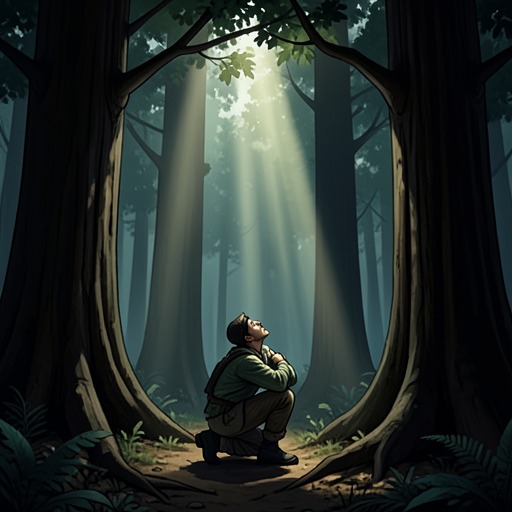
His loneliness changed decisively when he returned to the Moyea Valley and found the homesite erased. The fire had destroyed the house and even the Bible, leading Grainier to feel that the blaze had been stronger than God. In the sterile clearing he believed himself almost the only creature left, until wolves answered his voice from the distant peaks and their calls passed from ridge to ridge until the valley seemed to sing. The response did not remove his solitude; it enlarged it into an encounter with a nonhuman world that survived beyond the human catastrophe.
Grief, Visions, and Self-Conversation
The first phase of post-fire loneliness is marked by impossible perceptions. Grainier senses that something belonging to Gladys Grainier and the baby remains around the ruined home, perhaps the chocolates Gladys had bought in a red box, each piece held in a white paper cup. He sees those cups scattered across the ground, but each disappears when he looks directly at it. Toward evening, beside the river, he sees Gladys Grainier’s white bonnet sailing overhead. The vision is brief and unverifiable, yet it gives his solitude a shape: the absent wife returns not through ordinary communication but as a moving sign in the burned world.
Grainier stays in the camp for weeks, waiting for more visions and accepting the impossible because he wants it. He also begins speaking aloud, repeatedly sighing and saying, “A pretty mean circumstance!” His speech is both an expression of grief and an attempt to impose a small human order on silence. He thinks about Kate Grainier less often, partly because her short life seems less burdened by memory: she had hardly been awake, much less alive. Loneliness therefore differentiates the losses rather than flattening them into one undivided sorrow.
The fear of sleep reveals how deeply solitude has entered his body and routine. In the lean-to by the river, Grainier keeps a campfire burning as late as possible because he fears his dreams. At first he dreams of Gladys Grainier and Kate Grainier, then only of Gladys Grainier, and finally only of the campfire itself. He dreams of tending the fire, then wakes to find gray ash and charred ends where he had watched the flames burn all night in sleep. The lost family has been replaced by the repetitive image of maintenance, as though loneliness has reduced memory to the care of a fire that cannot preserve anyone.
Building a Life Among Animals
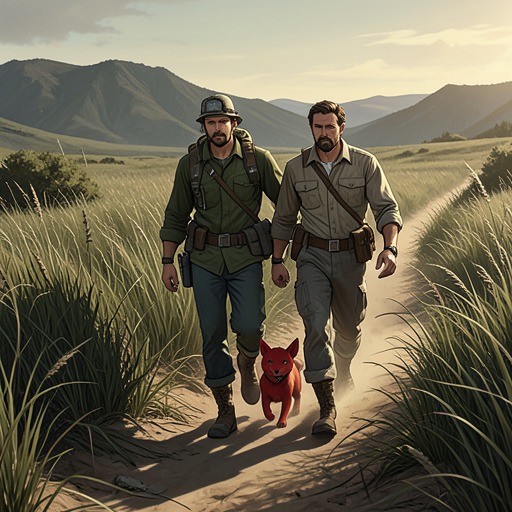
Solitude does not leave Grainier motionless. He works through it by making the burned place habitable. He lives through the summer on dried morels and fresh trout cooked in butter from Meadow Creek, buys a canvas tarp and rope, and acquires a nanny goat. A small red-haired female dog comes to him and stays, though she remains partly independent, sometimes wandering for days. Grainier stops talking to himself because he is ashamed of being overheard by the dog, a modest but revealing shift: animal company alters not only his surroundings but also his conduct and his sense of what counts as social presence.
He gathers willow whips in the less-damaged creek gorges and weaves a crate roughly two yards square and half as tall. He then walks with the dog to Meadow Creek, buys four hens and a rooster, and brings them home in a grain sack. The birds are periodically penned so that the hens will not lay eggs in hidden places. These actions turn loneliness into a household economy, however fragile: goat’s milk, fish heads, eggs, rope, timber, and a shelter gradually replace the lost domestic structure without reproducing the family that occupied it.
When Grainier returns to the homesite the following spring with a wagonload of supplies, the recovering ecology confronts him with a world that is populated but not restored. Bears outnumber people on the muddy road, orange butterflies rise from bear sign, and huckleberries are returning on the blackened hillsides. He cuts down five dozen small burned spruce to build a new home, then discovers that fireweed and jack pine have already grown thigh-high and that pine pollen drifts through the valley. The landscape’s renewal gives him work, but it also makes clear that recovery will produce a different place rather than return the old one.
Trains, Wolves, and the Expansion of Solitude
Three years after the early period of grief, Grainier lives in a second cabin built precisely where the first had stood. He now sleeps soundly, but his dreams have shifted to trains. He is aboard one, smells coal smoke, watches a world pass, and then finds himself standing in that world as the train’s sound fades. The scenes carry a fragile familiarity from childhood, and the actual locomotive of the Spokane International sometimes wakes him as the dream and the valley’s night sounds overlap. Loneliness thus becomes temporal as well as spatial: it places him between the family that has vanished, the childhood he barely recalls, and the modern world passing at a distance.
He remains in the cabin through winter, when the valley appears silent beneath deep January snow. The silence is actually crowded with the rumble of trains, distant wolf choirs, nearer coyote cries, and Grainier’s own howling, which he takes up as a kind of sport. His isolation is therefore not absolute muteness. It is a practice of listening and answering, in which the solitary man enters an imperfect chorus without ceasing to be alone.
The animal chorus becomes overwhelming after Kootenai Bob is killed under a train. As the Kootenai tribe searches the tracks for pieces of his body, the Great Northern train sounds long whistles and proceeds slowly through the area. The whistles set off coyotes and then wolves; Grainier’s red dog is also somewhere outside, unseen for days. On the fullest night, the howling seems to come from hundreds of animals and becomes so frantic and pitiable that Grainier understands it as a vast pronouncement, perhaps an alarm announcing the end of the world. When the pack floods his clearing, several wolves brush against him, but all disappear except one: the wolf-girl. Loneliness here opens into an encounter that unsettles the boundary between human domestic life and the wild community surrounding it.
Chosen Solitude and the Changed Valley
In old age Grainier still spends every summer and fall at the remote home, even when arthritis and rheumatism make ordinary chores difficult and two winter weeks there might kill him. By then he no longer expects the valley to recover its pre-fire condition. Spruce has given way almost entirely to scraggly jack pine; wolves are heard less often and from farther away; coyotes multiply, rabbits become scarce, and trout disappear from long stretches of the Moyea River. His loneliness is consequently ecological as well as personal. The place loses the species and sounds that once helped define his solitude, yet he continues to return.
He never explains what draws him back, but the narrative identifies a vow formed after the extraordinary night of the wolves and the wolf-girl. Remaining is not simply the failure to rejoin society. It is a decision to inhabit the damaged valley despite its altered plants, animals, and silences. Even after the red dog grows old, sick, and disappears into the woods to die alone, Grainier does not replace her for years. Eventually, after a town trip prompted partly by loneliness and partly by the search for companionship, he buys a large male dog of the far-north sledding type, which remains his friend for many years.
Grainier’s final isolation is literal. He lives more than eighty years, leaves no heirs, and dies in his sleep in November 1968. Although almost everyone in the region knows Robert Grainier, no one notices his absence through the fall or winter. Hikers find his body in spring, and they, with a doctor, bury him in the yard beside the cabin. Loneliness ends not with a public reunion or a restored family but with an unnoticed death in the place he chose to keep inhabiting. Yet the grave also completes his attachment to the valley: the solitary life that began as the aftermath of catastrophe becomes a physical belonging to the changed land.