Meadow Creek
Train DreamsMeadow Creek is the small railroad village on the Moyea River around which Robert Grainier’s life repeatedly gathers and disperses. Two miles down the valley from his cabin, it is first a practical railway settlement and a place of ordinary social contact, but it becomes the geographical hinge of his marriage, his labor, the destruction of his home, and his later itinerant existence. Its significance lies in that recurrence: Meadow Creek is not merely a backdrop but a durable marker against which industrial expansion, domestic attachment, ecological catastrophe, and personal isolation become visible.
Railroad Village and River Setting
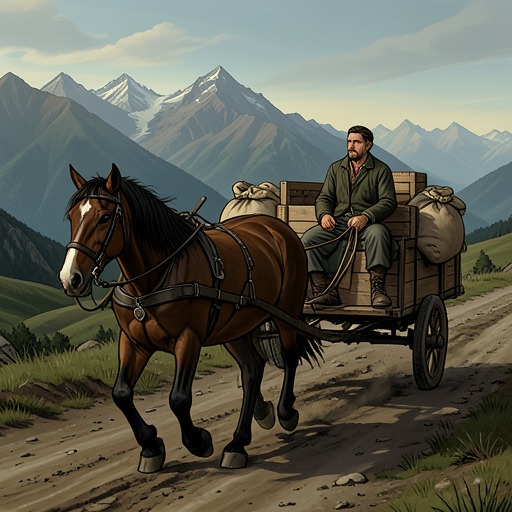
Meadow Creek is introduced as a railroad village situated two miles down the valley from Grainier’s home. After an execution party pursues a Chinese railroad laborer across the unfinished bridge, Grainier detours to the village store to buy a bottle of Hood’s Sarsaparilla for Gladys Grainier and their infant daughter, Kate Grainier. The errand places the settlement within the couple’s domestic routine: the village supplies a household necessity, while the road between Meadow Creek and the cabin connects paid railroad work with marriage and parenthood.
The Moyea River is equally central to the village’s physical and social life. On the return journey, Grainier stops upstream from Meadow Creek to bathe in a deep place in the river. Railroad workers gather there on a Saturday evening, wading in with their clothes on, shouting and splashing, drinking whiskey from flasks, and drying themselves on the rocks. Grainier recognizes nobody and remains apart, guarding his boots and the sarsaparilla bottle. The scene gives Meadow Creek a communal working population without making Grainier fully part of it: the village offers fellowship, but his attention remains fixed on the small private obligations waiting at home.
The railway also enters the cabin as a recurring sound. Many nights Grainier and Gladys hear the northbound Spokane International train passing through Meadow Creek. One night its distant whistle wakes Grainier, who discovers that Gladys is up with Kate beside the stove, feeding the baby cold boiled oats from her finger. The train’s passage therefore links the family’s intimate interior to the larger machinery of transportation, while the village functions as the audible and physical intermediary between them.
Bridge Building and Industrial Expansion
Meadow Creek is part of the railway’s effort to overcome the valley’s natural barriers. Forty-one days after the unfinished bridge incident, the first locomotive crosses the 112-foot span over a gorge sixty feet deep. Mr. Sears raises his four-shot revolver to signal the start; the engineer trips the brake and jumps out, and the men slowly urge the engine across the tracks until another man boards it at the far side. The workers cheer, but Grainier feels sad without knowing why, joining their celebration despite an inward response that the public ritual cannot explain.
The completed structure is named the Eleven-Mile Cutoff Bridge because it removes a long curve around the gorge and through an adjacent pass, saving the Spokane International the expense of maintaining eleven miles of rails and ties. Meadow Creek consequently represents infrastructure as both local fact and economic instrument. The bridge makes the landscape more efficient for the railway, but its construction also exposes the gap between collective industrial triumph and Grainier’s private unease.
The bridge changes Grainier’s sense of what work can be. His experience on the Eleven-Mile Cutoff makes him eager to join other enormous undertakings, leading him in 1920 to the Robinson Gorge Bridge repair project in northwestern Washington. There he encounters a railway bridge spanning a gorge 208 feet deep and 804 feet wide, capable of supporting an engine and two flatcars of logs, although it is so old and frightening that neither the engineer nor anyone else rides the cars across; the brakeman catches them at the far end. The trajectory from Meadow Creek to Robinson Gorge shows how the village serves as the starting point of Grainier’s attachment to monumental industrial labor.
After the repairs, Grainier moves higher into the forest with the Simpson Company. The timber system sends logs by six-horse teams to a railway landing, where a wood-burning Steam donkey drags them with cables onto flatcars. The railway carries the timber across Robinson Gorge and down the mountain toward the wider rail network. Meadow Creek is thus connected to a larger chain in which bridges, rails, horses, machinery, and forests convert remote terrain into transportable capital.
Fire, Abandonment, and the Ruined Valley
The 1920 Moyea Valley fire transforms Meadow Creek from a working settlement into a place of absence. Grainier returns from the Robinson Gorge job with four hundred dollars in his pocket and encounters a valley consumed by fire. Residents from along the Moyea River crowd into Bonners Ferry without homes, while the northbound Spokane International remains stopped until the flames subside and heavy rain soaks the Idaho Panhandle.
Grainier walks twenty miles toward Meadow Creek along the Moyea River Road, tying a handkerchief over his nose and mouth and repeatedly wetting it in the river to filter the smoke. The fire begins on the river’s east side above the village, crosses at a narrow gorge when burning spruce trees fall across it, and devours the valley. By the time Grainier reaches Meadow Creek, the village is deserted. The railroad platform remains, with a water barrel from which he drinks, but it no longer offers the ordinary services or human presence associated with his earlier visits.
The landscape beyond the village becomes a succession of industrial and domestic ruins. Charred trees stand like gigantic spears, the ground is gray, white, and black, and the remaining heat makes the burned valley feel both dead and not yet finished. Grainier continues toward the cabin while calling for Gladys and Kate, already understanding that nothing can remain but unable to stop searching. His passage through Meadow Creek is therefore also a passage from expectation to irreversible loss.
Ten days later, when the Spokane International runs again, Grainier rides through the valley from Creston, B.C., and sees the burned country at sundown. The train makes a great noise but cannot awaken the dead world below it. Meadow Creek’s former railway activity is set against a silence that industrial motion cannot overcome. The railway survives as a means of passage, while the settlement and the domestic world attached to it have been erased.
Regrowth and Recurrent Return
Meadow Creek begins to recover before Grainier does. In early autumn, Spokane businessmen raise a hotel at the little railroad camp. By spring, some dispossessed families return to begin again in the Moyea Valley. Grainier initially intends only to camp by the river, fish for speckled trout, and gather morels growing on fire-disturbed ground, but he gradually moves north until he is near his former home. He finds shoots and flowers emerging from the general death, yet the cabin site contains no recognizable trace of his former life except the woodstove, lying on its side with its legs curled beneath it.
The contrast between ecological regrowth and human erasure gives Meadow Creek a distinctive temporal character. The valley can produce new growth almost immediately, and the railroad camp can acquire a hotel, but Grainier’s cabin has been burned so completely that its ashes have merged with the surrounding ground. Meadow Creek can resume its social and economic function while the private history that once connected Grainier to it remains unrecoverable.
Grainier later establishes a seasonal rhythm in which summers are spent working in Washington, spring and fall at his cabin, and winters boarding in Bonners Ferry. Meadow Creek remains the transit point between these arrangements. When he prepares to leave his second cabin, he plans to bring his elderly little red dog by train from the Meadow Creek platform toward Bonners Ferry, offering to pay an extra nickel for her passage. The dog disappears before departure, leaving Grainier to hike to the platform without her. Even this small departure repeats the village’s larger pattern: Meadow Creek is where companions, households, and working identities are repeatedly gathered for movement, and where they may also be left behind.
Death, Memory, and Changing Mobility
Meadow Creek is also associated with the death of Kootenai Bob. In 1930, Grainier sees him outside the village hotel after visiting ranch hands from British Columbia persuade him to drink shandy during the era of Prohibition. Kootenai Bob has come to believe that the lemonade will cancel the beer’s effect, but by evening he is lapping beer from an eight-quart canning pan, unable to speak and repeatedly having urinated on himself.
After dark, Kootenai Bob wanders a mile up the tracks and lies unconscious across the ties. Four or five trains run over him before crows lead someone to investigate the following afternoon. His remains are scattered for a quarter mile along the right-of-way. Members of his people later move beside the rails, collecting fragments of flesh, bone, and cloth in brightly painted leather pouches for burial. The same railway that once carried industrial progress through Meadow Creek becomes a death mechanism, and the tracks’ promise of connection is answered by a body dispersed along their length.
Meadow Creek also remains a point of departure into newer forms of transportation. When Grainier and Eddie Sauer travel to the village so Eddie can seek work on a crew, Meadow Creek receives them as a labor market. Later, Grainier meets Eddie in Troy, Montana, for a road journey involving a wagon, mares, and a Ford Model T. Grainier precedes the automobile because his horses dislike both the machine and Eddie, and the horses are nearly stampeded when Eddie sounds the car’s horn. The contrast places Meadow Creek within a world where railroad labor persists even as automobiles alter travel, noise, and the practical relations between animals and machines.
Finally, the village belongs to the long chronology of Grainier’s memory. He later confuses the order of events in his life, remembering the World’s Fattest Man, Elvis Presley’s train, a wonder horse, a wolf-boy, and his 1927 biplane flight as parts of a sequence that began with an unremembered train ride. Meadow Creek remains one of the fixed places through which that unstable personal history passes. It is at once a railroad stop, a bathing ground, a ruined settlement, a hotel camp, a labor point, and a threshold to departure. Its persistence gives shape to a life in which technologies and landscapes change dramatically, while the ordinary act of returning to a familiar place becomes a way of measuring what can no longer be restored.