Moyea River
Train DreamsThe Moyea River is the defining waterway of the valley in which Robert Grainier’s life unfolds. It is at once a physical setting, a transportation corridor, a source of water and food, and a recurring measure of human vulnerability. Railroad construction reaches across it, workers bathe in it, families live beside it, and the 1920 fire follows its course through the valley. The river therefore joins intimate domestic memory to the larger systems of railway capital, timber extraction, migration, and disaster.
Setting and Early Associations
The river first appears as the dangerous depth beneath a bridge under construction in the summer of 1917. Robert Grainier becomes involved in the attempted killing of a Chinese railroad laborer accused of stealing from the Spokane International Railway’s company stores. Three railroad workers drag the captive up the long bank toward the unfinished bridge, and Grainier joins them by taking hold of one of the man’s bare feet. The river, fifty feet below the bridge at first and later described as part of a gorge sixty feet beneath the completed span, turns an act of workplace violence into a threat of public execution. The men intend to throw the prisoner over the trestle, but he escapes by clutching a beam and moving hand over hand along the skeleton of the next span while the gang alternately cheers and demands that he be stopped. The Moyea River is thus introduced beneath an act in which industrial infrastructure becomes a site of racialized violence and uncertain collective responsibility.
The river is also bound to Grainier’s earliest remembered history. As a child standing beside his uncle in Fry, Grainier watches more than a hundred Chinese families driven from town and loaded onto railroad flatcars. Decades later, when he nearly helps kill a Chinese laborer beside the Moyea River, that childhood scene returns to his understanding of himself. The river valley consequently carries not only the history of railway work but also the buried continuity between an earlier expulsion and later violence against Chinese labor.
Work, Recreation, and Infrastructure
After the 1917 bridge incident, Grainier walks home toward his cabin and detours to Meadow Creek to buy Hood’s Sarsaparilla for Gladys Grainier and their infant daughter, Kate Grainier. Before the final mile he stops at a deep place in the Moyea River to bathe. On Saturday evening, other members of the Meadow Creek railroad gang are already in the water, splashing in their clothes, drinking whiskey, and drying themselves on the rocks. Grainier remains apart, watching his boots and protecting the bottle intended for his family. The same waterway that lies beneath the trestle and the attempted execution therefore returns as part of an ordinary domestic errand, though the violence he has witnessed follows him home in visions of the Chinese man appearing on the road, in the woods, and around the creek.
The river is transformed by the bridge built across it. Forty-one days after the attempted killing, the first locomotive crosses the 112-foot interval over the 60-foot-deep gorge on the completed Eleven-Mile Cutoff Bridge. William Coswell Haley raises his four-shot revolver as a signal; the engineer moves the single engine slowly across the tracks, and another man waits on the far side to stop it before it runs out of rail. The crossing celebrates the railway’s ability to eliminate an eleven-mile detour around the gorge and reduce the company’s obligation to maintain that extra stretch of track. Grainier joins the cheering even though he feels unexpectedly sad. The river is made more accessible to capital and machinery, but the crossing also preserves the emotional shadow of the attempted execution that occurred above it.
The bridge awakens Grainier’s appetite for large works that alter the landscape. He later travels to northwestern Washington to repair the Robinson Gorge Bridge, a structure spanning a gorge 208 feet deep and 804 feet wide and capable of carrying an engine and two log cars. The Moyea crossing is therefore not an isolated improvement but the beginning of Grainier’s attachment to bridges, trestles, railways, and the monumental reshaping of supposedly impassable terrain. His work carries him away from the river while keeping its engineered crossing as a standard for the larger undertakings he seeks.
The Fire and the Ruined Valley
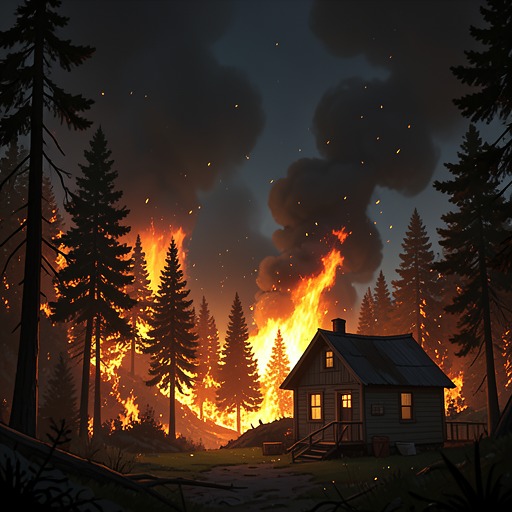
In the summer of 1920, Grainier returns from the Robinson Gorge project with four hundred dollars in his pocket and finds the Moyea Valley being consumed by fire. He reaches Bonners Ferry through thickening smoke and encounters residents from along the river who have lost their homes. At the fairgrounds, roughly a hundred refugees shelter among waterlogged remnants of their possessions, including dolls, mirrors, and bridles. Some people who fled south have survived; those who went north to outrun the flames have disappeared. The river valley has become a population displaced by fire, with the survivors unable to account for the missing.
Grainier walks twenty miles along the Moyea River Road toward his homesite, tying a handkerchief over his nose and mouth and repeatedly wetting it in the river. The fire began on the river’s east side above Meadow Creek, crossed the water at a narrow gorge by means of flaming spruce trees falling across it, and then devoured the valley northward. Meadow Creek is deserted, and the forest has become a field of charred, smoking trunks. Long before reaching home, Grainier understands that nothing can remain, yet he continues while calling for Gladys Grainier and Kate Grainier.
Ten days later, he rides the Spokane International through the burned valley at sundown. The blaze has climbed the ridges on both sides and gutted the valley along its entire length. The train makes a great noise as it moves through the blackened landscape, but the dead valley seems unable to respond. The railway survives as a functioning line and a vantage point from which the destruction can be surveyed, while the river corridor that supported settlement has been reduced to ash, smoke, and silence.
Return, Renewal, and Continuing Passage
Thirty days after the fire, Grainier attempts to return with horses, a wagon, and supplies, planning to build shelter and wait through the winter for his family. The road is buried under ash, in places so deeply that it cannot be distinguished from a winter snowdrift, and the reek makes breathing difficult. He abandons the plan and goes back to town, accepting that the fire has destroyed the possibility of simply resuming his former life.
By the following May, the river has become a place of tentative renewal. Grainier camps beside it, fishes for speckled trout, and searches for morels growing on ground disturbed by the fire. Moving north, he climbs the draw by which he and Gladys had habitually gone between their cabin and the water. Shoots and flowers have already emerged from the general death, but at the cabin site there is no recognizable trace of the former household. Only the overturned woodstove remains, its legs curled beneath it; inside is a barely charred piece of birch that Grainier associates with Gladys. The river’s regrowth does not restore the home, but it provides the setting in which renewal and irrecoverable loss appear together.
The Moyea River continues to organize Grainier’s later movements. His hauling work takes him along river roads and between communities that lack close railway access, making him a participant in a smaller, more flexible transportation network after the great bridge and timber projects. Travel beside the Kootenai River recalls William Coswell Haley and the Chinese laborer, but the same freighting life gives Grainier pleasure as he observes the follies and efforts of neighboring communities. Roads, wagons, horses, railways, and rivers form an interconnected geography through which people, goods, guilt, and memory circulate.
Sound, Death, and Narrative Significance
Even after Grainier settles permanently in the cabin, the river valley is never truly silent. Deep winter brings the apparent stillness of snow, but the soundscape includes trains on the Spokane International, distant wolves, nearer coyotes, and Grainier’s own deliberate howling. His dreams of the flames are often interrupted by the thunder of a night train moving up the valley. The river environment thus becomes an acoustic archive in which industrial noise, animal cries, and personal grief overlap.
The waterway’s broader network also connects to death. In 1930, Kootenai Bob drinks himself unconscious near Meadow Creek during the United States’ Prohibition, wanders onto the tracks, and is run over by a succession of trains. His remains are scattered along the right-of-way, while members of his people collect fragments of flesh, bone, and cloth in painted leather pouches for burial. The death occurs on the railway beside the river valley, showing again how the region’s transportation system can connect communities while also exposing bodies to mechanical destruction.
The Moyea River is consequently neither a pastoral refuge nor a passive background. It enables bathing, fishing, settlement, bridge building, timber transport, and freighting, but it also lies beneath attempted murder, carries the routes of displacement, and frames the aftermath of fire and railway death. Its recurring presence gives the narrative a durable geographical structure: human projects repeatedly cross, exploit, or follow the water, while the river and valley absorb their violence and outlast their claims to permanence.