Moyea Valley
Train DreamsMoyea Valley is both a physical setting and the defining landscape of Robert Grainier’s life. It begins as a settled river corridor connected to railways, lumber, and the labor that remakes the forest; the 1920 Moyea Valley fire then destroys Grainier’s home and apparently kills Gladys Grainier and Kate Grainier. In the decades afterward, the valley becomes a place of grief, improvised renewal, animal return, and ecological change, finally serving as Grainier’s remote summer refuge until his death.
A Valley Shaped by Movement and Extraction
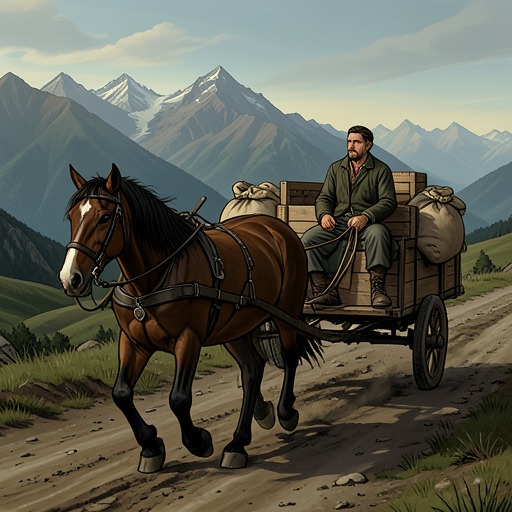
Moyea Valley lies along the Moyea River, within a wider frontier world organized by rail transport, timber, and changing settlement. The valley is not presented as untouched wilderness. Its forests are cut for industrial use, its roads and railway lines carry materials outward, and its communities depend on the movement of workers, families, refugees, and commercial goods. Grainier’s work with the Simpson Company belongs to this system: men haul logs by six-horse teams to railway landings, while machinery drags timber from the forest toward the railroad. The labor changes mountainsides and converts trees into an infrastructure linking the valley with larger markets.
The valley’s history is also bound to the displacement and marginalization of other populations. Grainier’s earliest memory is of more than a hundred Chinese families being forced out of Fry, a town later combined with Eatonville under the name Bonners Ferry. Many of the displaced families ended up roughly thirty miles west, in Montana, in the place that came to be called China Basin. By the time Grainier worked on bridges, that community had dispersed. The valley therefore belongs to a regional history in which railways and white settlement expand while Chinese communities are expelled and Kootenai people remain present but are often treated as part of a landscape outsiders believe they can reorganize.
The 1920 Fire and the Erasure of Home
In the summer of 1920, Grainier returned from the Robinson Gorge Bridge repair job with four hundred dollars in his pocket and found the Moyea Valley consumed by fire. Bonners Ferry was crowded with residents from along the Moyea River who had lost their homes. At the fairgrounds, about a hundred refugees camped among waterlogged remnants of ordinary life, including dolls, mirrors, and bridles. Others who had fled northward had disappeared, and no one could tell Grainier what had happened to Gladys Grainier and Kate Grainier.
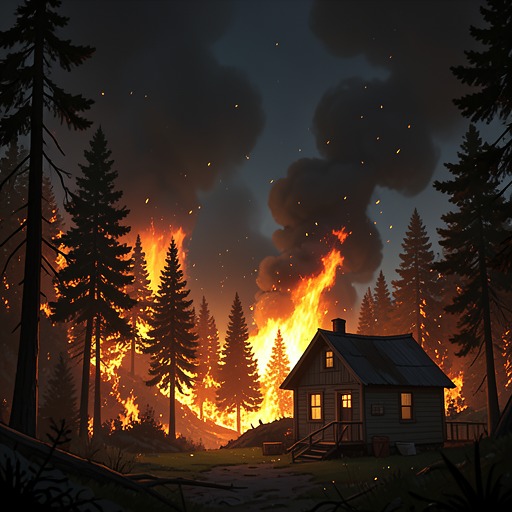
Grainier walked twenty miles along the Moyea River Road toward his homesite, breathing through a handkerchief repeatedly wetted in the river. The fire had begun on the river’s east side near Meadow Creek, crossed the river through a narrow gorge by means of falling, flaming spruce, and devoured the valley. Meadow Creek stood deserted. The forest had become a field of charred spears, and the world around him was reduced to gray, white, black, heat, smoke, and ash. At the Andersens’ property, the cabin had vanished so completely that only a buckled cookstove and scattered chimney stones revealed where it had stood.
Ten days later, after the Spokane International was running again, Grainier rode by train through the burned valley. The blaze had climbed both ridges and gutted the valley along its length. The evening scene became one of his most enduring memories: brilliant pastel light and pale clouds above a black, silent valley, while the train made a great noise that could not rouse the dead landscape. In Creston, British Columbia, he learned that no escapees from the fire had appeared there. The valley’s destruction thus becomes inseparable from the disappearance of his family and from the collapse of the settled world he had built.
Grief, Return, and Improvised Settlement
Grainier initially stayed with a cousin in Creston, unable to work and caught between knowledge and hope. He understood that he had lost his wife and daughter, yet repeatedly imagined that they had escaped and that he should search for them everywhere. His nightmares placed Gladys and Kate on the ruined homesite, dressed in smoking rags and finding nothing left. Thirty days after the fire, he rented two horses and a wagon, carried supplies up the river road, and intended to build shelter on his acre and wait through the winter for his family’s return.
The attempt to return forced a painful recognition. Ash lay so deeply over parts of the road that the route was as indistinct as if covered by winter snow, and Grainier concluded that only the fastest animals or creatures with wings could have escaped the fire. Unable to breathe in the reeking waste, he abandoned the plan and went back to town. Yet the valley continued to draw him. By the following spring, some dispossessed families had returned, and Grainier began camping beside the river, fishing for speckled trout and collecting morels that grew on fire-disturbed ground.
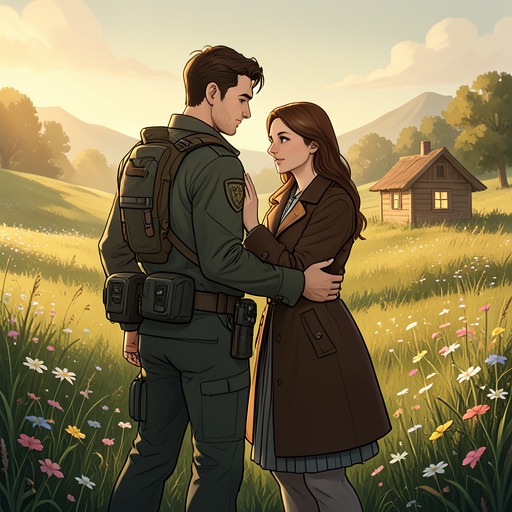
When he reached the vicinity of his former home, he found no recognizable trace of the cabin. The ashes had mixed with the surrounding layer, then been compressed by snow and altered by thaw. The woodstove lay on its side, its legs curled beneath it, but inside it remained a barely charred piece of birch. That remnant became a material link to Gladys Grainier, even as the absence of the family Bible suggested to Grainier that the fire had been stronger than the protection he had associated with God. The valley’s devastation therefore destroys not only property but also the religious and domestic meanings formerly attached to the homesite.
Grainier nevertheless begins to live from what the altered valley can provide. He survives the summer on dried morels and trout cooked in butter bought at Meadow Creek. A small red-haired female dog joins him; he acquires a canvas tarp, rope, a nanny goat, four hens, and a rooster, and builds a rough willow crate for the birds. The dog lives on goat’s milk, fish heads, and whatever she can catch, sometimes wandering away for days. These modest arrangements turn the burned homesite into a precarious household, sustained through dependence on both local commerce and the valley’s returning life.
Ecological Recovery and Permanent Transformation
The valley does not simply return to its former condition. In the first spring of Grainier’s renewed occupation, orange butterflies rise from blackened bear sign, bears travel the muddy road in greater numbers than people, and huckleberries begin to recolonize the dark hillsides. Grainier cuts five dozen small burned spruce for house logs, raises his canvas lean-to, and observes that fireweed and jack pine have grown thigh-high. Pine pollen drifts through the valley, and he realizes that unless he removes the new growth, his clearing will become forest again.
This recovery is vivid but not restorative in the strict sense. In later years, the valley’s destruction fades outwardly while its biological composition changes. The magnificent spruce disappear, replaced largely by scraggly jack pine. Wolves become less frequent and sound farther away; coyotes multiply, rabbits grow scarcer, and trout vanish from long stretches of the Moyea River. The landscape heals by becoming something else. Its return of plants and animals does not recreate the community, forest, or family that existed before the fire, and the apparent renewal carries the evidence of a long ecological afterlife of industrial settlement and catastrophe.
The valley also records the continued presence of animals as active inhabitants rather than decorative scenery. After the fire, wolves answer one another across the peaks, making the valley seem to sing, while birds briefly land as they cross the burn. Years later, after Kootenai Bob has been killed beneath a train, the whistles of the Great Northern Railway set off an enormous nocturnal chorus of coyotes and wolves. Grainier hears the cries as an almost apocalyptic pronouncement, and the valley becomes a shared acoustic space in which human death, railway machinery, and animal distress converge.
Grainier’s Lasting Attachment
Despite arthritis and rheumatism that make ordinary chores difficult, Grainier spends every summer and fall in the remote valley during his last years. He never explains to others what draws him back. His attachment is a vow born from the fire and reinforced by the valley’s successive transformations: the erased cabin, the surviving woodstove, the returning plants, the retreating wolves, and the altered river. Moyea Valley is no longer the place he lost, but neither is it merely a memorial to that loss.
After a later encounter with the wolf-girl, Grainier stays home for two weeks and then returns to town, where he obtains a large male sledding dog that remains his friend for many years. The valley continues to function as the setting in which his human isolation is negotiated through animals, work, memory, and seasonal return. When Grainier dies in his sleep in November 1968, his body remains undiscovered in the cabin through the fall and winter. Hikers find him in spring, and a doctor and the hikers bury him in the yard. The valley finally becomes not only the place of his home and grief but also the place of his unmarked, unattended resting place.
Moyea Valley’s significance lies in its refusal to separate personal tragedy from larger historical and ecological forces. Railway construction, timber extraction, wartime demand for spruce, settlement, displacement, fire, animal migration, and private mourning all occupy the same landscape. Grainier’s life gives the valley a human continuity, but the valley outlasts his household and changes beyond recognition. Its deepest pattern is not recovery as restoration, but survival through irreversible transformation.