Moyea Valley fire
Train DreamsThe Moyea Valley fire is the decisive catastrophe in Robert Grainier’s life: a 1920 conflagration that consumes the Moyea Valley, destroys his cabin and possessions, kills Gladys Grainier, and leaves the fate of Kate Grainier uncertain for years. It breaks the ordinary continuity of marriage, home, and settlement, yet it also becomes the condition from which Grainier’s later solitary life and the altered post-fire landscape emerge.
Causes and Setting
In the summer of 1920, Grainier returned from the Robinson Gorge Bridge repair project with four hundred dollars in his pocket, traveling by passenger car to Coeur d’Alene, Idaho, and then by wagon up the Panhandle. The journey brought him into a region already overwhelmed by the fire. A steadily thickening haze of wood smoke led him into Bonners Ferry, where residents from along the Moyea River crowded the town because they had lost their homes.
The catastrophe belonged to a landscape heavily shaped by railway construction, timber extraction, and wartime demand. Grainier had worked with the Simpson Company, where gangs of more than thirty-five men cut giant spruce, hauled logs by horse teams, and sent them toward railways crossing immense bridges. The demand for spruce had been intensified by World War I. The fire therefore strikes a valley already reorganized by industrial labor and transport, though the narrative does not reduce it to a simple industrial accident. It presents the conflagration as a force that overwhelms settlements, roads, forests, families, and inherited assumptions about human control.
Course and Destruction
Grainier first searched for Gladys Grainier and Kate Grainier among roughly one hundred refugees camping at the fairgrounds in Bonners Ferry. The survivors possessed only scattered, waterlogged remnants of their former lives, including dolls, mirrors, and bridles. Some had waded down the river and through the flames before emerging south of the burn; others had fled northward and had not been heard from. The refugees’ relief at survival, alongside their apparent lack of concern for those who might have failed to escape, intensified Grainier’s panic.
The northbound Spokane International train was halted in Bonners Ferry until the fire weakened and heavy rain soaked the Idaho Panhandle. Grainier then walked twenty miles along the Moyea River Road toward his homesite, tying a handkerchief over his nose and mouth and repeatedly wetting it in the river. Ash fell around him like silvery snow. Meadow Creek stood deserted, and beyond it the forest had become a field of charred, gigantic spears. The world was reduced to gray, white, black, and acrid warmth, with no living animal or plant visible.
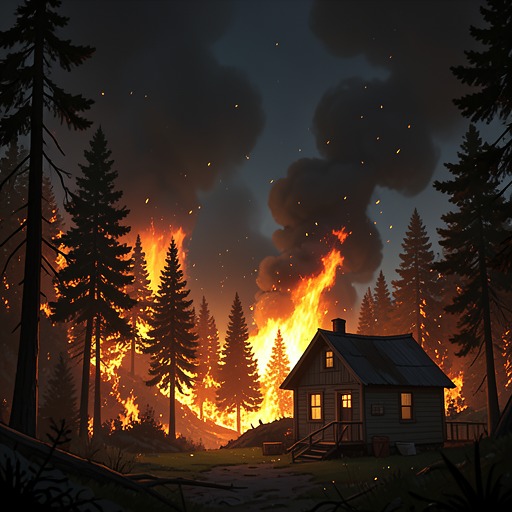
The fire’s path was immense. It began on the east side of the river not far above Meadow Creek, moved northward, crossed the Moyea River at a narrow gorge where flaming spruce trees fell across the water, and devoured the valley. At one point Grainier heard the roar and saw the conflagration half a mile ahead, a black-and-red curtain suspended against the sky. The heat stopped him; he collapsed into the warm ashes and wept. At the Andersen homesite, the cabin had vanished so completely that only a cookstove remained, its iron legs buckled and protruding from a high drift of ash.
Ten days later, after the Spokane International resumed service, Grainier rode up to Creston and back through the valley. The fire had climbed both ridges and stalled halfway down the far sides of the mountains, gutting the Moyea Valley along its length. From the train he saw the blackened valley beneath brilliant evening pastels and clouds catching light from beyond the mountains. The train made a great noise as it passed through, but the dead landscape seemed unable to respond. In Creston, he learned that no escapees from the Moyea Valley fire had appeared there.
Loss, Uncertainty, and Grief
Grainier stayed for several weeks at his cousin’s home, sickened by grief and confused by the absence of confirmed news. He understood that Gladys and Kate had probably been lost, yet the possibility that they had escaped repeatedly seized him. Each night nightmares brought Gladys back to the ruined homesite in smoking rags, carrying their daughter and finding nothing left. His grief was therefore divided between recognition and impossible hope.
Thirty days after the fire, Grainier rented two horses and a wagon, loaded supplies, and traveled back toward his acre. He intended to build shelter and wait through the winter for his family’s return. The journey through ash deep enough to obscure the roadbed finally destroyed that hope. The smell made breathing difficult, and the landscape convinced him that only the fastest animals or creatures with wings could have escaped. He abandoned the plan and returned to town, the physical passage through the burn forcing his mind to accept what it had resisted.
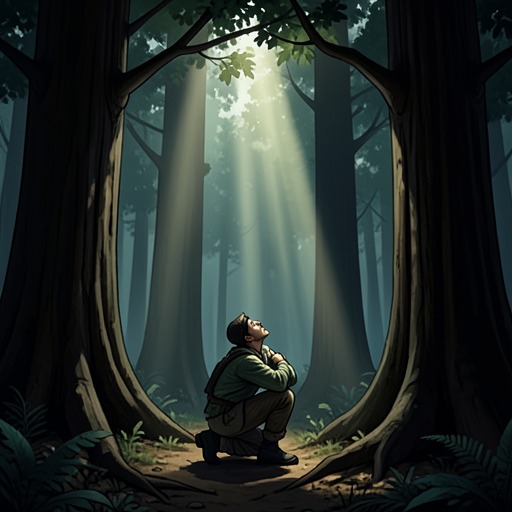
When he later returned to the homesite, he found no recognizable trace of the cabin or of family life. The cabin’s ashes had merged with the surrounding ash, been tamped down by snow, and dissolved by thaw. The woodstove lay on its side with its legs curled beneath it. After Grainier righted it and broke off its door, he found a barely charred piece of birch inside, an object Gladys had touched. He found almost nothing else: one construction spike, no Bible, and no other clear remnant. The absence of the Bible led him to conclude that the fire had been stronger than God, because even the book of God’s Word had not been protected.
The scene also sharpened the difference between Gladys’s death and Kate’s uncertain survival. Jack pine already stood a foot high by the clearing, but Grainier thought that Kate had never even grown to a sprout. Wolves answered one another across the distant peaks, while birds paused over the burn, and the valley’s animal voices made the destroyed homesite seem less empty than it first appeared. Grainier imagined Gladys’s red box of chocolates and saw white paper cups scattered around him, though each disappeared when he looked directly at it. Later he glimpsed Gladys’s white bonnet sailing overhead. He remained for weeks, wanting further visions and repeatedly sighing, “A pretty mean circumstance!”
Gladys’s Death and Kate’s Escape
Years later, a visitation gave the fire a more specific and terrible meaning. Gladys appeared to Grainier as a quavering illumination that took the shape of a woman. She did not speak, but conveyed that she mourned Kate, who had not entered the world of the dead and remained somewhere in the living world. The revelation transformed the earlier uncertainty: Gladys had died, but Kate had escaped the fire.
The vision reconstructed Gladys’s final flight from the cabin. As the fire descended, she gathered the baby and a few possessions, discarding clothes and valuables as the heat drove her toward the river. At the bluff she carried the Bible and the red box of chocolates while holding Kate against her chest. When she needed a hand to steady herself on the rocky descent, she threw away the Bible rather than the chocolates. The vision identifies this choice as the fatal moral judgment imposed on her: her indifference to God was presented as the cause of her undoing.
Twenty feet above the water, Gladys loosened a stone and fell onto the rocks, breaking her back. Unable to move her legs, she freed Kate from the knot in her bodice, allowing the child to crawl along the shore. The water then lifted Gladys and carried her away to drown. Kate survived long enough to gather the scattered chocolates from eddies and pools. At the same time, the vision follows the fire through the cabin: spruce trees burning above the gorge, the roof moss smoking, wall logs popping, a magazine curling into flame, the window shattering, jars losing their wax seals, lamps igniting, and a metal-lidded salt jar exploding before the entire structure caught fire. Gladys’s death and Kate’s escape thus become the hidden human drama inside the larger landscape catastrophe.
Rebuilding and Ecological Aftermath
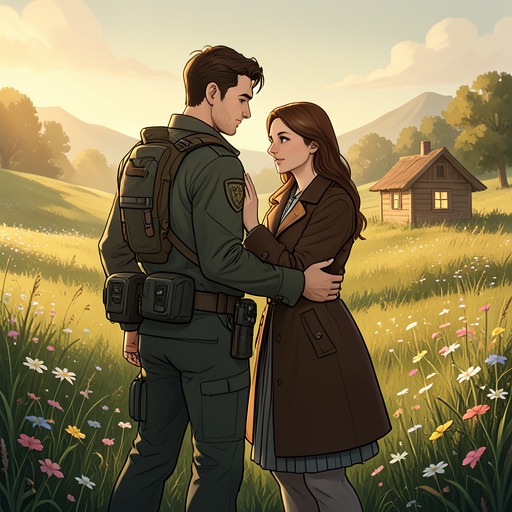
The fire did not end the valley’s history. A hotel was raised at Meadow Creek, and by spring some dispossessed families had returned to begin again. Grainier initially stayed away, but in May he camped beside the river, living on dried morel mushrooms and trout cooked in butter. He saw new shoots and flowers rising from the disturbed ground, and later returned with a tarp, rope, a nanny goat, four hens, and a rooster. A little red-haired female dog joined him, providing companionship and eventually whelping four wolfish-looking pups.
By the following March, animals had returned in force. Orange butterflies lifted from piles of bear sign, bears traveled the muddy road in greater numbers than people, and huckleberries began to appear on the blackened hillsides. Grainier raised his lean-to and cut five dozen burned spruce for a new cabin. When he returned from arranging the timber, he recognized that spring had become full and beautiful: green spread across the dark burn, fireweed and jack pine reached thigh height, and pine pollen drifted through the valley like a mustard-colored fog.
Grainier built an eighteen-by-eighteen-foot cabin, setting its stone foundation below the frost line and raising four walls nearly eight feet high in a month. The fire had already stripped the logs, but the new structure smelled strongly of dead timber, so he burned jack-pine needles on its dirt floor to alter the odor. His rebuilding was practical rather than restorative. He did not recreate the former home so much as establish a new life amid its absence.
Over the decades, the valley did not return to its pre-fire condition. The spruce disappeared, replaced almost entirely by scraggly jack pine. Wolves became less frequent and more distant, coyotes multiplied, rabbits became scarce, and trout vanished from long stretches of the Moyea River. The signs of destruction faded, but ecological recovery proved to be transformation rather than restoration: the land healed into a different community of plants and animals.
Lasting Significance
The Moyea Valley fire changes the scale of Grainier’s story. It begins as a search for a missing wife and daughter, becomes a confrontation with ash and silence, and continues as decades of seasonal return to a place that can never be restored. The fire removes Grainier’s marriage and home while leaving him with fragments: a stove, a piece of birch, visions of chocolates and a bonnet, and the later knowledge that Kate escaped.
Its consequences also extend beyond personal mourning. The valley’s altered species, retreating wolves, expanding coyotes, scarce rabbits, and disappearing trout make the disaster a permanent historical and ecological rupture. Human rebuilding, animal return, and forest succession do not erase the fire; they record its afterlife. The Moyea Valley fire is therefore both a sudden catastrophe and a long process, a single blaze whose damage continues through memory, settlement, guilt, family history, and the replacement of one living landscape by another.