Orphanhood
Train DreamsOrphanhood is the foundational condition of Robert Grainier's life. He enters the story not through a secure family history but as a child sent alone across the continent, carrying a destination pinned to his chest on the back of a store receipt. The absence of any reliable account of his parents makes displacement, uncertain identity, and improvised belonging central features of his later life.
Origins and Uncertain Identity
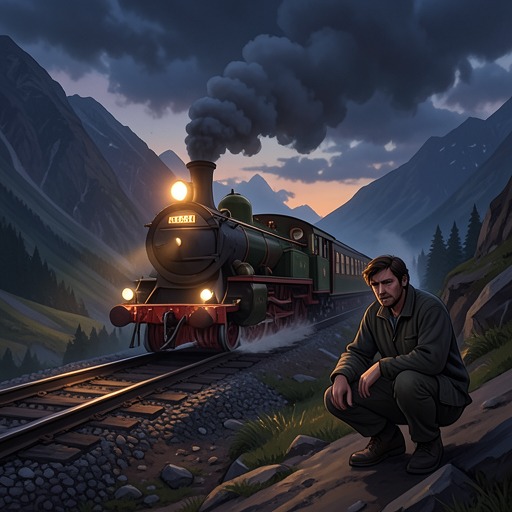
Robert Grainier was six or possibly seven when he arrived in Fry, Idaho, after several days on the Great Northern Railroad. He could not establish exactly where he had been sent from, and even his cousins contradicted one another: one claimed that he came from northeast Canada and had spoken only French, while two others said that he was a Mormon from Utah. They also disagreed about whether they were truly his cousins. The only point on which all three agreed was that Grainier had arrived by train.
His uncertainty extended to his birth. He believed that he had been born sometime in 1886, either in Utah or Canada, but could not say precisely where or when. He had eaten all his food on the first day of the journey, while various conductors kept him fed afterward. The adventure made him forget things almost as soon as they happened, and he soon lost this earliest portion of his life entirely. By the time he thought to ask his aunt and uncle who he was, they had both died, leaving no living parental authority capable of resolving the question.
Substitute Family and Early Belonging
In Fry, Grainier was taken into the household of his aunt and uncle, Helen and Robert Grainier. His aunt was the woman he thought of as his own mother as much as his cousins' mother, while his uncle Robert Grainier, the First, became the smoky-smelling man whom the boy quickly called Father. The family therefore supplied daily care without supplying a stable explanation of origin. Grainier belonged to them in practice, but the narrative preserves the gap between being cared for and knowing where one came from.
His earliest memory places him beside his uncle in the muddy street of Fry, within sight of the Kootenai River, watching the mass deportation of more than a hundred Chinese families. The memory joins private orphanhood to a larger scene of forced displacement. Men with axes, pistols, and shotguns watched as the families were herded onto three flatcars, and Grainier did not wonder where they were being taken until decades later, when he had nearly killed a Chinese laborer himself. His childhood position as a displaced child thus becomes part of a landscape already organized by racial violence, removal, and unequal belonging.
After Helen and Robert Grainier died, Grainier lived in his early teens with his eldest cousin Suzanne and her family. He received basic reading and arithmetic at the Bonners Ferry schoolhouse after Fry and Eatonville were combined under the name Bonners Ferry in 1899. He was never a scholar, but literacy helped him manage in the world. Without parents to insist that he remain in school, he quit in his early teens and became a layabout, showing how orphanhood operates not only as an emotional absence but also as the disappearance of ordinary supervision and social direction.
Orphanhood and Exposure to the World
The lack of a secure family structure left Grainier exposed to the improvised education of the frontier. While fishing alone along the Kootenai River, he encountered an itinerant laborer, or boomer, nursing an injured leg in a makeshift camp among the birches. The man's invitation and grim declaration that Grainier should regard a murdered man brought the boy into contact with adult violence outside the protection of school or household. Such encounters become part of Grainier's practical education: he learns from strangers, workplaces, accidents, and passing communities rather than from a continuous parental tradition.
The same vulnerability later appears in his participation in the attempted killing of a Chinese laborer accused of stealing from the Spokane International Railway company stores. In the summer of 1917, three railroad workers restrained the man and dragged him toward a bridge under construction above the Moyea River. Grainier joined them by grasping one of the prisoner's bare feet, then tightened his hold on both feet as the group tried to throw him from the trestle. The scene exposes how a man formed without a settled moral or familial inheritance can be absorbed into the collective force of a work gang. Grainier is not merely an observer: he declares his commitment to the group while physically helping to carry out its violence. The prisoner's escape, followed by Mr. Sears's ineffective revolver shots, interrupts the attempted execution but does not erase Grainier's participation.
Repeated Loss and Adult Isolation
Orphanhood is not confined to Grainier's childhood; it becomes a pattern of repeated severance. In 1920, after returning from the Robinson Gorge job with four hundred dollars, he traveled toward Bonners Ferry as the Moyea Valley burned. He searched among roughly one hundred refugees at the fairgrounds for his wife, Gladys Grainier, and their daughter, but no one had news of them. The fire destroyed the household that had given his adult life its most direct form of family continuity, leaving him once again without those to whom he belonged.
Years later, the death of Kootenai Bob deepened Grainier's isolation. In 1930, during Prohibition in the United States, Kootenai Bob was deceived into drinking a shandy that had become, in practice, a large quantity of beer. He spent the afternoon lapping beer from an eight-quart canning pan, wandered onto the tracks, and was run over by successive trains. His people later searched the right-of-way for fragments of flesh, bone, and cloth, placing what they recovered in brightly painted leather pouches for burial. The careful recovery of the dead contrasts with the uncertainty surrounding Grainier's own origins: Kootenai Bob's community can gather and ceremonially restore what the trains scattered, whereas Grainier's lost parents remain beyond recovery and explanation.
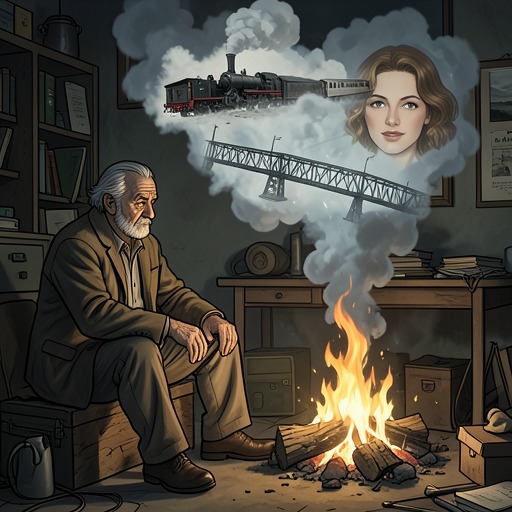
Grainier's later life in a cabin in the woods approaches a chosen version of orphanhood. He speaks aloud to himself when Eddie Sauer is absent and even his dog has wandered away, startling at the sound of his own voice. His isolation is therefore audible: the familyless child sent by train has become an adult whose companionship is intermittent and whose speech can return to an empty room. The surrounding world also changes after the Moyea Valley fire. Spruce disappears, jack pine becomes dominant, wolves grow more distant, coyotes more numerous, rabbits scarcer, and trout vanish from stretches of the Moyea River. Grainier's solitude is inseparable from this altered ecology.
Narrative Significance
Orphanhood gives Grainier a distinctive relation to identity, history, and community. He is repeatedly placed beside people who are being removed, hunted, scattered, or gathered after death: the deported Chinese families, the accused laborer pursued across the bridge, refugees from the Moyea Valley fire, and Kootenai people collecting Kootenai Bob's remains. His own biography follows the same logic of fragments. A train carries him into a family whose explanations conflict; later, fire and death strip away the relationships he has made.
The condition also helps explain the episodic shape of his life. Because no single family history securely organizes his past, his identity is assembled from work, accidents, animals, friendships, and memories of extraordinary encounters. Orphanhood is therefore not simply a biographical fact at the beginning of the narrative. It is the enduring structure through which Grainier experiences belonging: he can enter groups and form attachments, yet each attachment remains vulnerable to disappearance, and no later community can fully answer the question of where he began.