Peterson
Train DreamsPeterson is a surveyor for the Spokane International Railway, originally from Virginia, whose appearance and conduct make him an unsettling but revealing figure in Robert Grainier’s later life. After Peterson is shot by his own dog, Grainier transports him through a freezing night toward medical attention. The journey becomes less a straightforward rescue than an extended account of fear, rumor, and animal intelligence: Peterson’s wounded body carries the immediate fact of violence, while his story supplies the local mythology of the wolf-girl and the dog that supposedly learned too much.
Identity and Circumstances
Peterson works in the same railroad-centered world that has shaped Grainier’s labor, but he is not presented as a close friend or a prominent authority. He is described as a bare acquaintance who comes and goes through the area as a surveyor for the Spokane International Railway. His physical appearance also affects the encounter: a dented head and a “crazy eye,” the result of some mishap in his youth, make him difficult for Grainier to look at directly. The description places Peterson at the intersection of occupational familiarity and bodily estrangement. He belongs to the ordinary infrastructure of the region, yet his damaged face and extraordinary account make him seem almost like one of the strange stories circulating along the Kootenai River.
His injury occurs during a winter episode in which stories of remarkable dogs have become common. Local talk includes reports of canine rescues, tricks, supercanine intelligence, and humanlike understanding. Against that background, Peterson is the man who has actually been shot by his own dog. His employer and comrades consider putting him on a train to town, but fear that he may die before morning, so Grainier agrees to haul him from Meadow Creek to Bonners Ferry.
The Night Journey with Grainier
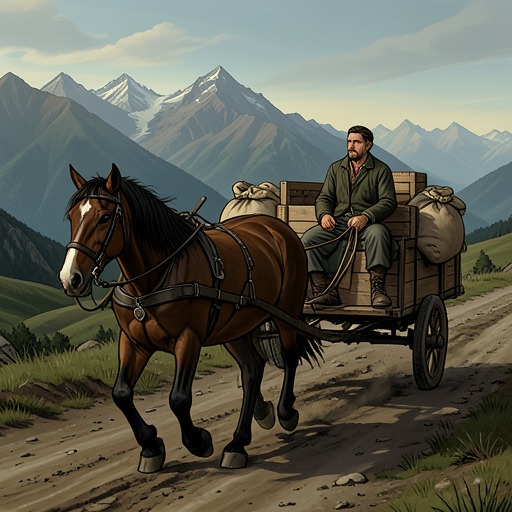
Grainier carries Peterson down the Moyea River Road wrapped in a blanket and half sitting up on a load of six sacks of wood chips arranged for his comfort. The road is dangerous in a plain, physical way: a thaw has melted the snow from the ruts, but freezing weather has returned, and Grainier worries that the injured man may die of cold before reaching the doctor. For the first several miles the two men scarcely speak. Grainier watches Peterson intermittently to make sure he remains alive, especially after darkness hides first the surveyor’s strange eye and then his entire face.
The silence eventually becomes unbearable. As the wagon moves through shadows, birch silhouettes, clouds around a yellow half-moon, the creak of the wagon and the clop of the mares intensify Grainier’s fear. He asks Peterson whether he is dead and whether he feels able to continue. Peterson answers that he is alive and, with characteristic bluntness, that he is “perfect.” The exchange gives the journey a grim comic rhythm: Grainier is trying to perform practical care, while Peterson’s evasive, painful replies force him to keep testing whether the passenger is conscious.
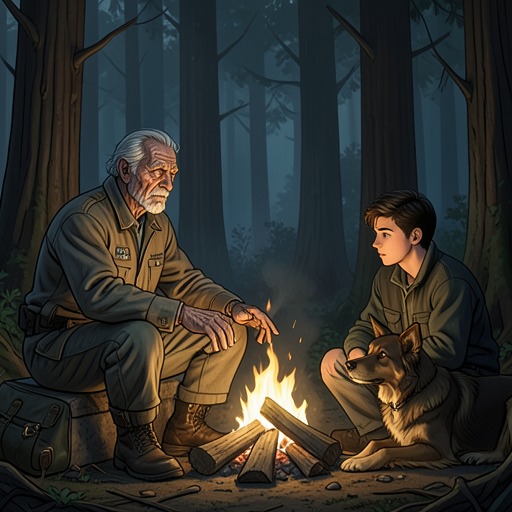
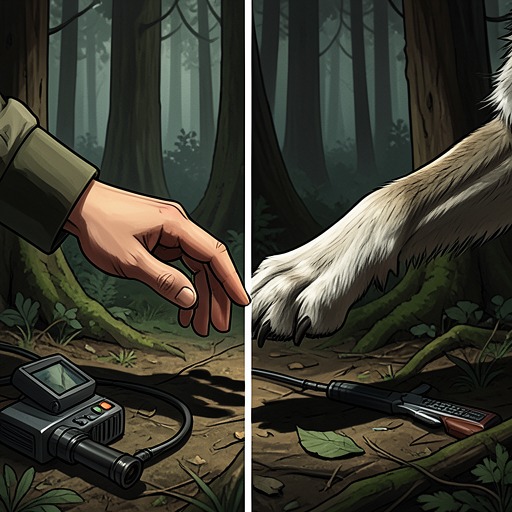
Once Grainier believes they have spoken enough to justify the question, he asks about the report that Peterson’s dog shot him. Peterson initially confirms it but offers little explanation, irritating Grainier, who threatens to stop and make him walk if he continues to evade the simple question. The threat produces Peterson’s fuller account. He says the dog acted in self-defense: Peterson had tied it up and intended to shoot it because of what Kootenai Bob had told him. When the dog slipped the rope and backed away from every step Peterson took toward it, Peterson swung the rifle by the barrel and struck at the animal. The dog then fired the gun, leaving Peterson wounded in the left shoulder and chest.
The episode makes the dog’s action difficult to classify. Peterson treats it neither as an ordinary accident nor as a completely inexplicable mishap. He believes the animal understood his intention, knew that Peterson meant to kill it, and responded deliberately. The dog therefore appears within Peterson’s story as an agent capable of reading human purpose and defending itself against human violence. Peterson’s own injury is the immediate consequence of trying to restore an uncomplicated hierarchy in which the man commands and the dog submits.
Kootenai Bob, the Dog, and the Wolf-Girl
Peterson attributes the decision to kill the dog to Kootenai Bob’s interpretation of its behavior. Grainier has already discussed wolfish dogs with Kootenai Bob, who explains that Kootenai tradition permits only the chief wolf to mate and only one she-wolf to bear litters. That rule makes a dog producing wolfish pups seem extraordinary, and Bob suggests that such an animal might be a dog-of-wolf and that Grainier might have begun his own pack. He also tells Grainier that “There’s not a wolf alive that can’t tame a man,” a saying that reverses the usual human fantasy of taming the wild.
Peterson’s version of Bob’s warning is darker and more elaborate. After Peterson lets the dog into his house, the animal escapes through a window and disappears for thirteen days. It returns almost wild and barely recognizes its master. Later, Kootenai Bob examines the dog’s eyes and claims to see the wolf-girl’s image in them. He says the dog has been with wolves and should be shot before it calls the wolf-girl into Peterson’s home. In the warning, the wolf-girl is imagined as a predatory, blood-drunk creature who might bring wolves to the house, consume Peterson, and speak in his own voice to people he has wronged.
Peterson says he believes the dog had been “confabulating with that wolf-girl person,” though he immediately qualifies even the word person. He calls her a creature and wonders whether she was ever created by God. His language reveals fear working through categories: dog and wolf, person and animal, creation and monstrosity. The account does not establish that the dog met the wolf-girl or that the wolf-girl caused the shooting. It does establish that Peterson’s attempt to kill the animal was driven by a local story, and that the story gave his fear a concrete target.
Peterson also repeats the region’s wider rumors. The wolf-girl was said to have been seen years earlier leading a pack, and a visitor from Seattle reportedly described a bloody sign between her legs. Peterson connects such stories to the Kootenai practice of naming animals as people, including Coyote-person and Bear-person. Yet his own testimony is hardly detached from the beliefs he describes. He dismisses the Kootenai as willing to believe anything strange, witchy, or religious while simultaneously accepting their warning seriously enough to shoot his dog. His skepticism and credulity occupy the same voice.
Fear, Responsibility, and Narrative Function
Peterson’s story changes Grainier’s experience of the road. Listening to the account in darkness, Grainier becomes afraid of seeing the wolf-girl and says he does not know how he will find the strength to travel the road at night again. Peterson admits that he cannot sleep through the night either. Grainier invokes God as a source of strength, but the conversation has already unsettled the boundary between ordinary danger and supernatural possibility. By the end of the journey, no wolf-girl appears; Grainier remains frightened, watching the woods, but the feared visitation does not occur.
Peterson is therefore less a confirmed witness than a transmitter of unstable knowledge. His account is nested inside Grainier’s journey and depends on statements from Mrs. Stout, Kootenai Bob, a Seattle visitor, and general tales about dogs. Each speaker enlarges the story while making its factual status less secure. The dog’s shooting is presented as a fact, but its motive is interpreted through rumor. Peterson’s injury is undeniable; the wolf-girl remains a possibility produced by overlapping testimony, cultural belief, and nocturnal fear.
His episode also belongs to a broader pattern in which animals repeatedly exceed the roles humans assign them. Dogs rescue masters, display humanlike intelligence, wander between domestic and wild worlds, and in Peterson’s case turn a gun back against the person holding it. The story does not simply prove animal personhood, but it repeatedly makes human certainty look fragile. Peterson’s attempt to silence an unsettling animal instead generates another tale, one that survives through retelling and becomes part of the region’s folklore.
Character Significance
Peterson’s importance lies in the contradiction he embodies. He is a railroad professional carrying the marks of practical modern work, yet he explains his wound through a chain of animal legends and supernatural fears. He seeks control by tying and beating the dog, but the dog escapes, understands his intention, and shoots him. He regards Kootenai knowledge as irrational, yet that knowledge governs his actions. He fears the wolf-girl as an inhuman threat, while his own violence toward the dog initiates the crisis.
Through Peterson, the narrative places local storytelling beside bodily fact without fully resolving either into the other. His damaged head, wounded shoulder and chest, frightened speech, and concern about the winter cold keep the episode grounded in material vulnerability. At the same time, his testimony opens onto the larger world of wolves, dog-of-wolf animals, animal-person categories, and the wolf-girl who haunts the surrounding community’s imagination. Peterson remains memorable not because the narrative confirms his explanation, but because his desperation shows how quickly fear can turn rumor into action—and how an animal’s resistance can expose the limits of human mastery.