Prohibition in the United States
Train DreamsProhibition in the United States is the legal and social backdrop against which the novel contrasts official restraint with persistent appetite, custom, and violence. It appears not as a self-contained political plot but as a pressure on ordinary encounters: a law that changes what people may drink, who is presumed to understand liquor, and how an apparently harmless mixture can become lethal.
Historical Presence and Narrative Setting
Prohibition is explicitly established by 1930, when the United States had been more than a decade into the policy. This places the novel’s later scenes in a society where alcohol is restricted, while neighboring Canada remains a practical counterpoint because liquor is still allowed there. The border therefore becomes more than a geographic line: it separates two legal regimes and gives Canadian visitors an authority that proves disastrously unreliable.
The period also forms part of a broader atmosphere of public suspicion and volatile collective judgment. Earlier in the story, a Chinese laborer accused of stealing from the Spokane International Railway’s company stores is dragged toward a bridge under construction above the Moyea River, while a work gang debates and attempts to throw him from the trestle. Elsewhere, the mass deportation of Chinese families from Fry is remembered as an early spectacle of organized exclusion. Prohibition belongs to this same historical world of regulation, racialized judgment, and communal action, though its immediate effect is comic in origin and catastrophic in result.
The Canadian Confidence Trick
The most consequential appearance of Prohibition comes when ranch hands visiting from British Columbia persuade Kootenai Bob to drink a jug of shandy, described as a mixture of lemonade and beer. They tell him that the lemon juice will nullify the beer’s effects. Because the United States has been under Prohibition for over ten years, Kootenai Bob accepts the people from Canada as experts: their country still permits liquor, so their confidence appears to rest on experience rather than deception or ignorance.
The scene exposes the gap between law and knowledge. Prohibition has not erased alcohol from the region; instead, it has made ordinary understanding of alcohol uneven and vulnerable to folklore. A legal distinction across the border is converted into misplaced trust. The drink’s name and ingredients suggest moderation, but the narrative steadily strips that appearance away as the lemonade disappears and the beer becomes the substance of the encounter.
Kootenai Bob’s Death
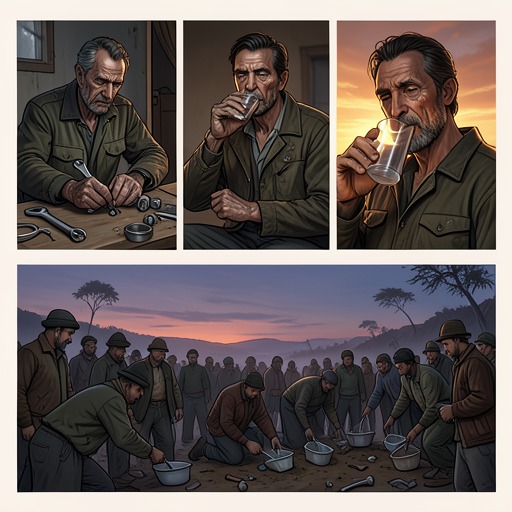
Grainier finds Kootenai Bob toward evening on a bench outside the hotel in Meadow Creek, his legs wrapped around an eight-quart canning pan filled with beer. He laps at it like a thirsty animal, has been guzzling all afternoon, repeatedly urinates on himself, and has lost the power of speech. The precise size of the pan gives the episode a brutal physical scale: this is not a casual drink but an extended collapse into intoxication.
After dark, Kootenai Bob wanders away and reaches the tracks roughly a mile from the hotel. He lies unconscious across the ties and is run over by a succession of trains. Four or five trains pass over him before crows gathering late the next afternoon prompt someone to investigate. His remains are scattered for a quarter mile along the right-of-way.
The aftermath gives the death a communal and ritual dimension. Over the next several days, members of Kootenai Bob’s people move along the bare strip beside the rails, finding fragments of flesh, bone, and cloth that the crows have missed. They collect these remnants in brightly painted leather pouches, presumably taking them away for burial with an appropriate ceremony. Prohibition thus enters the narrative through a legal framework but ends in a scene of bodily dismemberment and cultural recovery.
Law, Exclusion, and Irony
The episode’s irony lies in the collision between prohibition and excess. A regime intended to suppress drinking has not prevented alcohol from reaching Kootenai Bob; it has helped produce the ignorance and misplaced confidence that surround his drinking. The Canadian ranch hands’ assurance that lemon juice cancels beer turns the law into the source of a false medical principle, while Kootenai Bob’s death reveals the material consequences hidden inside that belief.
The novel places this incident beside other forms of collective violence. The Chinese laborer on the bridge is treated as a body that a work gang may restrain, chase, and attempt to discard; Chinese families are driven from Fry under armed supervision; Kootenai Bob’s body is later broken apart by trains, while his people work to reclaim what remains. These episodes do not make Prohibition the cause of every injustice, but they show a recurring world in which institutions, crowds, racial categories, and inherited assumptions determine whose bodies are protected and whose are exposed.
Narrative Significance
Prohibition is significant because it converts historical background into a mechanism of misrecognition. It explains why Kootenai Bob trusts visitors from Canada, why their claim about alcohol seems credible, and why the consequences of the afternoon are so disproportionate to its beginning. The policy remains mostly offstage, yet its absence from daily speech is precisely what makes it powerful: the characters live inside its effects without possessing reliable knowledge of the substance it regulates.
The episode also contributes to the novel’s larger pattern of unstable boundaries. The border between the United States and Canada separates legal systems; the fairground displays dog-of-wolf pups that trouble the boundary between species; rumors around the Moyea Valley blur human and animal identity; and the railway cuts through the landscape, turning travel and commerce into instruments of death. Prohibition belongs to this network of crossings and confusions. Its most memorable result is not a political debate but a mistaken certainty, followed by a body scattered along the tracks.