Renewal after fire and return to wilderness
Train DreamsThe burned valley is the defining landscape of Robert Grainier’s adult life: a place where industrial extraction, catastrophic fire, bereavement, human rebuilding, and ecological change become inseparable. The 1920 blaze destroys his home and apparently takes Gladys Grainier and Kate Grainier, but the valley does not remain dead. Plants return, animals reclaim the slopes, and Robert Grainier rebuilds a smaller life among the remains. Its decisive meaning lies in the difference between recovery and restoration: the land survives, but it never becomes the same land again.
The Fire and the Ruined Valley
In the summer of 1920, Robert Grainier returned from the Robinson Gorge Bridge repair job with four hundred dollars in his pocket. He traveled by passenger car as far as Coeur d'Alene, Idaho, then continued by wagon up the Panhandle, entering Bonners Ferry through an increasingly dense haze of wood smoke. The town was crowded with residents from along the Moyea River who had lost their homes, while the northbound Spokane International Railway had stopped until the fire subsided and heavy rain soaked the region.
Robert Grainier searched the refugees for Gladys Grainier and Kate Grainier, questioning people among roughly one hundred survivors gathered at the fairgrounds with waterlogged remnants of their possessions: dolls, mirrors, bridles, and other isolated objects. Some people had escaped by wading down the river and through the fire, while those who had gone north to outrun the flames had disappeared. The survivors’ relief at being alive existed beside their apparent indifference to those who might not have escaped, intensifying Robert Grainier’s frantic uncertainty.
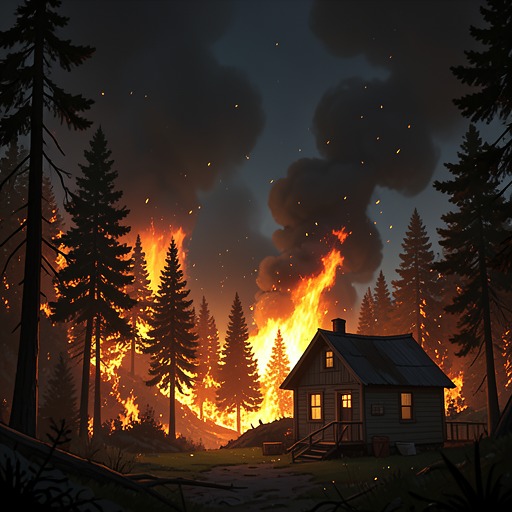
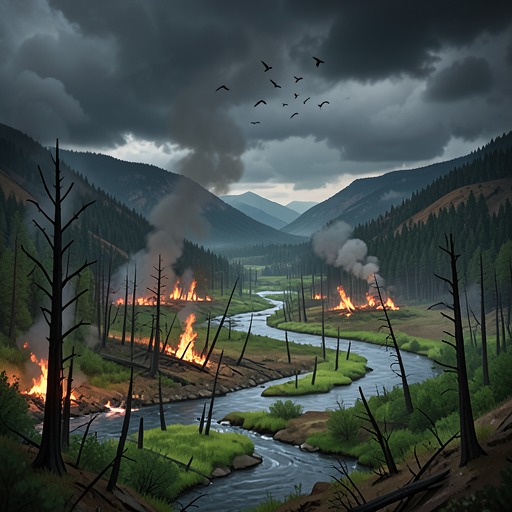
He walked twenty miles along the Moyea River Road toward his homesite with a handkerchief tied over his nose and mouth, repeatedly wetting it in the river to strain the smoke. The fire had begun on the river’s east side near Meadow Creek, crossed the water where falling spruce trees formed a bridge of flame, and consumed the valley. Meadow Creek stood deserted. Farther north, the living forest had become a field of charred spears, and the world was reduced to gray, white, black, and acrid heat. At the Andersens’ homesite, Robert Grainier could scarcely identify where the cabin had stood; only the cookstove, its iron legs buckled, rose from a drift of ash, with a few chimney stones scattered nearby.
The devastation continued beyond the first blackened stretch. As he approached his own home, the sound of cracking logs and hissing combustion grew louder, and the fire appeared ahead as a black-and-red curtain. The heat stopped him before he could reach it. He collapsed in the warm ash and wept, already understanding that the fire had consumed everything. Ten days later, when the Spokane International Railway ran again, he traveled through Creston, British Columbia, and back through the valley. From the train he saw the blaze’s full reach: it had climbed both ridges and gutted the valley along its length. Under a brilliant evening sky, the black landscape remained utterly still while the train’s noise passed through it without seeming to awaken it.
Grief, Ash, and the First Return
No refugees from the Moyea Valley fire appeared in Creston, British Columbia. Robert Grainier stayed with his cousin for several weeks, sickened by grief and confused by hope. He knew that he had lost his wife and daughter, yet an irresistible conviction repeatedly seized him that Gladys Grainier and Kate Grainier had escaped and that he must search for them everywhere. His nightmares transformed the ruined landscape into a scene of impossible return: Gladys Grainier emerged from the blackness in smoking rags, carrying their daughter, only to find the homesite empty.
Thirty days after the fire, Robert Grainier rented two horses and a wagon and carried supplies toward his acre, intending to build shelter and wait through the winter for his family to come back. The plan initially preserved the possibility of reunion, but the burned country destroyed that possibility more decisively than any report could have done. Ash lay so deeply over portions of the road that the roadbed disappeared beneath it, and the reek made breathing difficult. As he entered the waste, his sorrow seemed to lose its hopeful, feverish remainder; he turned back and returned to town.
By the following spring, dispossessed families had begun returning to the Moyea Valley, and Robert Grainier gradually followed. In May he camped beside the river, fishing for speckled trout and gathering morels, mushrooms that grew abundantly in ground disturbed by fire. When he came within sight of his old homesite, he climbed the draw that he and Gladys Grainier had once used between the cabin and the water. New shoots and flowers had already appeared amid the general death, creating a stark contrast between personal ruin and the land’s quick biological response.
At the cabin site he found no recognizable trace of his former life, only dark ground surrounded by black spruce spikes. The cabin had burned so completely that its ashes had blended into the common layer of the valley, then been pressed down by snow and altered by thaw. The woodstove lay on its side with its legs curled beneath it; when Robert Grainier righted it and opened the broken door, he found a barely charred piece of birch inside. That small remnant, associated with something Gladys Grainier had touched, became more powerful to him than the obliterated structure around it. He found no Bible and took the absence as evidence that the fire had exceeded the protective power he had attributed to God.
Regeneration and Human Reconstruction
The first regeneration was visible in the vegetation. Dozens of jack pine already stood a foot high around the clearing, and Robert Grainier imagined that by June or July the ground would be green with grass. Thinking of Kate Grainier, he contrasted the child’s lost growth with the seedlings’ vigorous emergence. His grief therefore encountered a biological process that was both consoling and cruel: the valley could produce new trees, but no growth could restore the child who had never reached maturity.
The returning vegetation was accompanied by returning voices. Robert Grainier believed himself almost alone in the sterile region until he called aloud and heard wolves answering from distant peaks. Their calls passed through the valley from pack to pack, while birds landed briefly as they crossed the burn. The wolves made the ruined homesite feel inhabited again, but not by the human household that had occupied it. Gladys Grainier’s presence instead appeared in visions: white paper chocolate cups seemed scattered around him and vanished whenever he looked directly at them, and a white bonnet resembling hers sailed overhead along the river.
He remained for weeks beside the river, waiting for further visions and allowing impossible perceptions to coexist with practical labor. He repeatedly expressed his condition as “A pretty mean circumstance!” and slowly recognized that work could keep the sigh from becoming his entire life. The fire had removed his house, family, and former social world; rebuilding would begin with food, shelter, and companionship rather than with an attempt to reproduce the past.
During the summer he lived on dried morels and trout cooked in butter bought at Meadow Creek. A small red-haired female dog joined him and stayed for a time, surviving on goat’s milk, fish heads, and whatever she could catch. Robert Grainier bought a canvas tarp, rope, and a nanny goat, then later constructed a roughly two-yard-square willow crate and bought four hens and a rooster. The animals turned the camp into a modest domestic arrangement. The dog offered company but also wandered for days, making companionship provisional rather than secure.
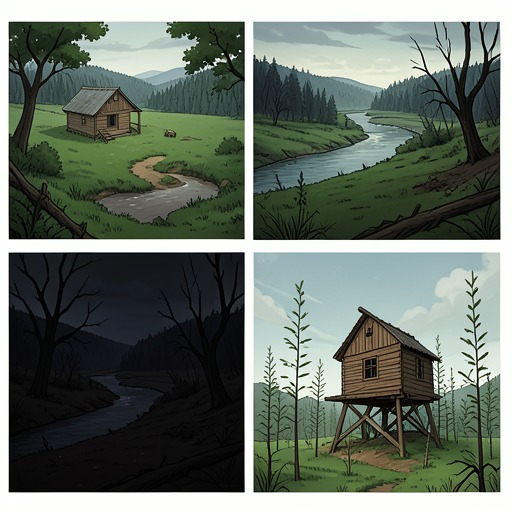
Late the following March, Robert Grainier returned with a wagonload of supplies. The valley’s animal life had become conspicuous: orange butterflies rose from piles of bear sign, bears outnumbered people on the muddy road, and huckleberries were returning on the blackened hillsides. At his old riverside campsite he raised a canvas lean-to and cut five dozen burned spruce for house logs. When he returned after arranging the horse’s return to Bonners Ferry, he saw that spring had transformed the burn with green growth, thigh-high fireweed, jack pine, and drifting pine pollen. The new forest was already vigorous enough that he would have to pull seedlings from his clearing if he wanted to keep it open.
He built a cabin approximately eighteen by eighteen feet, laying a stone foundation in a ditch deep enough to reach below the frost line, scribing and hewing logs, and lifting the higher ones into place himself. Within a month he had raised four walls nearly eight feet high. He postponed the windows and roof until he could obtain milled lumber, using canvas to cover the open end. The fire had already peeled the logs, but the wood carried an unpleasant smell, so he burned heaps of jack-pine needles on the dirt floor to alter the cabin’s odor. His reconstruction was therefore practical and incomplete, marked by the material aftereffects of the fire at every stage.
A Changed Ecology, Not a Restored One
The valley’s regeneration gradually made clear that the fire had produced a new ecological order rather than repaired the old one. Decades later, Robert Grainier understood that the region would never slowly resume its pre-fire condition. The signs of destruction faded, but the plants changed, and different plants supported different animals. The magnificent spruce forest was gone, replaced chiefly by scraggly, mean-looking jack pine. Wolves became less frequent and sounded farther away, coyotes multiplied, rabbits grew scarcer, and trout disappeared from long stretches of the Moyea River.
This succession gives the burned valley a history of replacement as well as renewal. Fireweed, jack pine, huckleberries, butterflies, bears, birds, and returning grasses testify that life continues, but their presence does not amount to a return of the former forest. The landscape’s apparent healing is therefore double-edged. It supplies food, shelter, and a reason to remain, while continually demonstrating that the world of Gladys Grainier and Kate Grainier cannot be recovered through natural growth.
The disaster is also connected to the human economy that surrounds the valley. Robert Grainier had worked in industrial logging operations where gangs of more than thirty-five men cut giant spruce, hauled timber with horses, and fed logs into railway systems. The work altered mountainsides on a scale he compared to the pyramids, while the demand for spruce had been intensified by the war in Europe. The same broad system of railways, timber extraction, and settlement shaped the region in which the fire destroyed a human home. Afterward, commercial rebuilding quickly appeared: businessmen from Spokane raised a hotel at Meadow Creek, and some families returned to begin again.
Robert Grainier’s own return was slower and more solitary than that of the settlers or businesses. He worked as a freighter along Highway 2, using horses and a wagon to serve communities without close railway access, but the river and the burned valley kept drawing him back. The landscape became not merely the site of loss but the place where he could continue a life on his own terms, supported by labor, animals, fishing, and seasonal movement.
The Valley as Lifelong Home
Even in his final years, when arthritis and rheumatism made ordinary chores difficult and winter in the cabin would have killed him, Robert Grainier spent every summer and fall in his remote home. His persistence was not based on the belief that the valley would restore itself or return his family. He remained because the altered place had become the ground of his vow, memory, and identity.
The animal changes registered the passing of time more clearly than any human institution. The wolves were heard less often, the coyotes became more numerous, and the river lost trout. Yet Robert Grainier continued to inhabit the boundary between domestic life and wilderness, first with the little red dog and later with a large male sledding dog who became his friend for many years. The companionship of these animals did not replace Gladys Grainier and Kate Grainier, but it allowed a life shaped by attachment to continue after human attachment had been broken.
The burned valley finally becomes an image of survival without restoration. Its ash supports new plants, its roads carry returning people, and its clearings can hold a cabin, goats, hens, and dogs. At the same time, the vanished spruce, the missing family, and the changing animal population remain irrecoverable. Robert Grainier’s repeated return accepts that contradiction rather than resolving it. When he died in his sleep in his cabin in November 1968 and was found only in the spring by hikers, the valley received him as it had received everything else: through disappearance, persistence, and a slow transformation that left no world exactly as it had been.