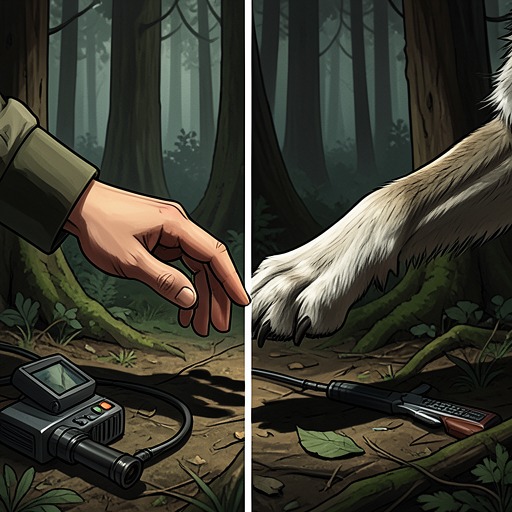
Robert Grainier and Kate-no-longer (the wolf girl)
Train DreamsRobert Grainier and Kate-no-longer (the wolf girl) is a father-daughter relationship distorted by the destruction of Grainier’s home and the disappearance of his family. Its decisive moment comes when Grainier recognizes a badly injured wolf-girl as his daughter Kate, even though nothing visible seems capable of proving her identity. He rescues and treats her, but their reunion does not restore the family or return Kate to human society: after one night in his cabin, she escapes through the window and resumes her slow, animal-like journey toward the river.
From Family Loss to Impossible Recognition
The relationship is defined first by absence. Grainier had lost Kate and Gladys in the fire that destroyed his home, and his later life was marked by the belief that the Chinese railroad laborer he had nearly helped to kill had taken revenge by calling down a curse upon them. That belief links the father’s guilt over an earlier act of collective violence with the later appearance of his daughter in an unrecognizable form. The connection is not established as an objective supernatural fact; it is Grainier’s conviction, and it makes Kate’s return feel both like a miracle and like a punishment.
Kate’s transformation is presented through the starkest possible bodily evidence. When the wolves flood through the clearing outside Grainier’s cabin, one creature remains behind: a childlike female figure, panting and apparently hurt. In the moonlight Grainier sees a delicate human structure bent at the arms and legs, but also a face like a wolf, hairless and marked by greenly shining eyes. Her left leg is shattered, with splintered bloody bone below the knee. She has crawled on three limbs, dragging the broken leg behind her, and has snatched most of her hair out, leaving only a few patches. The body preserves enough of the child to invite recognition while displaying enough animal damage to make ordinary recognition impossible.
Recognition Without Proof
Grainier asks whether the creature is Kate, but the scene immediately removes the usual grounds for certainty. Nothing about her appearance tells him that she is his daughter. She gives no sign of knowing him, meets none of his attempts at recognition, and watches him in flat terror. Yet Grainier simply knows that she is Kate. The relationship therefore rests on paternal recognition rather than reciprocal identification: his knowledge survives where language, memory, facial likeness, and social identity have failed.
That asymmetry makes Kate-no-longer more than a transformed version of the lost child. The narrative explicitly distinguishes Kate from “Kate-no-longer,” presenting the wolf-girl as a being who once was Kate but is no longer Kate in the ordinary human sense. She growls, barks, snaps, and nearly fades into apparent unconsciousness when Grainier approaches. Her behavior does not confirm a daughter’s return; it tests whether a father can continue to act as a father when the child before him cannot answer as one.
Care as the Relationship’s Last Shared Language
Grainier responds first with fear and defensive readiness. He searches for something with which to strike the creature and approaches barefoot in his long johns, carrying a hurricane lamp and a club. His huge shadow magnifies the menace of the encounter, while the entire valley falls silent except for his footsteps and the wolf-girl’s panting. The scene makes care emerge from, rather than bypass, terror. Grainier does not possess a prepared remedy or a clear understanding of what he has found; he acts because she is injured and because he is the one present.
He lifts Kate-no-longer beneath the arms and carries her into the cabin. She breathes rapidly, faintly, and shallowly, whimpers once against his ear, and snaps her jaws without otherwise struggling. Grainier lays her on his pallet and prepares a splint from kindling. He cuts his long johns into strips, straightens the leg as best he can, whittles a piece of wood so that it cups the shin, and binds it in place. His admission that he is not a doctor but is merely the person who is there defines the relationship’s ethic: he cannot reverse her transformation, explain her suffering, or guarantee her survival, but he can perform the immediate work of a father’s care.
The improvised treatment also restores a limited domestic space around Kate. The cabin, built by Grainier after the fire, becomes for one night a shelter in which the damaged child can lie on a pallet, receive air through an opened window, and be watched while she sleeps. Grainier studies her leathery skin, calloused wrists, and misshapen, hardened feet, searching for the human thought that seems absent from her sleeping face. His attention is intimate but not possessive; he observes what has happened to her without pretending that observation can make her whole again.
The Failed Return
The reunion ends without mutual understanding or a grand recovery. A train passes through the valley and enters Grainier’s dream rather than waking him. Near daylight, a smaller sound brings him awake: Kate-no-longer has stirred and is leaving. She leaps through the window before he can intervene. Grainier watches her crawl and pause to twist sideways, snapping at the bindings on her injured leg as a wolf or dog might. She moves slowly along the path toward the river.
Grainier means to track her and bring her back, but he never does. This failure is not simply a missed opportunity. His care has reached its limit, and Kate’s departure establishes that the father cannot reclaim the daughter by force or restore her through recognition alone. He can carry her, splint her leg, and provide temporary shelter; he cannot make her respond to his name or re-enter the world from which she has been separated.
A Bond Framed by Animal Stories
The relationship is surrounded by a local network of stories about the uncertain boundary between human beings, wolves, and dogs. Kootenai Bob explains that, according to Kootenai knowledge, only one breeding pair in a wolf den produces pups, and he suggests that a wandering dog might have produced a dog-of-wolf after encountering a wolf pack. When Grainier tries to teach such a pup to howl, the animal remains silent, while Grainier’s own howling releases something heavy from his heart. Kootenai Bob’s warning that no living wolf is unable to tame a man turns animality into a force capable of changing human beings rather than merely threatening them.
Later, stories of dogs rescuing masters, performing humanlike feats, and even shooting a man circulate along the Kootenai River and through the Panhandle. Peterson claims that his dog had spent thirteen days in the woods after Kootenai Bob told him the wolf-girl had been seen, and he believes the dog returned changed, capable of knowledge and of conferring with the wolf-girl. At fairs and theaters, wolfish children and dog-of-wolf creatures are displayed as curiosities, including the wolf-boy in the Rex Theater’s 1935 show and wolfish pups exhibited by two Kootenais. These tales make Kate’s appearance part of a broader folklore of interspecies crossings, but her encounter with Grainier is more intimate and more painful: she is not a spectacle to be displayed, but his wounded child.
Narrative Significance
Grainier and Kate-no-longer embody the book’s recurring tension between attachment and wilderness. Grainier’s bond with her is powerful enough to survive the destruction of the family, the loss of language, and the alteration of the body, yet it cannot overcome the conditions that produced her estrangement. The father recognizes continuity where the world would see only a creature, while Kate’s conduct insists that recognition does not necessarily create a shared human relationship.
Their meeting also reverses the usual rescue story. Grainier saves Kate from immediate death by carrying her indoors and repairing her broken leg, but the apparent rescue does not culminate in reintegration. The child leaves as soon as she can move, and Grainier does not pursue her. The relationship thus ends in a form of painful release: love is shown not by possessing Kate-no-longer or forcing her back into a human order, but by helping her survive long enough to choose the direction of her departure.