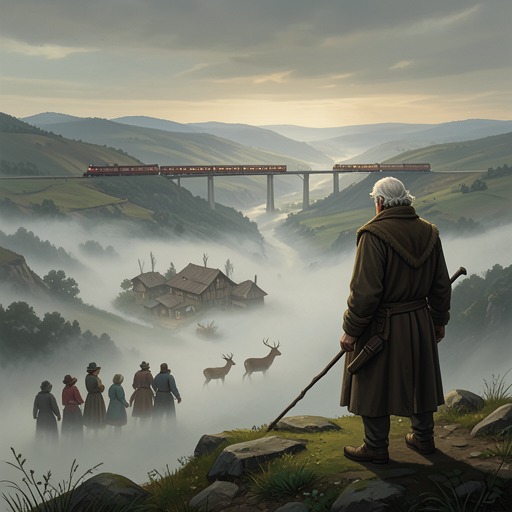
Robinson Gorge Bridge
Train DreamsRobinson Gorge Bridge is a railway bridge spanning an immense chasm in northwestern Washington. Nearly thirty years old when Robert Grainier arrived to repair it in 1920, the bridge embodies the scale of the region’s timber economy: a precarious structure built to carry a locomotive and two flatcars of logs across a space 208 feet deep and 804 feet wide, while also exposing the danger and impermanence beneath industrial expansion.
Construction and Physical Setting
Robinson Gorge Bridge had been designed to cross a gorge too deep and broad for an ordinary route. Its railway could support an engine and two log cars, but the bridge remained so wobbly and terrifying that no one actually rode the cars across it, not even the engineer. Instead, the brakeman caught the moving equipment at the far end. The arrangement reveals both the bridge’s usefulness and its uneasiness: it connected the timber operation to the wider railway network, yet its operation depended on men managing a structure they did not fully trust.
The bridge belonged to a system of temporary-looking but monumental infrastructure. After repairs, logs were hauled from the forest by six-horse teams to a landing, dragged by a Steam donkey with two iron drums and long cables, loaded onto flatcars, and sent across the empty depth of Robinson Gorge before descending the mountain toward the railways of the continent. The bridge therefore functioned not as an isolated marvel but as a crucial link between cut timber, mechanical power, animal labor, and national transportation.
Grainier’s Work There
Robert Grainier went to northwestern Washington in 1920, eager to take part in large undertakings after his experience on the Eleven-Mile Cutoff Bridge. The Robinson Gorge project was described as grander than the earlier bridge, and its dimensions intensified his attraction to work that transformed inaccessible landscapes into routes for machines and freight. Once the repairs were completed, he moved higher into the forest with the Simpson Company to help remove timber.
Grainier worked as a choker in the woods rather than at the landing. Sawyers felled spruce in pairs, limbers cleared the branches, buckers cut the trunks into eighteen-foot lengths, and chokers looped cable around the logs so horses could pull them within reach of the railway. He valued the physical strain and exhaustion of the labor, as well as the sensation of being remote among countless spruce trees. The bridge’s existence thus opens into a wider landscape of disciplined work, where the forest is converted into standardized lengths, cable loads, and railway cargo.
The logging gang sometimes exceeded forty men and never fell below thirty-five. From sunrise until supper they felled and bucked giant spruce, shouted their communications, and lived with pitch in their beards, dust ground into their clothing, and the harsh smell of timber, animals, manure, steam, and sweat. The camps’ patched tents were said by Arn Peeples to include canvas first used by Union infantry during the Civil War and later by the U.S. Cavalry in the Indian campaigns. Robinson Gorge Bridge therefore stands at the end of a long chain of military, commercial, and extractive uses of land and material.
Industrial Network and Human Cost
The bridge allowed timber to move outward, but the work surrounding it remained governed by danger. Arn Peeples warned that a tree could kill even when a skilled sawyer judged its fall correctly ninety-nine times out of a hundred. His own death came when a dead branch from a tall larch struck the back of his head. The resulting illness—dizziness, fever, delirium, and growing forgetfulness—ended with his death in bed, and the men buried him while the company’s demand for spruce continued.
That demand was connected to World War I. Although an armistice had been signed, the camp captain believed the war might resume, and he insisted that the company could not spare the men even for a day of mourning. When illness spread through the camp, the work was finally closed for the summer, the surviving workers received small bonuses, and they were ordered to leave. The bridge and railway thus appear as instruments of connection whose operation rests on exposed labor, corporate urgency, and a willingness to continue despite injury, illness, and grief.
Later Memory and Significance
The bridge remained part of Grainier’s mental map long after the repair job ended. His first summer in the woods and his work at Robinson Gorge became an early point in a lifetime of moving through changing systems of transport. In 1962 or 1963, when he was nearly eighty, he watched young ironworkers on a new trestle carrying U.S. Highway 2 across the deepest gorge of the Moyea River. The new highway crossed directly above the chasm, while the old road made a long detour through a shallow crossing. The younger workers tossed hard hats onto a safety net, jumped after them, and bounced across it; Grainier remembered that he had once been agile on girders himself, though he could no longer climb onto a high stool without queasiness.
This later scene makes Robinson Gorge Bridge a measure of historical change rather than merely a setting. The old railway bridge was terrifying because its machinery and structure barely tolerated ordinary use; the newer highway trestle presents a more regulated, visibly protected version of height and risk. Yet both depend on workers suspended over a gorge, and both turn difficult terrain into a passage for modern transportation. Grainier’s memory holds together the bridge’s grandeur, the forest’s destruction, the laborers’ danger, and the melancholy of watching a world of massive undertakings continually replace itself.