Simpson Company
Train DreamsSimpson Company is the logging enterprise through which Robert Grainier moves from bridge construction into sustained timber extraction. It represents the industrial organization of the northwestern forest: men, horses, cables, temporary roads, rail flatcars, and steam machinery are coordinated to convert standing spruce into material that can travel toward the continent-wide railway network. The company gives Grainier demanding work and a measure of belonging, but its production system also exposes laborers to bodily danger, epidemic illness, and eventual physical decline.
Entry into the Timber Operation
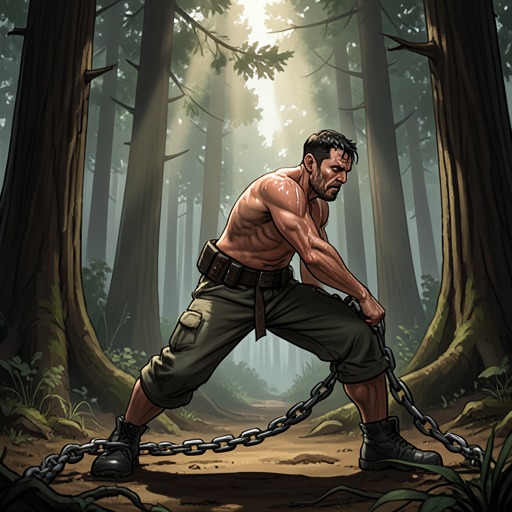
After the repairs on Robinson Gorge Bridge were completed in 1920, Grainier moved higher into the forest with Simpson Company and joined a timber crew. The railway in this area did not serve ordinary settlement or passenger travel; its purpose was to carry logs out of the forest. The roughly forty men in Grainier’s group had to bring felled timber to within reach of the railway landing, using six-horse teams and a network of short corduroy roads spread through the woods.
The work was divided into specialized stages. Sawyers worked in pairs to fell the spruce, limbers cleared branches with axes, and buckers cut the trunks into eighteen-foot lengths. Grainier worked as a choker in the woods, looping cable around the prepared logs so that the horses could drag them toward the landing. This division of labor made the forest legible as a production process: trees became standardized loads, and separate workers, animals, tools, and transport lines were made to function as one chain.
Machinery, Transport, and Scale
At the landing, the central machine was a steam donkey, an old wood-burning engine with two enormous iron drums. One drum paid out cable while the other wound it in, dragging logs toward the landing while the hook was sent simultaneously to the choker preparing the next log. Its throbbing, booming, and groaning overwhelmed the sounds of the horses on the skid road. The contrast between mechanical noise and the horses’ nearly erased movements shows how the company’s system joined older animal power to industrial force rather than replacing one with the other.
Once gathered at the landing, the logs were loaded onto railroad flatcars. The railway carried them across the immense depth of Robinson Gorge and down the mountain toward its connection with the wider rail network of the American continent. The bridge therefore functioned as part of Simpson Company’s extraction apparatus: its dramatic span was not merely an engineering achievement but a route by which timber could be removed from an otherwise difficult landscape and inserted into a much larger commercial system.
Labor Discipline and Wartime Demand
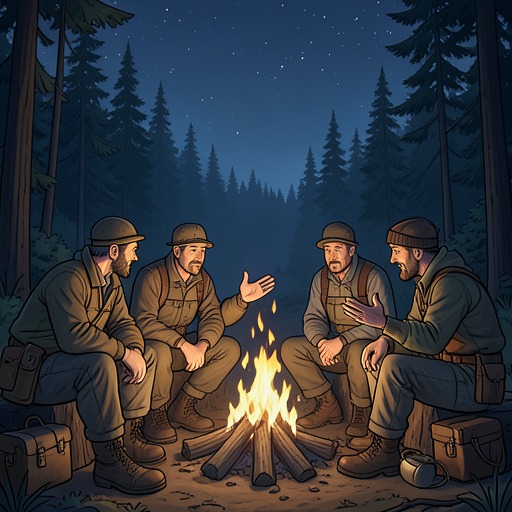
The crew worked from sunrise until suppertime, felling and bucking giant spruce into pieces that were barely manageable. The men sometimes numbered more than forty and never fewer than thirty-five. Their work changed the face of the mountainside, while pitch accumulated in their beards, sweat washed dust from their clothing and packed it into the creases of their bodies, and the heavy odor of resin irritated their throats and eyes. The forest was treated as an opponent to be overcome, and the workers’ shouted communications were part of the constant effort to control weight, direction, timing, and risk.
The company’s pace was also shaped by the demand created by World War I. At Arn Peeples’s funeral, the captain explained that the war in Europe had created an intense need for spruce. Although an armistice had already been signed, he believed the fighting might resume, and the crew was expected to continue working. When illness spread through the camp, he still insisted that the company’s schedule governed their movements: the men were sent away only after the job had been closed down and the final logs had been brought down the mountain.
Danger, Illness, and Company Control
The forest’s danger was not accidental in the workers’ understanding of it. Arn Peeples warned that a sawyer might judge a tree correctly ninety-nine times, yet the hundredth could strike him dead. His own death exposed the cruel reversal within that knowledge. A dead branch from a tall larch, a widowmaker, struck him across the back of the head. He initially recovered enough to complain of a twisted spine and to describe his wish to walk crookedly, but dizziness, fever, and delirium followed. He was found dead in his bed several days later.
The crew’s response combined respect for Peeples with the pressure of production. His friend Billy praised him as a man who had never cheated or stolen, while the captain regretted that the company would not allow the men a full day to stop work. The captain’s statement that it was the company, and the war, that prevented a pause makes the organization’s priorities explicit: even mourning was subordinated to output and schedule.
The camp then became vulnerable to an influenza crisis. Harold, the captain’s twelve-year-old son and the camp’s young grease monkey, collapsed in front of a team of horses while spreading dogfish oil on the skids. Grainier pulled him clear by the leg of his pants before the horses could trample him. Billy later developed chills and fever, and six additional men fell ill. The captain calculated the men’s payoffs, gave each worker a four-dollar bonus, and ordered them to leave because he feared an epidemic like the one that had killed his own thirteen siblings in a single week. The decision closed the operation for the season, but it also shows that the company’s labor force could be dispersed as soon as illness threatened the continuity of extraction.
Grainier’s Work and Its Aftermath
For Grainier, Simpson Company’s forest work was physically punishing but personally compelling. He relished the strain, exhaustion, and deep rest that followed a day as a choker. The immense trees made him feel remote from ordinary troubles, and he imagined the forest as a protective presence even while its falling timber could kill without warning. His attachment to the work was therefore double: the same environment that offered isolation and a sense of safety was organized as a dangerous workplace.
The job also strengthened Grainier’s attraction to large undertakings. His earlier experience helping construct Eleven-Mile Cutoff Bridge had made him eager to witness projects in which groups of men removed portions of the forest and assembled structures across otherwise impassable spaces. Simpson Company extended that fascination from bridge building to extraction. Yet the extension came at the cost of his body. When Grainier later returned to the Washington woods for one final summer to pay off his team and wagon, a wild limb knocked his jaw crooked, his joints deteriorated, and his shoulder and knee became unreliable. He was eventually restricted to tearing down old workers’ shacks and salvaging usable lumber before returning to Bonners Ferry, finished as a woodsman.
Simpson Company thus marks both a productive phase and a bodily limit in Grainier’s life. Its roads, cables, horses, steam donkey, and flatcars turn the forest into an efficient chain of extraction, while the deaths, fevers, injuries, and accumulated joint damage reveal what that efficiency demands from individual workers. The company’s timber economy connects industrial infrastructure and wartime demand to the remaking of the mountain landscape, but Grainier’s later incapacity preserves the human cost of that transformation in his own damaged body.